


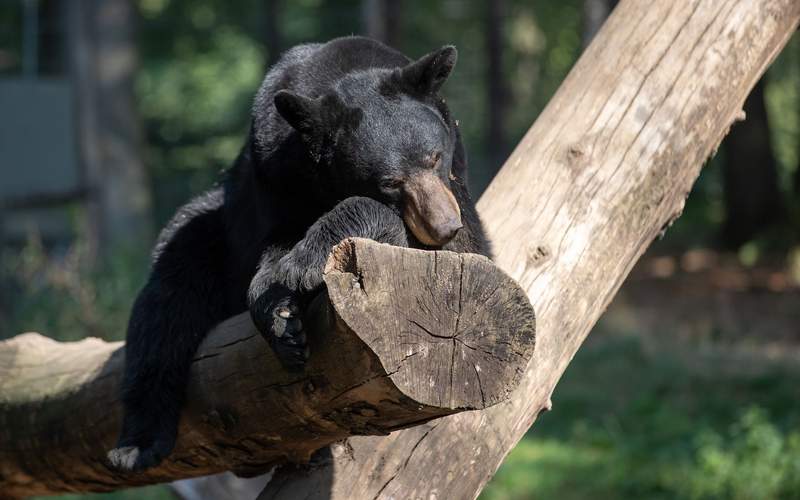
Frenzied Fauna: Bear’s Urban Jaunt Exposes Japan’s Wilderness Creep
POLICY WIRE — Tokyo, Japan — One doesn’t usually associate industrial efficiency or urban sprawl with ursine invasions. But an improbable visitor, a single, uninvited bear, recently disrupted...

POLICY WIRE — Tokyo, Japan — One doesn’t usually associate industrial efficiency or urban sprawl with ursine invasions. But an improbable visitor, a single, uninvited bear, recently disrupted that comfortable separation in a Japanese town, offering a stark, if somewhat absurd, commentary on humanity’s ever-shifting boundary with the wild.
It wasn’t a philosophical musing or a policy debate that kickstarted the day’s events. It was brute, unadulterated nature smashing into suburbia. This creature, a lumbering beast of instinct, burst onto the scene with a sudden ferocity, leaving four individuals injured and an entire community rattled. People typically think of nature as something you visit—a park, a hiking trail. Not something that busts through your municipal fabric, looking for a mid-afternoon beverage. [QUOTE_PLACEHOLDER]
And that’s what it did, after its initial chaotic entry. It didn’t just attack people — and flee to the forest, like some kind of cartoon villain. Oh no, this bear—it’s almost got a cinematic flair, hasn’t it—decided a factory offered a more interesting interlude. This wasn’t some remote, rundown facility. This was a place of work, of production. Imagine clocking in, thinking your biggest worry is that TPS report, and then *boom*—a bear in accounting.
The sequence of events sounds like a bizarre fable: predator stalks, then injures a quartet of people, vanishes, reappears within a factory’s sterile confines, helps itself to a liquid refreshment, and then simply departs, leaving bewildered authorities and a local population asking just what in the actual wilderness just happened. This isn’t just a quirky local news story; it’s a symptom, a flashing neon sign pointing to a much larger, global trend.
But this isn’t solely a Japanese problem. From snow leopards in Pakistan’s high altitudes adapting to increasingly fragmented habitats as human settlements expand, to Bengal tigers encountering villagers in India’s Sundarbans, the collision points are escalating across the globe. Just last year, an estimated 10,000 to 12,000 snow leopards globally, a species already struggling with habitat loss, found themselves pushed ever closer to livestock and human populations, leading to escalating conflict according to the Snow Leopard Trust. Because when space shrinks, conflicts broaden. These are not just ecological events; they’re sociological stress tests.
And the official response, as it always is in such unexpected scenarios, ranged from hurried warnings to armed pursuit. They had to mobilize. Imagine being the civil servant tasked with explaining that municipal infrastructure isn’t designed for bear incursions. You’ve got your budget for road repairs, for schools, for social services. You haven’t got a line item for ‘rogue ursidae urban interdiction squad’.
The creature’s casual exit, leaving behind a bewildered population and a factory with a probably-sticky floor, is perhaps the most disquieting part. It just… left. No apology, no explanation. Just a swift, silent disappearance, melting back into the vague notion of ‘the wild’ it had briefly, dramatically, abandoned. It suggests a future where these lines aren’t just blurred, they’re erased. And we’re going to have to get used to it. Or at least, come up with better contingency plans than ‘hide under your desk — and hope for the best.’
What This Means
This episode, more than just a momentary blip of local news, functions as a minor tremor foreshadowing larger seismic shifts in how human civilization interacts with its natural environment. It’s a policy conundrum in a furry, clawed package. Economic development and urbanization, particularly in nations like Japan with dense populations and encroaching forest land, continually shrink wild animal habitats. These aren’t isolated incidents; they represent the sharp end of an increasingly fractured coexistence.
The bear’s brazen foray into a factory, even pausing for a drink—it’s not just quirky; it speaks to the increasing desperation of wildlife pushed to the brink of their traditional territories. This particular animal found itself in an urban space because, frankly, its own traditional larder is probably thinning out, or the routes it uses are being paved over. The economic implications aren’t trivial: property damage, disruptions to commerce, increased public safety expenditures, and even an adverse impact on tourism in areas branded as ‘unsafe’. Consider how such events contribute to a creeping sense of unease, feeding into broader anxieties about control and predictability in an age that desperately craves both.
For governments, it means recalibrating wildlife management strategies, moving beyond simple containment to proactive urban planning that considers ecological corridors and robust educational campaigns for residents. It also hints at the perpetual slowdown in addressing long-term ecological consequences when short-term economic gains take precedence. If a single bear can cause this much localized disruption, what are the broader ramifications when entire ecosystems are destabilized?
And what’s the long game here? More fences? Bigger animal control units? The real solution, difficult and expensive as it’s, involves rethinking land use and confronting the direct fallout of a warming climate and expanding human footprint. Otherwise, these silent collisions will become increasingly loud, forcing governments to allocate precious resources to wildlife crises instead of, say, strengthening infrastructure or bolstering healthcare. We’re effectively building a global habitat mosaic where the pieces don’t quite fit anymore, leading to more, not fewer, unexpected encounters—and injuries. It’s a costly inefficiency, one we’re just beginning to pay for.