


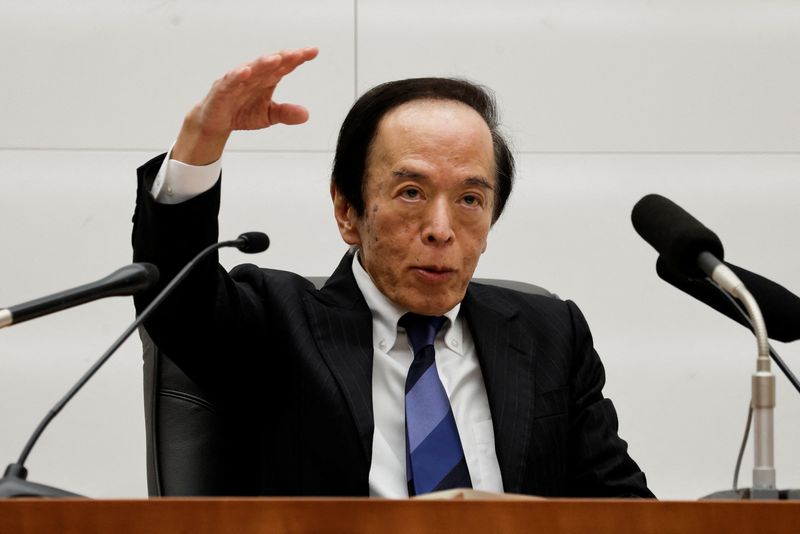
Tokyo’s Unlikely U-Turn: BOJ’s Ueda Breaks Decades of Deflationary Drifts
POLICY WIRE — Tokyo, Japan — For twenty-five years, give or take, financial pundits kept harping on Japan’s ‘unique’ economic malaise. Deflation. They just...

POLICY WIRE — Tokyo, Japan — For twenty-five years, give or take, financial pundits kept harping on Japan’s ‘unique’ economic malaise. Deflation. They just couldn’t shake it. Price declines became a way of life, a seemingly immutable fact of the Nipponese existence. Pensions withered, savings lost value (quietly, subtly, but they did), and every central bank governor became another general fighting a ghost.
So, you gotta wonder what kind of shockwaves Governor Kazuo Ueda actually felt ripple through the Kantei — the Prime Minister’s official residence — when the Bank of Japan, under his watch, decided it was finally time to worry about inflation. Not as a theoretical boogeyman, but as an actual, honest-to-god policy problem. It’s like watching a dedicated botanist, after decades studying desert flowers, suddenly having to deal with a rainforest.
Because that’s precisely what’s happened. The BOJ, once the global outlier clinging desperately to negative interest rates and an almost cartoonish yield curve control strategy, just decided to pack it all in. No more minus signs. No more absurdly large bond purchases keeping yields pinned. They’ve finally called time on what amounted to a massive, protracted experiment designed to coax life back into a somnambulant economy. And you know what? It’s about damn time.
This isn’t just some technical adjustment, folks. It’s a monumental shift. It’s the central bank, that staid institution famous for its opacity and cautious incrementalism, effectively saying, “Oops, we accidentally conjured up a dragon we actually have to fight.” And it’s not a small one. Japan’s core consumer price index (CPI), excluding fresh food, climbed by 2.8% year-on-year in March, according to data from the Ministry of Internal Affairs and Communications. That’s above the BOJ’s target, — and it’s been there for quite a stretch.
Governor Ueda, a man of quiet academic demeanor who nonetheless possesses a reputation for pragmatism, made it clear. “We’re not just adjusting knobs anymore; we’re re-tuning the entire engine,” he reportedly remarked in an off-the-record briefing — a sentiment reflecting the weight of the moment. This wasn’t some snap decision; it’s the culmination of months of carefully calibrated market rhetoric and subtly telegraphed signals. He’s had to walk a tightrope, managing expectations without spooking a market accustomed to nearly three decades of cheap, abundant money.
But the market didn’t spook. Not really. The yen finally found some backbone. Equities barely flinched, even appreciating on the day. This suggests the market — a creature of habit, truly — had seen it coming. Most of it, anyway. “Tokyo’s finally admitting that zero ain’t what it used to be. It’s a calculated gamble, certainly, but one they really had no choice but to take,” explained Taro Yamamoto, a senior economist at Mitsui Global Research, probably sipping a meticulously prepared green tea as he said it. And he’s got a point. Wage growth, while still patchy in parts, is actually moving. That’s a critical component for sustainable inflation, for the economy to really get out of its old rut. Without that, you’re just kicking the can down the road.
📄 POLICY WIRE WHITEPAPER PUBLISHED: PAKISTAN'S NATIONAL SECURITY POLICY PRIORITIES
👉 READ BY CLICKING HEREAnd so, we’re watching the unwinding of an extraordinary chapter in global monetary policy. The BOJ isn’t just hiking a bit; they’ve cleared the path for a series of further, more conventional hikes. That means actual, positive interest rates are no longer some far-off theoretical concept for the world’s third-largest economy. It’s happening. Think about what that does to global capital flows. You bet it gets complicated, fast.
What This Means
This policy pivot by the BOJ marks a seismic shift for the Japanese economy, naturally, but its ripples extend far beyond the shores of Honshu. For one, a stronger yen, a likely outcome, makes Japanese imports cheaper and potentially stifles its export-heavy industries, at least initially. That’s a classic trade-off, — and one Ueda clearly decided was worth taking to battle inflation at home. But it also changes the landscape for global investors. For years, the ‘carry trade’ — borrowing in cheap yen and investing in higher-yielding assets elsewhere — was a no-brainer. Those days are rapidly diminishing.
But there’s more to it than just that. Emerging markets, including nations in South Asia like Pakistan, often feel the sting when major economies tighten their belts. As Japanese rates climb, global capital — which historically flowed freely into these markets looking for returns — could get sucked back into ‘safer’, now better-paying, developed economies. For Pakistan, already wrestling with a depreciating rupee and persistent inflation (its annual inflation rate recently hit 20.7%), a stronger yen or a globally tighter monetary environment complicates its ability to attract foreign investment. It can also exacerbate debt servicing costs, particularly if loans are denominated in harder currencies that gain strength against the rupee.
Because every major central bank move impacts the others, whether they like it or not. The BOJ’s decisive move injects an interesting variable into a global economic picture already clouded by geopolitical tensions and uneven growth. It’s a gamble, yes, but a necessary one, aimed at anchoring Japan in a world where money actually costs something again. The world watches, undoubtedly curious — and a little nervous — to see if the patient finally found its cure, or if this new medicine has its own unpleasant side effects.