


The Brutal Economics of Being Overshadowed: Jalen Brunson’s Gritty Ascent from Doncic’s Long Shadow
POLICY WIRE — New York City, USA — Imagine dominating your domain, a veritable colossus, only to suddenly find yourself reduced to an afterthought—a bit player in someone else’s grand drama. That’s a...

POLICY WIRE — New York City, USA — Imagine dominating your domain, a veritable colossus, only to suddenly find yourself reduced to an afterthought—a bit player in someone else’s grand drama. That’s a brutal drop. And it’s a reality few understand quite like Jalen Brunson, whose meteoric collegiate career at Villanova gave way to a sobering stint as a basketball footnote before his electrifying rebirth as the New York Knicks’ unlikely orchestrator.
It wasn’t a question of capability. No, not really. But the NBA’s talent machine has a way of reshuffling egos, even proven ones. Brunson, a two-time NCAA champion, hit the professional ranks as the 33rd overall pick in the 2018 draft. A solid-enough spot, right? Then the Dallas Mavericks—the team that snatched him up—also landed Luka Doncic, a phenom from Slovenia with an entire continent’s hype machine already in overdrive. Doncic was the chosen one. Brunson was, well, also there.
It gets ugly fast when you’re a top dog thrown into a pack of predators where another one’s clearly got the alpha scent. Brunson’s final year at Villanova saw him average a robust 18.9 points in roughly 32 minutes per contest. Those numbers took a real nosedive, to a mere 9.3 points across 22 minutes per game during his Mavericks rookie campaign, according to NBA.com archives. Not exactly a glowing endorsement for a kid who’d never known second-best.
“The only time is probably my rookie year… watching Luka doing his thing so effortlessly,” Brunson candidly recalled when asked if he’d ever felt like an imposter. “That was probably the only time, and it made me kind of question myself to see how hard I actually had to work to be in the position that I wanted to be in.” He didn’t just question himself; he picked himself apart, brick by brick. A testament, if you will, to the unforgiving nature of professional sports where yesterday’s glory means squat.
Because the thing is, potential often outshines proven performance, especially when that potential comes wrapped in international mystique. Brunson found himself boxed out, not just by Doncic, but by a roster crammed with other guards. He was a piece of trade bait waiting to happen, an afterthought in the Mavericks’ grand designs. He wasn’t Doncic. He couldn’t be. And that was the problem. For Dallas, that’s. Not for Brunson.
He eventually skipped town, landing in New York, a city that loves a grinder—a guy who looks you in the eye and gets to work. The Knicks provided a stage where his relentless work ethic, his grit, wasn’t just appreciated; it was the whole darn show. Suddenly, the overshadowed talent was the marquee name. But that shift didn’t magically silence the critics.
But the whispers followed. They always do. You know, the armchair quarterbacks, the former coaches. They said he was too short. He wasn’t a ‘1A’ player, not really championship timber. It’s the kind of noise that sticks, even when you’re knocking on the door of the Finals. The valuation of athletic talent, much like a commodity, shifts based on perceived utility and scarcity. Brunson, initially undervalued, dramatically changed his market price through sheer force of will.
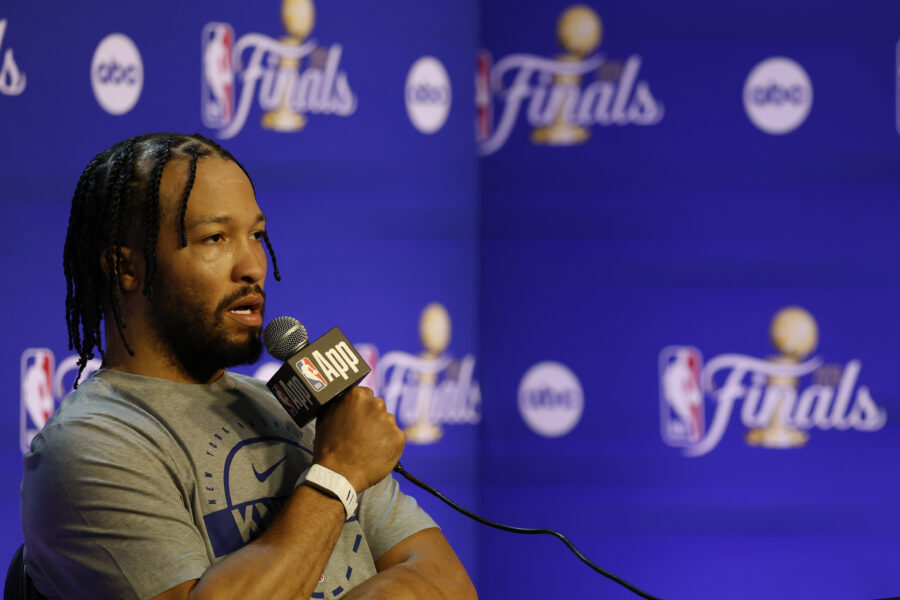
“We’ve been doubted a lot. There’s been a lot of noise from the outside that we could talk about, complain about, do something about – but we’ve always gone back to the gym and worked on our game,” Brunson declared with an almost weary defiance. “We can’t be satisfied just because we’re here.” It’s a sentiment that rings true beyond the court, echoing in every boardroom or parliament where performance is measured and detractors are legion.
What This Means
Brunson’s trajectory isn’t just a sports story; it’s a policy parable wrapped in sweat — and sneakers. It dissects the raw economics of talent allocation—how perceived star power can eclipse genuine skill, often leading to a mispricing of assets. Organizations, be they sports franchises or government agencies, often invest heavily in ‘flash-in-the-pan’ or high-pedigree acquisitions, potentially overlooking robust, less flashy talent already within their ranks, or those available at a lower premium. The early NBA draft process is, in many ways, a sophisticated (if often flawed) market, where emotional narratives sometimes sway cold, hard analytics. What’s the political analog? Think about how established, ‘glamorous’ foreign policy initiatives often soak up resources while quieter, more persistent efforts in less visible regions might be ignored. For example, substantial resources might chase big, obvious geopolitical shifts while community development projects in, say, a quiet Pakistani province struggle for funding despite their long-term stabilizing effects. But then, it’s not always about where you start, is it? Brunson proves that the economic engine of pure will—the decision to outwork and outthink everyone—can rewrite the narrative entirely. Sometimes, being initially undervalued means you have something bigger to prove, and that chip on your shoulder becomes a perpetual motion machine for growth. That’s a lesson even the staunchest fiscal conservatives, and frankly, developing nations aspiring for greater global recognition, should heed. Hard work, yes. But strategic repositioning in a market that simply didn’t know your true value. It’s what policy strategists might call a successful market correction initiated by the individual himself, against overwhelming odds.
This saga speaks volumes about talent retention, about knowing when to cut your losses, and when to fight like hell to create your own value. And it speaks, perhaps most tellingly, to the sheer, stubborn, human refusal to stay in someone else’s shadow, especially when you know deep down you’re meant for the sun. The Finals against the Spurs will just be the latest stage for this particular sun.