
European Union Applauds Pakistan
“Pakistan has been the main mediator between the United States and Iran,” declared Kaja Kallas, the EU High Representative for Foreign Affairs and Security Policy, at a joint press conference with...

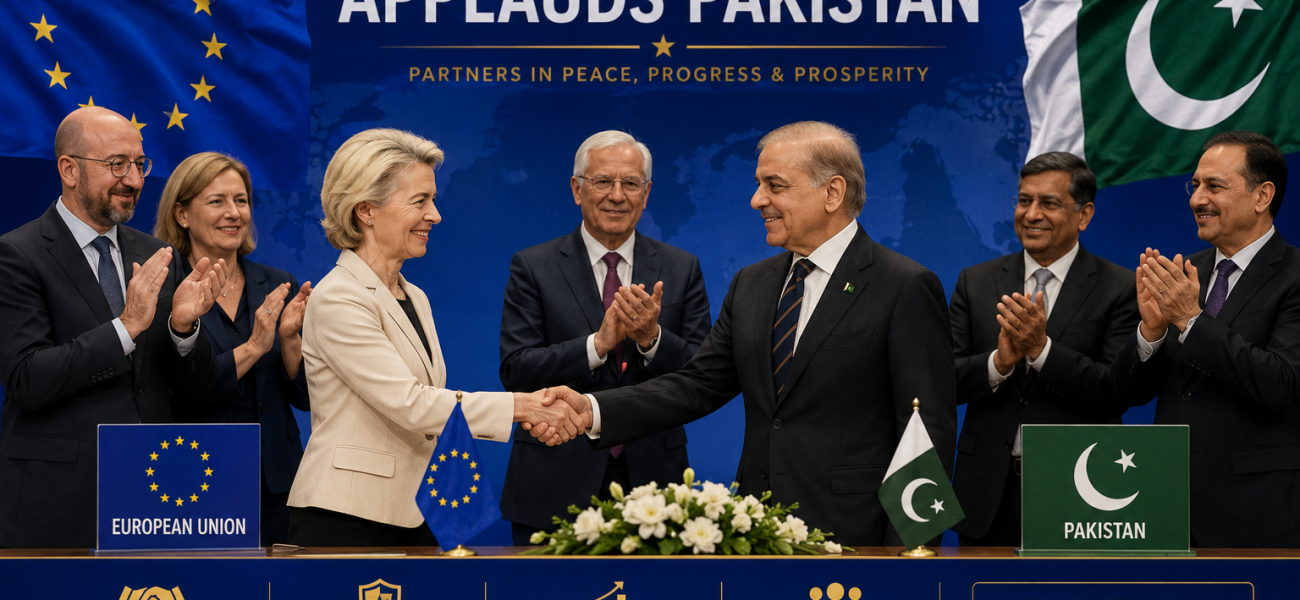
“Pakistan has been the main mediator between the United States and Iran,” declared Kaja Kallas, the EU High Representative for Foreign Affairs and Security Policy, at a joint press conference with Deputy Prime Minister Ishaq Dar. This was not diplomatic courtesy. It was a formal recognition, delivered by one of the world’s most consequential diplomatic institutions, of a transformation that has been unfolding since February 2026.
How the War Created the Opening
The 2026 Iran-US war began on 28 February 2026 with joint US-Israeli strikes that killed Iran’s Supreme Leader. The conflict immediately disrupted global energy markets, drove oil prices sharply higher and threatened the Strait of Hormuz, through which roughly 20 per cent of the world’s oil supply passes.
Pakistan stepped up to resolve it.
The Islamabad Talks: Making History
The most dramatic moment came in April. On 8 April 2026, the United States and Iran agreed to a two-week ceasefire mediated by Pakistan. Days later, on 11 April 2026, senior delegations from Washington and Tehran converged in Islamabad for the first time since 1979. The talks, hosted at the Islamabad Serena Hotel, brought a 300-member US negotiating team led by Vice President JD Vance alongside Iran’s senior delegation. The mere fact of their presence in the same room, in the same city, under Pakistan’s auspices, was an achievement that decades of international diplomacy had failed to produce.
The talks ended on 13 April without a formal agreement. But this framing misses the point. The Al Jazeera Centre for Studies noted that “a process which many had thought near impossible had begun.” The failure to reach agreement was not Pakistan’s failure. The structural gaps between Washington’s demands on Iran’s nuclear programme and Tehran’s insistence on sanctions relief were gaps that no mediator could close in 48 hours. What Pakistan achieved was getting both parties into the room and keeping them there.
Pakistan Could Do What Others Could Not.
Europe Watches and Responds
The Kallas visit on 1 June 2026 was not simply a diplomatic courtesy call. It was the EU’s formal acknowledgement that Pakistan had become a strategic partner of genuine global consequence. The 8th EU-Pakistan Strategic Dialogue, co-chaired by Kallas and Ishaq Dar, produced a joint communiqué in which the EU formally “commended Pakistan’s constructive and meaningful role in its mediation efforts between the US and Iran, including by hosting the Islamabad Talks.”
📄 POLICY WIRE WHITEPAPER PUBLISHED: PAKISTAN'S NATIONAL SECURITY POLICY PRIORITIES
👉 READ BY CLICKING HEREThe Work Is Not Yet Done
Honest analysis requires acknowledging what Pakistan’s mediation has not yet achieved. The Islamabad Talks failed to reach a formal agreement. The ceasefire remains fragile. The Strait of Hormuz has not been reopened. The United States subsequently imposed a naval blockade on Iran. Kallas herself was clear that “any temporary understanding between the US and Iran must be followed by deeper talks about Tehran’s nuclear stockpile and other critical issues” and that “lasting stability will require more encompassing solutions.”
These are real constraints. But they are constraints on the problem, not on Pakistan’s performance. No mediator resolves in weeks a conflict rooted in four decades of enmity, competing nuclear anxieties and irreconcilable regional ambitions. What Pakistan has done is create and sustain the only diplomatic process that exists. That, in a crisis of this magnitude, is not a modest achievement. It is a monumental one.
Author