


UK’s Tightrope Act: Diplomatic Charms Over China’s Moral Hurdles
POLICY WIRE — London, UK — Forget the fire and brimstone. Britain’s foreign policy playbook for Beijing these days reads less like a sermon from the mount and more like a carefully calibrated...

POLICY WIRE — London, UK — Forget the fire and brimstone. Britain’s foreign policy playbook for Beijing these days reads less like a sermon from the mount and more like a carefully calibrated investment prospectus. After all, principled stands—especially those that ding the bottom line—are a luxury few can afford right now. The notion that the United Kingdom should just outright “cancel” engagement with China, it seems, has officially been sent to the diplomatic dustbin.
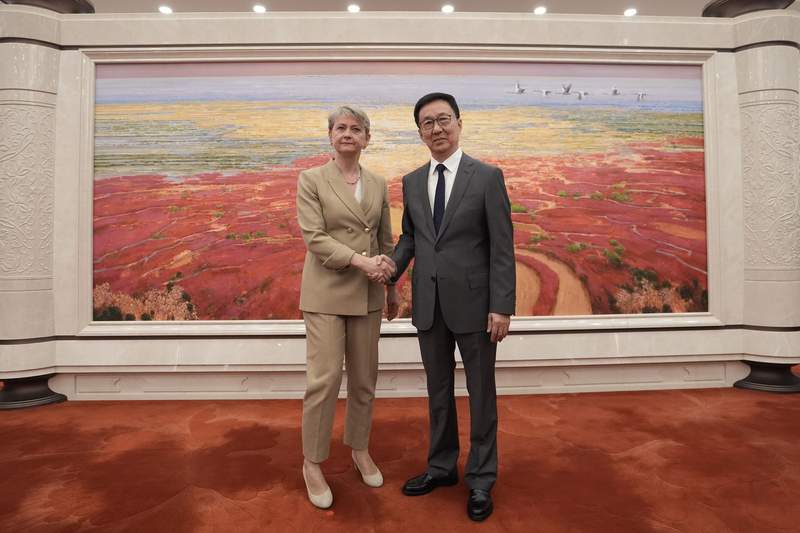
It was never really a policy, of course. But the framing came direct from senior Labour figure Yvette Cooper, currently Shadow Home Secretary, who, in a recent strategic outreach trip, effectively distanced her party – and by extension, a potential future government – from what she termed a ‘cancel culture’ approach to the People’s Republic. That’s a clever bit of wordplay, isn’t it? She wasn’t just talking about trade, either. She meant broader geopolitical interaction, the whole messy dance.
The subtext? We get it, everyone. The Uyghurs. Hong Kong. Taiwan. But also, factories. Investments. Supply chains. And that, frankly, shapes a lot of policy decisions, particularly for nations grappling with their own economic woes. It’s an almost brutal calculus of national interest versus abstract values. This isn’t just Britain’s conundrum, mind you. Many Western capitals are doing a similar two-step, though few articulate it with such casual candor. They’re all trying to figure out if it’s possible to talk about human rights without slamming the boardroom door shut.
“Engaging with China doesn’t mean condoning every action,” Cooper was reported to have stated, (a line that, to be fair, could’ve been pulled from almost any recent foreign minister’s briefing notes). “It means recognizing the complexity of global power dynamics and protecting British interests through dialogue, not isolation.” It’s pragmatic, certainly. But it also begs the question: What, precisely, does that dialogue achieve when real consequences aren’t on the table?
Because let’s be honest, the economic incentives are enormous. China remains the UK’s third-largest trading partner, with bilateral trade reaching over £100 billion in 2022, according to the Office for National Statistics. You don’t just walk away from those numbers on a moral whim, do you? Especially not when the world economy feels like it’s teetering. There’s a real fear among policymakers, left and right, that pulling back too much just means ceding influence, and business, to others. They call it a strategy. Others call it an awkward compromise. And sometimes, you know, both can be true.
Critics, of course, weren’t buying the soft sell. “This isn’t about ‘cancel culture,’” countered Sir Iain Duncan Smith, a Conservative MP — and vocal critic of Beijing. “This is about standing up for universal human rights. To pretend that a visit to Beijing changes the fundamental abuses happening within China’s borders is naive at best, and complicit at worst.” His exasperation? You could almost feel it emanating from the news wires.
📄 POLICY WIRE WHITEPAPER PUBLISHED: PAKISTAN'S NATIONAL SECURITY POLICY PRIORITIES
👉 READ BY CLICKING HEREBut how does this play in places like Pakistan, a nation already deeply intertwined with China through the Belt and Road Initiative? For many in the Muslim world, Western critiques of China often ring hollow when balanced against the economic lifeline Beijing offers, or when compared to perceived Western hypocrisy elsewhere. If even major European powers are openly prioritizing trade over human rights concerns when dealing with Beijing, it just makes the arguments for adhering to Western-backed democratic norms that much harder to swallow for nations looking for development partners. It reinforces a narrative that economic pragmatism always, eventually, wins out over ideals. It’s a perception problem that runs deep, affecting everything from aid policy to diplomatic leverage.
What This Means
This subtle shift in messaging – openly disavowing a “cancel culture” approach – signals a broader realignment within Britain’s political establishment toward Beijing. It’s an admission, perhaps unspoken, that the post-Brexit dream of a ‘Global Britain’ sometimes requires an uncomfortable level of transactional diplomacy, even with nations whose values fundamentally clash with Western liberal democratic norms. The economic pressures, coupled with geopolitical realities—think Russia, think Taiwan, the brutal calculus of crisis elsewhere—have clearly tipped the scales towards engagement, however uneasy it might be. This isn’t about grand moral victories; it’s about safeguarding interests in a decidedly complex global arena.
it lays bare a tension. A tension between aspirational foreign policy, grounded in liberal values, and the fiscal realities of running a modern state, especially one looking to punch above its weight on the international stage. But it’s also a move that could potentially complicate relationships with staunch allies—like the US under its current hardline stance—who might view this as a weakening of resolve. Every nation’s trying to secure its future, after all, and the methods can get messy. Ultimately, it’s about acknowledging the dragon’s economic fire and deciding it’s better to negotiate with it, rather than just stand back and complain about the smoke.