

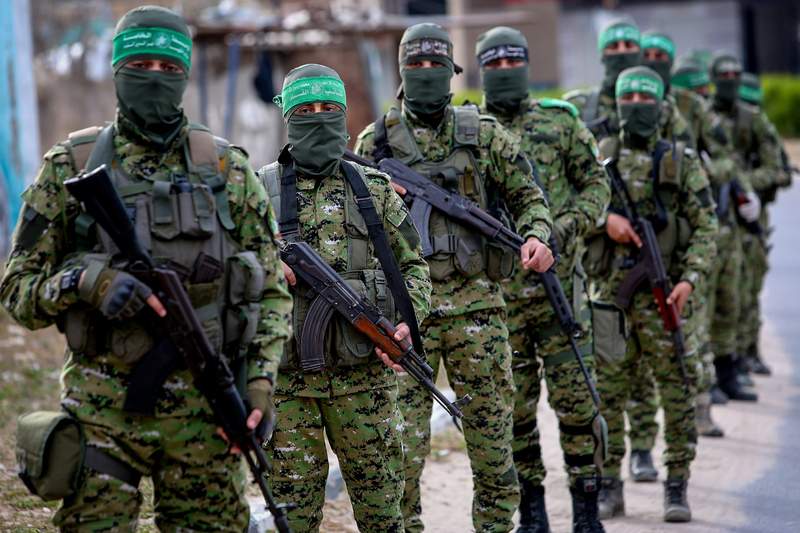
Gaza’s Crucible: The Scramble for Hamas’s Crown in the Rubble
POLICY WIRE — Gaza Strip, Palestine — The whispers are growing louder than the explosions, suggesting a different kind of war unfolding in Gaza’s pulverized districts. Not against an external...

POLICY WIRE — Gaza Strip, Palestine — The whispers are growing louder than the explosions, suggesting a different kind of war unfolding in Gaza’s pulverized districts. Not against an external enemy, but within the subterranean labyrinths and the dusty streets—a bitter contest for leadership of Hamas itself. While the world frets over ceasefire deals and aid convoys, the insurgency’s future hangs on who finally clutches the reins, a shadowy primary taking place amidst unprecedented destruction. It’s a ruthless calculation, a cold succession battle for an organization that’s learned to thrive in the harshest environments. And frankly, the candidates are lining up, some known, others mere specters, all vying for what many see as a poisoned chalice.
It’s an open secret, of course, that key figures in Hamas’s top brass have been targeted, cornered, or eliminated. This relentless pressure, applied by Israel and—let’s be honest—implicitly desired by several regional players, doesn’t annihilate the group; it merely forces a brutal evolution. The current conflict isn’t just shaping Gaza’s skyline; it’s remaking its militant ecosystem from the ground up. This isn’t your grandfather’s insurgency, you see. The candidates for Hamas’s supreme leadership aren’t just military strongmen anymore. They’re technocrats, ideologues from the diaspora, and local figures hardened by years of siege, each with a distinct vision, or lack thereof, for a post-conflict Gaza. Some want to rebuild; others want to keep fighting.
“The international community’s objective remains a durable peace — and a future for Gaza not defined by terrorism,” U.S. Secretary of State Anthony Blinken recently told reporters, a subtle nod to the ongoing internal struggles. “Any legitimate leadership must unequivocally reject violence and commit to governing responsibly for all Palestinians.” He’s not wrong; Washington’s banking on a ‘moderate’ force somehow materializing, a notion many Mideast veterans find quaint at best, deluded at worst. But he articulates a clear hope, even if it feels distant. Then there’s the regional perspective. “What happens within Hamas directly affects the stability of our entire neighborhood,” stated Faisal bin Farhan Al Saud, Saudi Arabia’s Foreign Minister, in a terse interview. “We seek partners for peace, not perpetual conflict; the coming leadership of any Palestinian faction will need to understand this new reality.” His words, usually measured, reflected palpable regional anxiety.
The internal political landscape for Hamas is as complex as a Byzantine tapestry, fragmented between its Gaza contingent, the influential diaspora in Qatar and Lebanon, and the underground command. Who gains ascendancy? Is it a militant hawk, rising from the ashes of battle, or a more pragmatic political operator, keen on reconstruction funds and international legitimacy? The answer will undoubtedly reverberate far beyond Gaza’s borders. Because frankly, nations like Pakistan, for instance, which has historically shown staunch support for the Palestinian cause—often echoing widespread public sentiment—are watching this drama intently. Any perceived shift in Hamas’s posture, any hardening or softening, carries immense weight across the Muslim world, influencing diplomatic alignments and public discourse, affecting even its own complex relationship with Asia’s unseen geopolitical shifts.
📄 POLICY WIRE WHITEPAPER PUBLISHED: PAKISTAN'S NATIONAL SECURITY POLICY PRIORITIES
👉 READ BY CLICKING HEREIt’s not just about leadership; it’s about control, resources, — and future tactics. Whoever emerges will face an immediate, staggering task: governing a pulverized territory where, according to the UN Office for the Coordination of Humanitarian Affairs (OCHA), over 75% of Gaza’s population, or more than 1.7 million people, have been displaced since October 2023. That’s a nightmare brief for any politician, let alone one navigating the aftermath of intense warfare and international pariah status. They’ll need to consolidate power, re-establish order—if such a thing is even possible—and attempt to navigate donor countries demanding accountability even as those same countries have little to no leverage over a defiant, deeply entrenched militant group.
What This Means
The leadership vacuum within Hamas isn’t simply an internal squabble; it’s a powder keg that could ignite new regional dynamics or extinguish flickering hopes for future peace. If a hardline military figure assumes power, expect continued resistance, likely bolstered by Iranian support, exacerbating an already fragile regional security picture. This scenario would push any thoughts of a two-state solution further into the distant, foggy future, solidifying Israel’s security concerns and leading to more cycles of violence. Conversely, if a more politically savvy, diaspora-based leader takes the helm, we might see a more nuanced engagement strategy, perhaps even a tactical pivot toward focusing on governance and leveraging international pressure for reconstruction. But don’t misunderstand: any ‘moderation’ from Hamas would be purely strategic, not ideological, meant to garner resources and alleviate popular suffering. It’s a pragmatic necessity, not a change of heart. This isn’t just about Gaza’s internal power brokers; it’s about whether the Palestinian movement veers further into isolation or tentatively, perhaps begrudgingly, seeks a more recognized path, however imperfect. Either way, the stakes couldn’t be higher for the millions caught in its crosshairs, for the entire Middle East, and for global stability. It’s a critical moment, an unpredictable shift waiting to happen, all while the world largely watches and wonders from afar, occasionally weighing in with another carefully worded statement.