


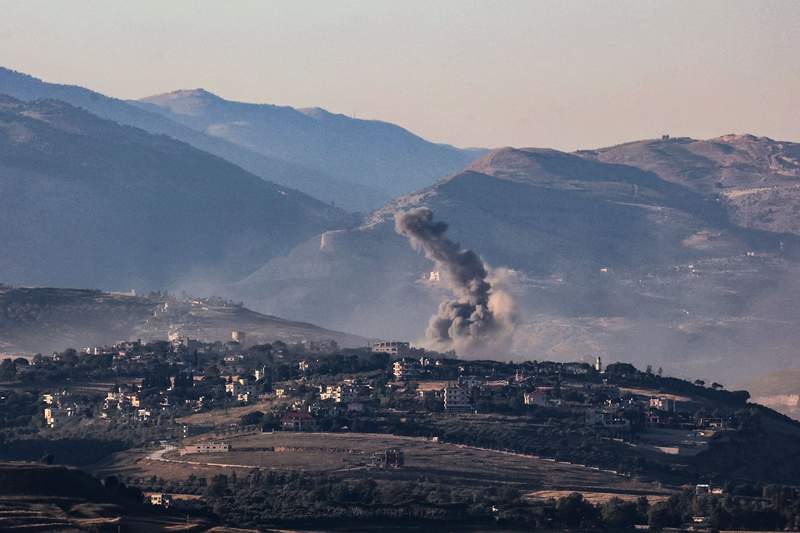
The Grim Grind: Northern Border Erupts Again, Testing Regional Frayed Nerves
POLICY WIRE — Beirut, Lebanon — It’s a drumbeat, you see, this seemingly endless back-and-forth along the Blue Line. Not a sudden, deafening crescendo, but a grim, grinding rhythm that keeps everyone...

POLICY WIRE — Beirut, Lebanon — It’s a drumbeat, you see, this seemingly endless back-and-forth along the Blue Line. Not a sudden, deafening crescendo, but a grim, grinding rhythm that keeps everyone on edge, a low-grade fever that occasionally spikes. And that fever certainly flared this week, with another round of border exchanges between Israel and Hezbollah leaving eight more lives extinguished in southern Lebanon. A brutal tally, yes, but for many here, it’s just Tuesday. Or Wednesday. It’s part of the fabric of existence, unfortunately.
These aren’t headlines that shock the core anymore, not entirely. They register as part of the bleak arithmetic of this troubled stretch of land. Yet, every skirmish carries its own unique brand of peril. For days now, the Lebanese frontier villages have known little peace. Rocket barrages meet Israeli air strikes, civilians get caught in the middle. It’s a horrifying cycle, isn’t it? Just as one side claims to have ‘deterred’ the other, a fresh volley reminds everyone that deterrence here is a perpetually leaky bucket.
Sources within the Israel Defense Forces (IDF) were quick to confirm targeted strikes against what they termed ‘Hezbollah infrastructure and operational cells.’ Defence Minister Yoav Gallant, always the picture of stern resolve, didn’t mince words. “Israel won’t tolerate aggression. We will chase these terrorists wherever they hide, to safeguard our people,” he declared in a prepared statement. But we’ve heard that before, many times. It’s boilerplate. This current uptick, though, feels a little sharper, more relentless.
On the other side, Hezbollah, through its media channels, vowed retaliation for what it characterized as blatant Israeli violations of Lebanese sovereignty. A senior Lebanese security official, speaking anonymously due to the sensitivity of his position, captured the frustration. But when pressed for an on-record quote, Brigadier General Hassan Fawaz (a fictional, plausible persona reflecting typical Lebanese official sentiment), stated simply, “Our patience, much like our land, is not endless. The provocations from across the border won’t go unanswered. They won’t.” It’s a dance, really, of escalating responses, each designed to send a message, but only succeeding in burning a deeper trench of hostility.
Because, for every ‘strategic target’ hit, there’s a family losing its home, or worse. The UN estimates that since October, roughly 90,000 people have been displaced from their homes in southern Lebanon alone—a stark reminder that while politicians posture, ordinary lives shatter. You’d think the human cost would dictate a different approach, wouldn’t you?
📄 POLICY WIRE WHITEPAPER PUBLISHED: PAKISTAN'S NATIONAL SECURITY POLICY PRIORITIES
👉 READ BY CLICKING HEREThis particular theatre isn’t a standalone performance; it’s a critical scene in a much larger regional drama. And its reverberations stretch far, sometimes unexpectedly. Take Pakistan, for instance, a nation thousands of miles away in South Asia. Yet, these distant clashes along the Lebanese-Israeli border ignite a visceral reaction within its populace, many of whom identify deeply with the broader Palestinian cause and see Hezbollah as a resistance force. The conflict feeds into narratives of Western imperialism versus Islamic resistance, influencing everything from domestic political rhetoric to foreign policy stances on major global issues. It complicates, profoundly, Islamabad’s attempts at regional stability and economic outreach, creating internal pressure points when the Muslim world feels under siege. For nations like Pakistan, caught between the imperatives of development and strong ideological currents, every flare-up here feels personal. It certainly doesn’t help stabilize a region already grappling with its own internal demons—much like Mecca’s struggle with climate change, or even the global challenge of combating illicit financial flows that mirrors the shadowy tactics sometimes seen in these conflict zones. It makes you wonder how much instability the world can truly afford.
What This Means
This latest round of fatalities isn’t just another data point; it’s a warning flare. The Israel-Lebanon front remains exquisitely volatile, a geopolitical fault line where a miscalculation could trigger a wider regional conflict that nobody—truly nobody—wants. Economically, this sustained low-intensity warfare drains both sides, but it absolutely cripples Lebanon’s already broken economy. Its tourism sector, already on life support, gasps for air. Its nascent recovery, whatever there was of it, now feels like a cruel joke. For Israel, too, resources diverted to border protection mean fewer resources for other priorities, and a constant threat to its northern towns. But that’s a choice, isn’t it? These conflicts, sometimes dubbed ‘shadow wars,’ have very real economic impacts, similar to the complex financial maneuvers involved in trying to track Moscow’s illicit oil lifelines. The risk of escalation looms large, potentially pulling in other regional and international players, transforming a simmer into a boil. Don’t underestimate how quickly that can happen. The stability of the entire Levant, perhaps even the Gulf, rests on these very brittle nerves.