


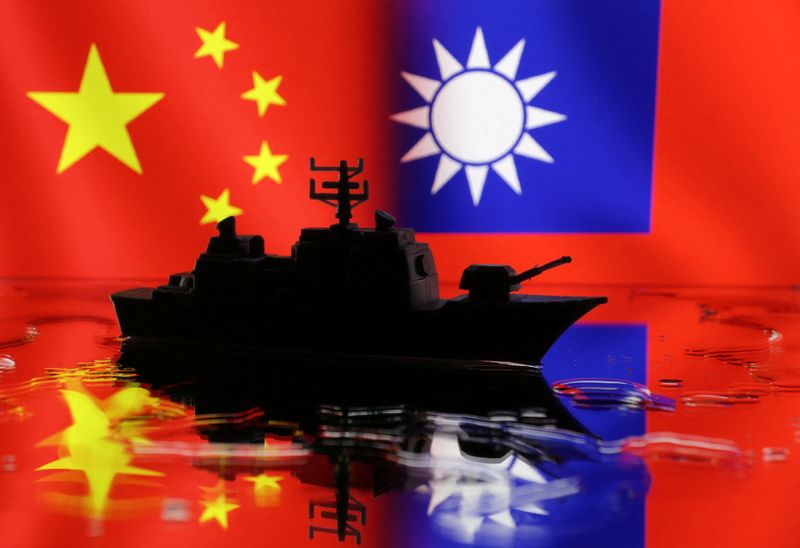
Beijing’s Maritime Lines in the Sand: Sovereignty Versus Seaborne Rights
POLICY WIRE — Hong Kong, China — The quiet clatter of cargo containers moving across the Pacific – a constant rhythm of global commerce – might seem far removed from the arcane disputes over...

POLICY WIRE — Hong Kong, China — The quiet clatter of cargo containers moving across the Pacific – a constant rhythm of global commerce – might seem far removed from the arcane disputes over international maritime law. But China’s recent declaration, asserting that it opposes any country using freedom of navigation to undermine its sovereignty, casts a long shadow over those prosaic journeys. It isn’t just about territorial claims in distant seas; it’s about rewriting the very operating manual for the world’s most critical trade routes.
It’s not often that bureaucratic pronouncements from Beijing ignite quite this level of strategic head-scratching across international chanceries. Sure, the usual suspects are present—naval patrols, fishing boat incidents, and all the familiar diplomatic bluster. But this specific, rather stark phrasing feels less like a negotiating point and more like a definitive red line drawn in deep ocean ink. The message is simple, isn’t it? Sail your ships, absolutely. Just don’t think for one second that we don’t have an eye on you, or that we don’t believe our claims trump your passage. [QUOTE_PLACEHOLDER]
For nations heavily reliant on sea lanes, from Washington to Wellington, this isn’t simply an academic debate for law professors. It directly impacts their economies, their alliances, — and their geopolitical calculus. Consider for a moment the staggering scale: Roughly one-third of global shipping – valued at over $5 trillion annually – navigates the South China Sea, according to estimates from the UN Conference on Trade and Development (UNCTAD). That’s not a footnote, is it? That’s the entire pipeline for immense portions of international trade, carrying everything from oil to microchips.
The implied tension here is palpable. Freedom of navigation, a doctrine enshrined in international law, essentially grants all vessels the right of innocent passage through international waters. China’s assertion suggests that its sovereign claims, which are often disputed and far-reaching, could supersede that global norm. It’s a conceptual struggle, you see, between centuries of maritime tradition and Beijing’s modern, robust interpretation of national prerogative. And it creates real-world friction. Imagine a U.S. Navy destroyer, conducting what it terms routine operations, encountering a Chinese coast guard vessel. That’s a flashpoint waiting to happen, not some theoretical scenario. It’s playing out almost daily in various guises.
But the ramifications stretch far beyond immediate maritime encounters. Consider Pakistan, for instance, a nation strategically situated at the crossroads of Central Asia, the Middle East, and the Indian Ocean. Its Gwadar Port, a cornerstone of China’s Belt and Road Initiative, aims to provide China with closer access to energy supplies from the Persian Gulf, bypassing the long and potentially contested sea lanes through the South China Sea. If China feels compelled to exert stronger control over distant maritime domains, how might that influence its engagement with countries like Pakistan, already tied so closely through economic corridors and infrastructure projects? It’s not just about guarding its immediate shores; it’s about securing supply chains—and influence—far from home. The implications for nations in the broader Muslim world, especially those deeply reliant on maritime trade through these same arteries, can’t be ignored either. They’re effectively caught in the geopolitical squeeze.
This isn’t new posturing. Beijing has for years pushed back against what it views as provocative maneuvers by foreign navies in its claimed territories, often accusing them of encroaching on its sovereign rights. The rhetoric, though, feels a little sharper now, a little more absolute. It’s an interesting evolution, or perhaps, simply a clearer articulation of what has been understood by many as the underlying principle all along. Some might even suggest it’s China just laying its cards on the table. And those cards aren’t subtle.
📄 POLICY WIRE WHITEPAPER PUBLISHED: PAKISTAN'S NATIONAL SECURITY POLICY PRIORITIES
👉 READ BY CLICKING HERESo, the question then becomes, what happens when two unstoppable forces – the deeply ingrained international norm of free navigation and a rising power’s increasingly assertive claims of sovereignty – meet head-on? You don’t need to be a grizzled naval strategist to see the inherent tension. It’s a diplomatic game of chicken, played out on the high seas, with the global economy as a captive audience.
What This Means
This particular phrasing from Beijing isn’t merely political theatrics; it’s a policy directive with profound geopolitical and economic ripples. Politically, it signals an intensification of China’s challenge to the established international maritime order, particularly in the South China Sea. It forces countries, especially the U.S. and its allies, to choose between de-escalation that could be interpreted as tacit acceptance of Chinese claims, or continued Freedom of Navigation Operations (FONOPs) that risk direct confrontation. There’s little room for ambiguity, meaning future incidents, like recent near-collisions, become even more perilous.
Economically, for nations that depend on these waterways—which is virtually every trading nation on Earth—it introduces a layer of uncertainty and potential vulnerability. Any perceived restriction on navigation could escalate shipping costs, impact supply chain reliability, and divert trade routes, causing inflationary pressures globally. Countries in South Asia and the broader Muslim world, many of whom are either directly engaged with Chinese economic initiatives like the BRI or rely heavily on stable sea lanes for their own trade, might find themselves in a precarious position. Their economic lifelines are tethered to waters where geopolitical tensions simmer. Ultimately, Beijing’s statement serves notice: the price of free passage might just be open to renegotiation.