


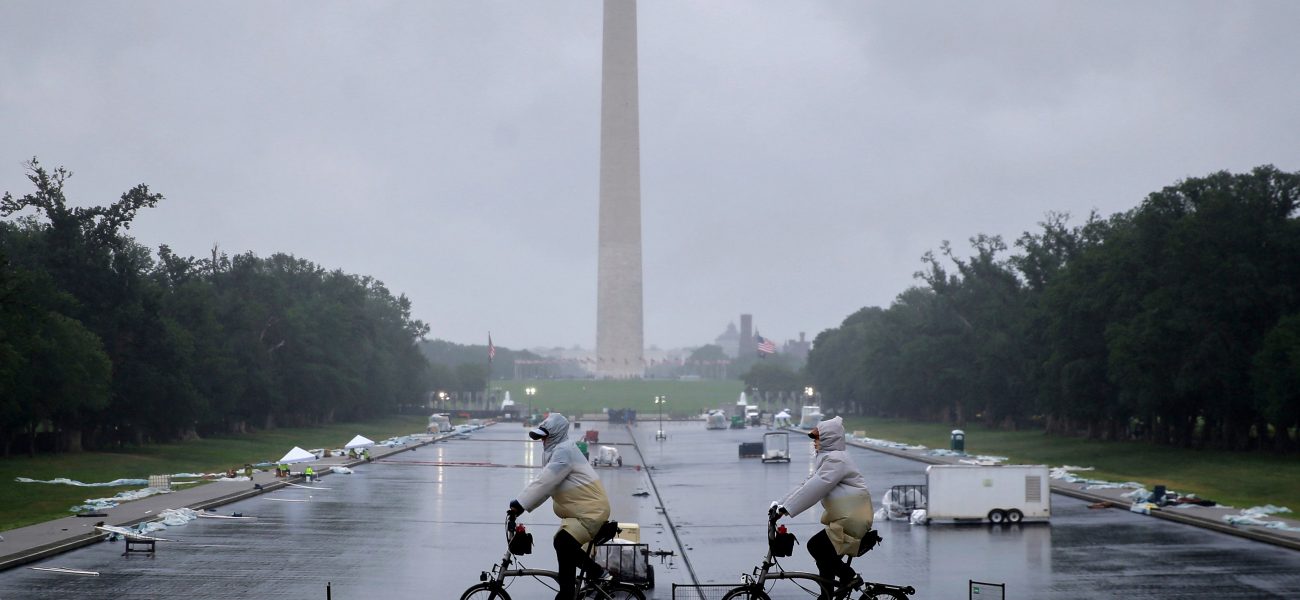
Dredging Up the Past: Trump’s Reflecting Pool Rhapsody Falls Flat
POLICY WIRE — Washington, D.C. — Forget for a moment the looming elections, the escalating conflicts abroad, or the gnawing worries of inflation—our political discourse has apparently been reduced to...

POLICY WIRE — Washington, D.C. — Forget for a moment the looming elections, the escalating conflicts abroad, or the gnawing worries of inflation—our political discourse has apparently been reduced to debating federal spending on a puddle. A very large, very famous puddle, mind you. But still. The latest skirmish in America’s ongoing reality war centers on whether former President Donald J. Trump is accurately assessing the fiscal stewardship of his predecessors regarding the Lincoln Memorial Reflecting Pool.
It’s an odd place to draw a line, isn’t it? But then again, much of the past few years has been. Trump recently leveled accusations that Presidents Barack Obama and Joe Biden blew “hundreds of millions of dollars”—a truly colossal sum—on renovating the iconic Washington feature. His remarks, broadcast across various platforms, seemed calculated to ignite familiar outrage, painting his rivals as reckless spendthrifts.
But the numbers, they’re stubborn things. The truth? Not even close to what he’s spinning. Records from the National Park Service—and confirmed by multiple, less politically-charged accounting exercises—show that the major renovation of the Reflecting Pool, completed back in 2012, came in at about $34 million. That’s a tidy sum, absolutely, especially in a time of tightening budgets. But it’s hardly “hundreds of millions.” And it definitely wasn’t on Biden’s watch, who, in 2012, was still Vice President, operating with a completely different portfolio than greenlighting fountain projects.
“They squandered money like drunken sailors, on things nobody asked for, believe me,” Trump declared recently at a rally in Wisconsin, leaning into his characteristic blend of hyperbole and implied grievance. “Billions. Really. While our borders are open, they’re rebuilding water features for tourists. Nobody’s ever spent money like them, not ever.” His supporters ate it up, nodding, cheering, completely unfazed by the disconnect from observable reality. Because sometimes, the narrative trumps the facts.
“It’s just another brick in the wall of fabrications we’ve come to expect,” fired back Representative Pramila Jayapal (D-WA), speaking to Policy Wire from her Capitol Hill office. “It’s not about the Reflecting Pool; it’s about trying to rewrite history, trying to sow distrust in institutions and truth itself. While we’re grappling with genuine legislative challenges—issues that truly impact everyday Americans—we’re constantly dragged back to debunking playground taunts. It’s exhausting, and frankly, it undermines the serious work we’re here to do.” Her exasperation, you could practically taste it through the phone line.
And that’s the real trick, isn’t it? This isn’t a one-off mistake or an innocent miscalculation. It’s a calculated deployment of misinformation, aimed squarely at political foes. Its effectiveness isn’t in its truthfulness, but in its ability to lodge itself in the collective consciousness of a partisan audience, mutating into an unshakeable ‘alternative fact.’
📄 POLICY WIRE WHITEPAPER PUBLISHED: PAKISTAN'S NATIONAL SECURITY POLICY PRIORITIES
👉 READ BY CLICKING HEREIt’s a phenomenon not restricted to America’s political swamp, either. Consider the swirling vortex of online misinformation campaigns impacting countries like Pakistan, for instance. From fabricated news stories designed to destabilize political opponents to expertly photoshopped images spread through social media channels to inflame sectarian tensions, the playbook is remarkably similar. In Islamabad or Washington, the currency of disinformation trades freely. The tools might change, but the objective—to manipulate perception and undermine established narratives—remains chillingly consistent. Indeed, the shadow economy of prediction markets thrives on such uncertainty, monetizing chaos.
One academic study, published in Science Advances in 2021, found that politically motivated falsehoods on social media spread six times faster than factual information. Six times! Think about that for a second. That’s an astonishing, depressing rate, practically ensuring that by the time a fact-check gets eyes on it, the initial falsehood has already colonized the brains of millions. It means truth is always playing catch-up, always on the back foot.
What This Means
The persistence of demonstrably false claims, especially from high-profile figures, corrodes public trust across the board. Economically, this erosion can manifest in market instability as investors react to narratives rather than data, or in taxpayer funds being spent on debunking efforts rather than substantive policy analysis. Politically, it deepens the partisan trenches, making compromise an elusive myth. When basic facts are contested, when a $34 million project becomes “hundreds of millions” with a rhetorical flick, the ability to engage in meaningful debate about actual governance vanishes. Leaders aren’t just discussing policy choices; they’re arguing about what happened five minutes ago. It’s a losing game for everyone involved, particularly for an electorate that needs reliable information to make informed choices. This incessant noise creates a climate where real issues—climate change, economic inequality, foreign policy—get drowned out by squabbles over historical maintenance budgets for fountains. Even critical national security discussions are not immune to the gravitational pull of partisan fiction. We’re living through a constant, low-grade disinformation crisis, and the Reflecting Pool is just one more ripple in its endless surface.