


Hoosier Habitat at High Water Mark: A Deer’s Deluge and Dissenting Dialogues on Disaster Relief
POLICY WIRE — Indianapolis, USA — It’s usually the headlines about bureaucratic blunders or high-stakes legislative brinkmanship that command attention here at Policy Wire. But sometimes, a single...

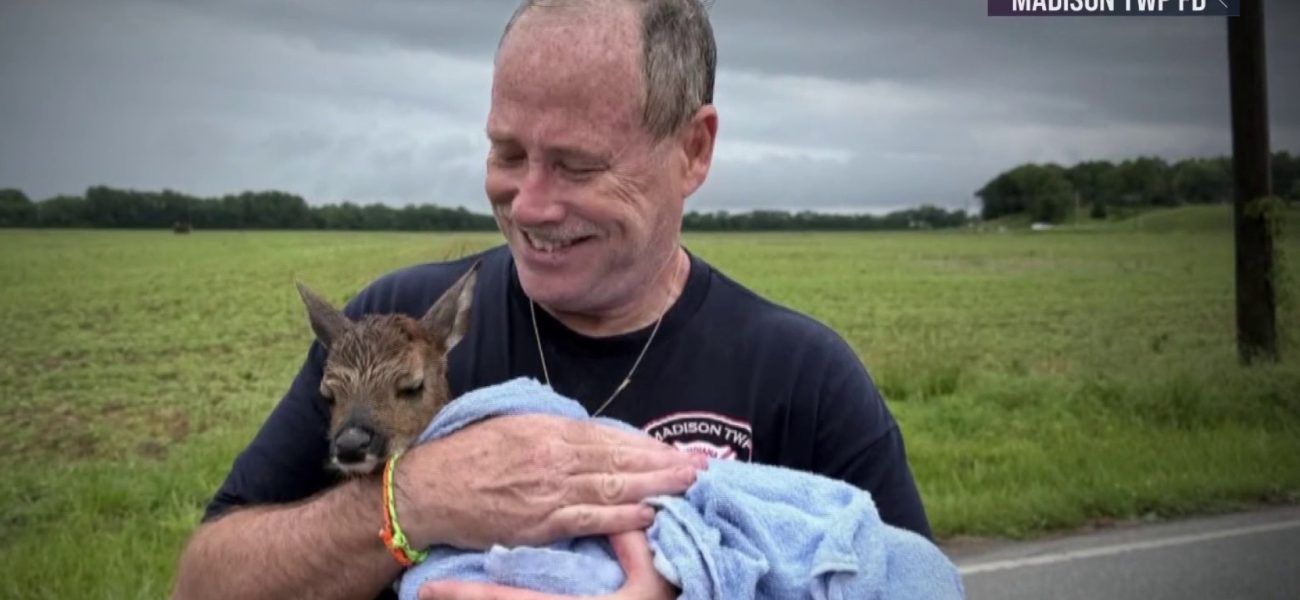
POLICY WIRE — Indianapolis, USA — It’s usually the headlines about bureaucratic blunders or high-stakes legislative brinkmanship that command attention here at Policy Wire. But sometimes, a single snapshot—a fragile life caught in nature’s unforgiving grip—drags a host of larger questions into sharp relief. Take, for instance, a recent event in America’s heartland: the image of Indiana firefighters plucking a baby deer from what was described as [QUOTE_PLACEHOLDER] certainly tugged at the heartstrings.
It’s a story custom-made for social media feel-good clicks, a brief respite from the relentless drumbeat of global instability. You see the photos, maybe a short video clip, and think, ‘Oh, good for them.’ And it’s true, bravo to the folks risking their own safety. But look a little closer, peel back the superficial layer of human-animal bonding, — and you start to wonder. Why does a distressed fawn merit immediate, decisive intervention, while millions of humans worldwide still lack basic flood protection or timely rescue from far worse environmental catastrophes? It’s not just a philosophical ponderance; it’s an uncomfortable calculus of resources — and empathy.
Flooding, in Indiana or anywhere else, isn’t just about a dramatic rescue. It’s an economic disruptor, a societal divider. Homes vanish, livelihoods evaporate. Farms become temporary lakes. And when local emergency services are diverted, however commendably, to save wildlife, one can’t help but ask about the wider allocation of public resources. Are we sufficiently equipped? Is this an anomaly, or a forecast of what’s to come as erratic weather patterns—intensified by a warming planet—become the norm? The official account provided little detail, merely stating the intervention to save a [QUOTE_PLACEHOLDER].
Because, let’s be frank, these sorts of environmental disruptions aren’t confined to a pleasant Indiana suburb. They’re hammering communities from coastal America to the vast river plains of Pakistan. We see it in Sindh province, for instance, where last year’s floods displaced over 33 million people—a catastrophe that dwarfs a struggling fawn but receives a fraction of the West’s collective emotional bandwidth. Their struggle isn’t cute; it’s often brutal, messy, and involves hard choices, sometimes even abandonment of what can’t be saved. You don’t often find heartwarming viral content about a Pakistani family losing their entire home for the third time in a decade, but those stories are far more frequent and far more devastating.
And it raises an awkward question about perception: is human suffering in faraway lands simply too abstract for immediate emotional resonance? Or is the narrative easier to consume when it’s an innocent creature in direct peril, untainted by geopolitical complexity or historical grievances? Don’t get me wrong, saving the fawn was a humane act. No arguments there. But the framing—and indeed, the media’s focus—often feels… incomplete. We’re eager to celebrate a local hero for pulling a deer from the drink, but less eager to discuss systemic failures that put that deer, and countless human beings, in peril in the first place.
In Pakistan, for example, the National Disaster Management Authority estimates annual flood losses averaging $4.1 billion, a figure that includes agricultural devastation and infrastructural damage, far beyond what any local fire department could ever hope to mitigate through individual acts of heroism. That’s a staggering burden for a developing economy, and it points to a broader, global problem demanding a global strategy, not just localized, albeit commendable, tactical responses. The fact is, local fire departments aren’t funded to tackle the downstream effects of global climate change; they’re set up for emergencies, like when the [QUOTE_PLACEHOLDER] was in danger.
📄 POLICY WIRE WHITEPAPER PUBLISHED: PAKISTAN'S NATIONAL SECURITY POLICY PRIORITIES
👉 READ BY CLICKING HEREBut the irony deepens. For every cheer lauded for the Indiana crew, there’s likely an unspoken grumble among local residents whose flooded basements or ruined businesses received less immediate, personalized aid. They don’t typically go viral. Their struggles are just another line item on an insurance claim form, another bureaucratic hurdle to clear. It’s about optics versus outcome, isn’t it? Because at the end of the day, a single, compelling narrative about animal rescue often outshines the complex, systemic plight of human communities struggling against the same forces. It just is what it’s. And maybe that’s the whole point.
It’s not just about rescuing a [QUOTE_PLACEHOLDER]—it’s about the silent conversation happening beneath the surface, about who and what we prioritize when nature unleashes its fury. And whether we’re truly prepared for what’s coming, from the quiet creeks of Indiana to the raging rivers of the Global South. For a broader perspective on challenges faced by communities globally, consider insights into invisible threats and policy dilemmas or the global impact of relentless climate patterns. That’s the cold, hard policy angle folks probably don’t see in the viral clips.
What This Means
This localized animal rescue, while emotionally resonant, lays bare uncomfortable truths about our societal values and disaster preparedness. Economically, resources diverted for such feel-good endeavors—while commendable at an individual level—don’t scale to address the colossal costs of widespread environmental upheaval. Politically, the immediate emotional draw of saving a visible, innocent creature can overshadow the deeper, more complex policy discussions necessary for effective climate adaptation and infrastructure resilience. For regions like South Asia, disproportionately affected by climate change, the West’s focus on smaller, easily digestible narratives misses the true scale of humanitarian and economic crises unfolding daily. It reinforces a skewed perception of risk and responsibility, potentially hindering international cooperation on large-scale environmental aid and development. The collective public sigh of relief over a fawn’s rescue offers little solace to a farmer in Pakistan whose entire harvest has been washed away by floodwaters exacerbated by distant industrial emissions. It’s a reminder that empathy, while powerful, needs to be paired with hard-nosed policy and equitable resource allocation to truly tackle the crises confronting a warming world.