

Fan Fury, Silverware, and the Quiet Coup: Inside Arsenal’s Billionaire Reckoning
POLICY WIRE — London, England — They say nothing focuses the corporate mind quite like outright revolt. For Arsenal Football Club, an English institution worth billions, that reckoning arrived not...

POLICY WIRE — London, England — They say nothing focuses the corporate mind quite like outright revolt. For Arsenal Football Club, an English institution worth billions, that reckoning arrived not with an accounting spreadsheet but with a mass of red-clad supporters, placards waving, demanding change. Years of perceived stagnation, capped by back-to-back eighth-place finishes in the Premier League, culminated in a spectacular public dressing-down—the proposed Super League fiasco serving as a very expensive final straw—that observers now grudgingly concede forced its distant American owners to actually, you know, pay attention.
It’s a peculiar thing, seeing a global sporting behemoth brought to heel by its own customers. And Arsenal, lest we forget, is far more than a football team; it’s a financial asset, a brand, a vessel for commercial partnerships spanning continents. But even the cold logic of asset management found its match in the white-hot passion of a fanbase tired of being taken for granted. For nearly a quarter-century, after all, the Gunners hadn’t lifted the league title—a particularly galling statistic for a club of its historical stature.
Josh Kroenke, the 46-year-old scion who effectively runs the family’s day-to-day operations, now speaks of a deliberate, long-term vision. But don’t mistake that narrative for pre-ordained genius. That vision crystallized, by his own admission, under duress. Back around the time of the embarrassing Europa League final in Baku, Kroenke had apparently told his father, Stan, that they’d “need to be prepared to fall and take a few blows in order to return to the very top.” A prophetic statement, perhaps, but one delivered in an era where the club was already plummeting.
But the real inflection point, the one that forced introspection, wasn’t some strategic blueprint developed in an anonymous boardroom. No, it was the sheer vitriol directed at the club’s ownership when the European Super League plans blew up in their faces. Suddenly, years of detached financial stewardship, long critiqued by the media, became a screaming street-level concern.
Because here’s the truth: for much of Arsène Wenger’s twilight years, and certainly immediately after his departure, the Kroenke Sports & Entertainment (KSE) empire appeared content to let Arsenal float. Modern football, however, moves fast. It’s a relentless, money-guzzling beast, not a self-sustaining anomaly. “I understand the perception that the board only cared about Champions League revenue,” Josh Kroenke candidly told a British broadcast crew recently, an acknowledgment that suggests, finally, a degree of understanding, albeit one purchased with public outrage.
That realization—that football, at this scale, isn’t just about income statements but also about the visceral connection to millions—seems to have forced a structural shift. The delay, Kroenke implied, was partly due to his father solidifying 100% ownership, clearing the decks for what came next. But whatever the reason, the outcome is clear: the club rebuilt its entire sporting infrastructure, giving Manager Mikel Arteta and Technical Director Edu unprecedented autonomy and resources. Now, just The Price of Ambition: How a Single Transfer Reshaped the Premier League Power Play isn’t simply about what money you spend, but how smartly you spend it, and with whose trust.
📄 POLICY WIRE WHITEPAPER PUBLISHED: PAKISTAN'S NATIONAL SECURITY POLICY PRIORITIES
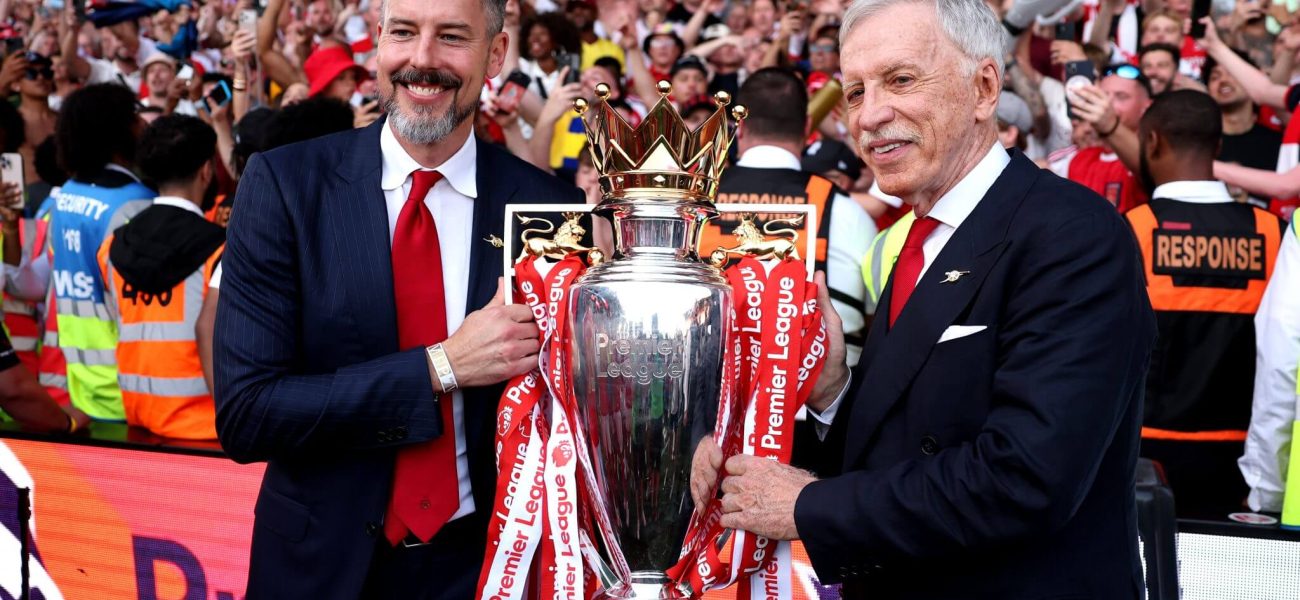
👉 READ BY CLICKING HEREThis wasn’t just a corporate reorganization; it was a cultural awakening. For two decades, a sense of malaise had hung heavy over the club. Yet, on Sunday, the ultimate trophy—the Premier League title—was paraded at Selhurst Park, the Kroenkes themselves present, momentarily shedding their public anonymity to hand it over to the captain. And they weren’t booed. An extraordinary turnaround in perception, bought with victories.
What This Means
The Arsenal saga offers a sobering lesson in the delicate dance between global capital and local sentiment, particularly pertinent for sports franchises increasingly owned by overseas investors. For clubs with vast, passionate international fanbases, including those watching keenly from across South Asia—like in Pakistan, where English Premier League allegiances run deep and rivalries spill into animated online forums—this narrative resonates. It’s a reminder that even billion-dollar enterprises aren’t immune to public accountability, not when the product they’re selling is built on collective identity and dreams. We’re witnessing a growing assertiveness of fan communities globally; in many ways, the fan protests mirroring larger, sustained calls for transparency and local agency against often opaque corporate power, not dissimilar to civic movements pushing for stronger democratic voices in their own nations. One could argue it’s this constant push and pull between governance and the governed that shapes more than just the playing field, but wider sociopolitical structures. Look no further than recent voter turnouts in places like Lahore, demonstrating a growing, sustained engagement for a stake in their future, much like the Arsenal faithful’s enduring demand for control over their club’s destiny. Perhaps even for those nations fighting for greater sovereignty, like on Youm-e-Takbeer: A Day of Sovereignty, Strength, and National Resolve, the underlying sentiment – a desire for self-determination and voice – isn’t so different from a fan wanting a say in their club’s direction.
This isn’t about mere sporting success, mind you. It’s about corporate governance in an age of distributed stakeholder power. It’s about understanding that even the most well-heeled ownership group must ultimately answer to the very human emotional investment of its customer base. What this recent triumph really underscores isn’t just shrewd football management—though it certainly is that—but rather the very real, very potent power of popular opinion to reshape the direction of enormous commercial entities. The Kroenkes may have steered the ship, but it was the rising tide of discontent that finally put wind in their sails.