


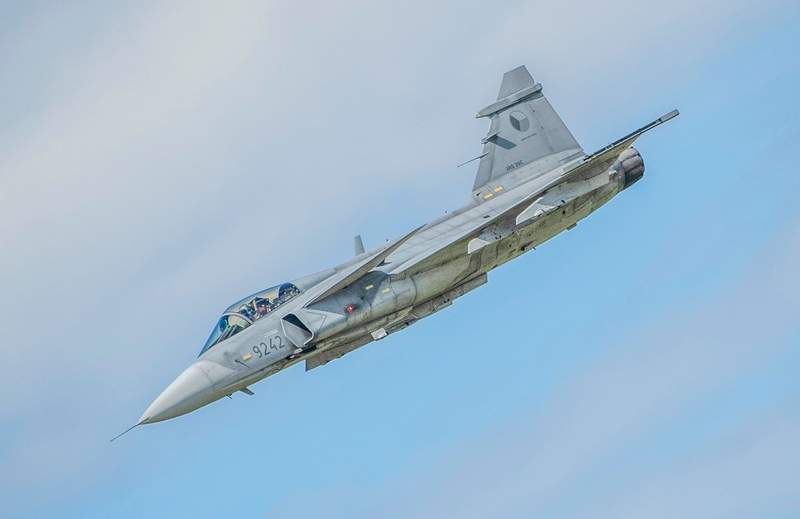
Europe’s Skies Reconfigured: Sweden’s Gripen Deal Casts Long Shadow Over Geopolitics
POLICY WIRE — STOCKHOLM, SWEDEN — In a world where the thunder of war still echoes across continental borders, Kyiv’s rumored quest for two dozen Swedish Gripen E/F fighter jets isn’t...

POLICY WIRE — STOCKHOLM, SWEDEN — In a world where the thunder of war still echoes across continental borders, Kyiv’s rumored quest for two dozen Swedish Gripen E/F fighter jets isn’t just another shopping trip for weaponry. No, this feels different. It’s less about filling a specific tactical void and more about a tectonic shift, a deepening European commitment, that’s already got the war rooms — and the markets — buzzing with uneasy chatter. Call it the silent repositioning of an entire continent’s strategic posture, plain — and simple.
The murmurs from various diplomatic circles, amplified by whispers within Sweden’s defense apparatus, point to an understanding, a ‘gentleman’s agreement’ even, paving the way for Ukraine to acquire approximately 20 of Saab’s sophisticated multi-role aircraft. It’s a numbers game, sure, but what are these numbers really saying? They’re speaking to a brutal, grinding reality on Europe’s eastern flank. They’re also saying that nations aren’t just sending old gear anymore; they’re ready to re-equip a country fighting for its survival with top-shelf kit.
And let’s be blunt: this isn’t just an airborne taxi service. The Gripen, a notoriously agile and cost-effective fighter, brings capabilities Ukraine desperately needs: advanced electronic warfare suites, beyond-visual-range missile engagement, and a knack for operating from dispersed, less-than-ideal runways. This procurement, if finalized, dramatically expands Ukraine’s aerial deterrence. Because, let’s face it, they’ve been battling with often outdated Soviet-era relics, holding their breath against a foe with far superior airpower for far too long.
Ukrainian officials, who’ve honed their lobbying efforts into a fine art, are predictably effusive. “This isn’t just about jets; it’s about reshaping our skies, brick by agonizing brick,” said Oleksiy Danilov, a former Ukrainian National Security and Defense Council Secretary, with his typical unvarnished candor. “Every single piece of advanced tech like this—it bites back at the aggressor, makes them think twice. We don’t just want peace; we want a peace built on real strength.” His words, steeped in a nation’s fierce defiance, don’t just speak to military strategists but also to the weary citizen.
Across the Baltic, the tone from Stockholm is one of pragmatic resolve, layered with a good deal of self-interest in promoting domestic defense industries. Pål Jonson, Sweden’s Minister for Defence, put it succinctly: “Our commitment to Kyiv isn’t just moral; it’s a strategic investment in European stability, full stop. These Gripen E/Fs are precision instruments for a nation defending its very existence.” It’s not a donation, mind you, but a calculated transaction, suggesting a long-term strategic partnership.
But the ramifications of such a significant deal ripple out far beyond the immediate front lines. Think about the global arms market. Global defense spending hit an all-time high of $2.2 trillion in 2022, a 9% increase from 2021, largely driven by the war in Ukraine, according to data compiled by the Stockholm International Peace Research Institute (SIPRI). This Ukrainian procurement represents a considerable chunk of that increased expenditure and influences similar debates in other regions.
📄 POLICY WIRE WHITEPAPER PUBLISHED: PAKISTAN'S NATIONAL SECURITY POLICY PRIORITIES
👉 READ BY CLICKING HERETake South Asia, for instance. Nations like Pakistan, perpetually navigating a fraught regional security environment, watch such developments closely. Their own military planners, often tasked with updating aging fleets while facing budgetary constraints, observe how these European transfers impact existing defense industry supply chains and geopolitical alliances. If European allies prioritize Ukrainian rearmament, does it slow down or alter the procurement timelines for other nations also looking for modern airframes? It’s a ripple effect in an increasingly interconnected — and well-armed — world.
What This Means
The prospective Gripen deal signals a marked intensification of support for Ukraine, moving beyond older stock to contemporary, highly capable platforms. Politically, it deepens Sweden’s stake in European security — and its ties to a potential future NATO member, despite still wrangling with Ankara’s stubborn membership holdout (remember that drama?). Economically, it represents a substantial injection into Saab’s coffers, likely fueling further innovation, but it also reflects a global market adjusting to sustained conflict and heightened defense postures.
It’s a clear message to Moscow: the West isn’t just patching up wounds; it’s equipping Ukraine to genuinely contest air superiority. This could prolong the conflict, absolutely, but also dramatically increase Ukraine’s leverage in any future negotiations, if such talks ever gain traction. for countries on the fringes, like many across the Muslim world, witnessing such massive rearmament efforts in Europe raises questions about regional security balances and the availability of advanced military hardware. These dynamics impact not only immediate conflict zones but also long-term regional arms races, especially when it concerns critical strategic assets like fighter jets. There’s a distinct feeling that what happens now will reverberate for decades. Nations that might’ve been on the fence about defense spending, or who’ve seen an unexpected slump in economic heavyweights globally, might suddenly find their own policy engines kicking into overdrive to match the evolving landscape. But it’s not without cost, a deep, pervasive one.