


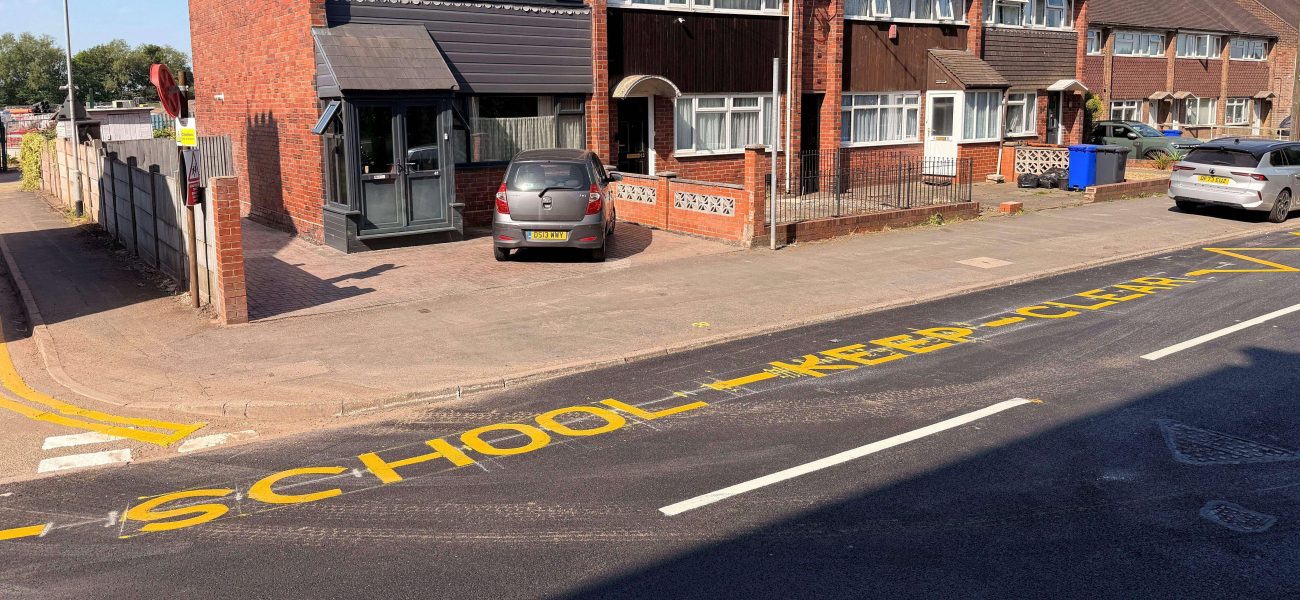
Painted Puzzles and Public Purse: A Council’s Linguistic Roadwork Blunder Echoes Wider Incompetence
POLICY WIRE — London, UK — Somewhere, a line painter (or maybe a pencil pusher with questionable spellcheck) scribbled a minor heresy onto the tarmac. Not a grand corruption scandal, not a war waged...

POLICY WIRE — London, UK — Somewhere, a line painter (or maybe a pencil pusher with questionable spellcheck) scribbled a minor heresy onto the tarmac. Not a grand corruption scandal, not a war waged on false pretenses, but a simple, almost laughably mundane, misspelling. And yet, this unassuming gaffe—a local council making a mess of school zone signage—manages to pull back the curtain on a performance we’ve all grown accustomed to: the subtle, persistent drumbeat of bureaucratic inefficiency. It’s an opera in miniature, performed on asphalt, reminding us that even the most well-oiled machines, or those aspiring to be, can stutter on the simplest of vowels.
It wasn’t some esoteric technical term that tripped up the local authorities. It was the word ‘school’. Not ‘schul’, not ‘skool’, but something so creatively askew that its initial public exposure likely garnered more eye-rolls than genuine outrage. They’d painted over the initial mishap, of course. Cleaned up the physical evidence. But the memory—the photographic evidence, thanks to the instant gratification of modern smartphones—it lingers. It’s a smudge on the civic ledger, a quiet symbol of public money spent twice for one task. [QUOTE_PLACEHOLDER]
This small-town comedy of errors, initially perhaps a fleeting chuckle, carries a surprising weight for those paying attention. We’re not just talking about the cost of white paint — and an hour of manual labor. Oh no. We’re talking about oversight, about quality control, about the sheer banality of human error scaling up to taxpayer burden. A local council somewhere botched the spelling of the very institution it ostensibly serves to protect — and regulate. It wasn’t exactly an earthquake, but the tremor was there. And it got fixed. But at what cost?
Because these little administrative bumps aren’t isolated incidents. They’re symptomatic. Think about the infrastructure projects that grind to a halt because some permit was misfiled. Or the public funds diverted to fix a clearly flawed design blueprint, only to find the new fix creates its own set of problems. They call it ‘snakes and ladders’ in Islamabad for good reason—projects moving forward, then sliding right back, sometimes thanks to issues no more complex than miscommunication, poor drafting, or simple, stunning oversight. Pakistan, for instance, often faces public scorn over the condition of its roads and urban planning, where misspellings or baffling signage wouldn’t feel out of place. It’s a mirror reflecting an exasperating reality that citizens worldwide, from Wiltshire to Lahore, begrudgingly recognize: the path of public works isn’t always paved with competence.
But how much does this small-scale bumbling really hit the wallet? While the immediate repaint might be pennies, the cumulative impact of such missteps is anything but. According to a 2022 analysis by the UK’s National Audit Office, inefficiencies and preventable errors in public sector projects accounted for nearly 10% of total project costs—a figure that, across the hundreds of billions spent annually, adds up fast. It’s money that doesn’t build schools, or fix healthcare, or upgrade critical utilities. It just… vanishes into the ether of rectification. You’d think, given the stakes, someone would double-check the damn words. But then, thinking is the operative term here, isn’t it?
📄 POLICY WIRE WHITEPAPER PUBLISHED: PAKISTAN'S NATIONAL SECURITY POLICY PRIORITIES
👉 READ BY CLICKING HEREAnd what’s perhaps more concerning than the monetary cost is the corrosion of trust. Every misspelled street sign, every delayed application, every poorly communicated public service notice erodes a little bit of that precious, brittle faith citizens place in their government. They start to wonder what other, bigger mistakes are being made behind closed doors. They wonder about the efficacy of a system that can’t even correctly label a ‘school’. It’s a creeping doubt, insidiously expanding, until people just sigh — and expect the next gaffe. It’s a slow-burn crisis of credibility, far more damaging than a temporary roadblock.
This particular incident—a simple road marking—serves as a curious metaphor. It’s the small, public manifestation of a broader administrative frailty. It’s an inconvenient truth painted in glaring white (or blacked-out white) for all to see. Nobody gets hurt. The school bell still rings. But the message it sends is less about learning, — and more about just getting by, imperfectly.
What This Means
This episode, though localized, presents a miniature blueprint for larger systemic challenges facing public administration globally. Politically, such highly visible blunders fuel populist narratives about incompetent government, giving easy fodder to those who advocate for reduced state intervention or, conversely, demand drastic reforms. It isn’t just about paint, you know. It’s about public sector productivity, transparency, and accountability—concepts often lauded in policy documents but routinely faltering in street-level execution. Economically, even minor rectifications contribute to the ‘overhead of error,’ diverting funds and human capital from productive outputs. Think about how this ripples out; if basic signage is an issue, what does that say about complex procurement deals or ambitious social programs? It contributes to a general sense of fatigue and skepticism among the populace, often impacting voter turnout or increasing support for protest movements. From a developmental perspective, especially in rapidly modernizing regions like South Asia, the consistent failure to execute basic tasks efficiently undermines progress and wastes international aid or national investment. When a nation is trying to attract foreign direct investment, or convince its own people to buy into grand economic visions, these kinds of prosaic, utterly avoidable errors chip away at its credibility. One might even connect this seemingly trivial mistake to broader discussions on governance effectiveness, much like the ongoing scrutiny of administrative practices in other sectors. Because if you can’t get ‘school’ right, what hope is there for complex fiscal policy?