


Altitude of Apathy: Rockies’ Follies Mirror Broader Institutional Malaise
POLICY WIRE — Washington D.C. — They say thin air makes a baseball fly further in Denver. Maybe so. But it seems to do little for organizational competence, or individual performance, when...

POLICY WIRE — Washington D.C. — They say thin air makes a baseball fly further in Denver. Maybe so. But it seems to do little for organizational competence, or individual performance, when expectations bottom out. Nobody predicted glory for the Colorado Rockies this season. Not after shedding 119 games the year prior. Still, a creeping sense of familiar dread settles over Coors Field, thick as the city’s summer haze, as the club — once touted as a nascent turnaround story – limps along, showcasing a particular brand of dysfunction that ought to grab the attention of policymakers well beyond the bleachers. Because what you see playing out on that emerald green is less a baseball team’s slump, and more a clinical study in institutional stagnation.
It’s not just the pitching staff that’s faltering, grappling with the usual assortment of arm woes—elbows, shoulders, the entire sad symphony of athletic wear-and-tear. That’s almost expected. Ryan Feltner — and Chase Dollander sidelined? Par for the course, it seems. The real intrigue, the truly maddening bit, resides in the everyday grind of offensive futility, particularly when a player gifted with a defender’s instinct seems to forget how to swing a stick. And we’re not talking about some rookie call-up here.
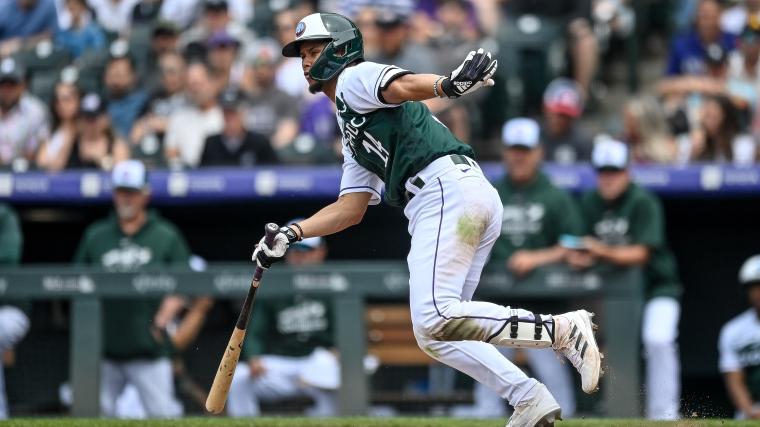
Ezequiel Tovar, a shortstop heralded for his vacuum-like glove, has become a microcosm of the franchise’s larger malaise. Bleacher Report’s Zachary D. Rymer recently tagged his batting woes in the power-friendly confines of Coors Field as a ‘misdemeanor.’ A ‘misdemeanor,’ he wrote, at a stadium notorious for inflating offensive stats. Tovar’s current OPS (On-base Plus Slugging) sits at a meager .578 — a far cry from the roughly .700 considered league average. In the rarified air of Denver, his OPS plunges even further to .466. That’s just abysmal, plain and simple.
“Look, we’ve invested heavily in scouting and development,” insisted one Colorado Rockies executive, speaking to Policy Wire on background, emphasizing the phrase ‘long-term vision’ as if it were a mantra. “You don’t just bail on talent. He’s young, he works hard. We expect better, yes, but Rome wasn’t built in a day, nor will a contender in Denver be.” But you have to wonder if their definition of “investment” is just slightly…off. Like a budget allocated purely for consultants and PowerPoint presentations, with precious little reaching the actual front lines.
The Rockies started 13-14 in April, a brief glimmer of false hope, only to crater to a 20-36 record by late May, 15.5 games back in the NL West. The data’s unflinching. And you don’t need an MBA to understand what happens when a prime asset — a player paid millions, surrounded by an entire organizational apparatus designed to maximize his performance — dramatically underperforms, especially in an environment engineered to boost his numbers. It raises questions about more than just the individual; it indicts the entire system.
This isn’t just about a shortstop who can’t hit a curveball. It’s about a pattern, an almost clinical demonstration of how a lack of sustained, strategic investment, coupled with seemingly inexplicable talent mismanagement, can doom an enterprise regardless of its inherent advantages. It echoes concerns one might hear about nations with immense potential but perpetually stalled development, say, Pakistan, where systemic issues often hobble individual brilliance and economic initiatives. Where does the blame truly lie: with the individual not seizing an opportunity, or the environment that fails to foster growth? But often, it’s both.
📄 POLICY WIRE WHITEPAPER PUBLISHED: PAKISTAN'S NATIONAL SECURITY POLICY PRIORITIES
👉 READ BY CLICKING HEREConsider the analogy: a nation blessed with fertile land, strategic geographical positioning, and a youthful population, yet consistently failing to meet basic development benchmarks. Who’s truly at fault? The farmers? Or the agricultural policy, the infrastructure, the market access? General Azhar Shah, a retired Pakistani military analyst, once observed, “We often speak of the resilience of our people, but that resilience is tested by the lack of clear, consistent policy direction. Individual effort can only carry you so far if the foundation itself is shaky.” His words, originally about Islamabad’s internal challenges, ring strangely true when watching the Rockies.
What This Means
The theatrical struggles of the Colorado Rockies, and specifically players like Ezequiel Tovar, serve as a stark, if sporting, metaphor for institutional challenges that transcend baseball diamonds. It’s not simply poor play; it’s a failure of policy. The organization, despite significant revenue streams typical of major league sports, repeatedly demonstrates an inability to scout, develop, or retain top-tier talent effectively—or worse, extract optimal performance from the talent they do acquire. This echoes situations in bureaucratic labyrinths and state-owned enterprises across the globe, from Washington’s beltway to the corridors of power in Southeast Asia. When a team operates with what seems like a casual indifference to strategic planning and accountable execution, the outcome is predictable. They lose.
Politically, this kind of systemic underperformance breeds cynicism. Constituents (or fans) lose faith. They see potential squandered, resources misallocated, — and accountability shirked. Economically, a chronically losing proposition—whether a baseball team or a government department—represents a drain. It deters investment, both monetary — and emotional. If the Colorado front office struggles to identify and nurture a mere dozen baseball players, what does that say about broader capabilities in selecting and nurturing public sector leadership? It’s a compelling, albeit indirect, argument for transparent governance and data-driven policy in every sphere, lest our own critical ‘infrastructure’—be it public services or national institutions—performs at a misdemeanor level. For more on institutional struggles that transcend borders, consider the deep-seated challenges in fostering potential amid humanitarian crises. It’s about more than just numbers; it’s about hope.