


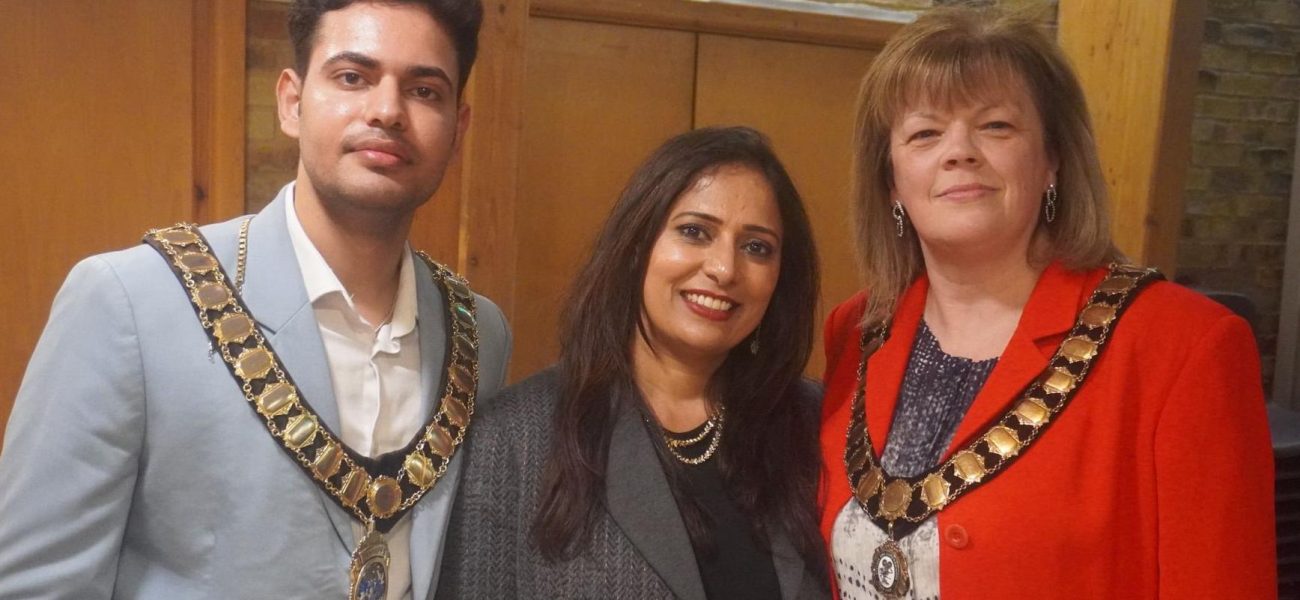
Beyond Borough Hall: A Mother’s Quiet Hand in UK’s Shifting Political Sands
POLICY WIRE — London, UK — One doesn’t usually look for the genesis of municipal power in the hum of a home kitchen, amidst the daily grind, but sometimes, that’s exactly where ambition...

POLICY WIRE — London, UK — One doesn’t usually look for the genesis of municipal power in the hum of a home kitchen, amidst the daily grind, but sometimes, that’s exactly where ambition gets its start. We’re often told about grand visions and impassioned speeches, but it’s the quiet nudges, the constant belief from the unheralded figures behind the scenes—the mothers, you might say—that often set the stage for something quite remarkable.
It’s no small feat, becoming mayor of a British council today, especially when you’re barely past your college years. And even less so when your background hails from the teeming subcontinent, a path not traditionally littered with civic pathways in Western democracies. The latest news, however, flips that script a bit: we’ve got a new, Indian-origin mayor in a UK borough, someone whose age alone would make headlines. He’s said to be the youngest. But that’s only half the story, maybe even less than that.
No, the more telling part of this particular ascendancy, and indeed, what makes it interesting, is the casual acknowledgment that a parent, his mother, had a pretty deep hand in shaping this particular political journey. One imagines the late-night talks, the constant push for academic excellence (a hallmark, let’s be frank, of many South Asian families across the diaspora), and perhaps even a gentle, or not-so-gentle, suggestion to enter public service. It’s a familiar refrain, isn’t it?
This individual, whose name is being celebrated in local circles, isn’t just an anomaly of age but a marker of evolving demographics within UK politics. He’s Indian-origin, which—when paired with his youth—speaks volumes about changing attitudes and expanding opportunities. He joins a growing cohort of elected officials whose roots stretch far beyond the white cliffs of Dover, reaching into bustling Indian cities, quiet Pakistani villages, and vibrant Bangladeshi communities. It’s a trend that quietly chips away at old narratives.
Political engagement, it turns out, is catching. We’ve seen these dynamics before, in cities from Toronto to New York, where immigrant populations, initially focused on economic stability, eventually turn their attention to political representation. This is that progression, unfolding right here, right now, in Britain.
It’s important to grasp that these individual stories don’t occur in a vacuum. They connect directly to larger transnational narratives of migration, integration, — and cultural fusion. Think about the quiet power wielded by Pakistani-origin figures in cities like London — and Birmingham, for instance. Or consider the increasing political sway of South Asian communities in Canada. This particular UK mayor is just another visible ripple. His success—and, crucially, the often-overlooked familial infrastructure supporting it—reflects a broad demographic shift that has been unfolding for decades.
The UK Census 2021 revealed that ethnic minority groups constitute 18.3% of the total population, an increase from 14.2% in 2011, underscoring this undeniable demographic momentum. (Source: Office for National Statistics). And those numbers, they don’t just stay on a spreadsheet; they trickle down into votes, into public office, and eventually, into shaping policy.
When asked about the genesis of his political aspirations, the newly minted mayor didn’t wax poetic about grand societal ideals or policy papers. He reportedly stated, quite simply, that his mother’s ‘hard work and inspiration’ was a defining factor, an influence that had been [QUOTE_PLACEHOLDER] throughout his upbringing. And that, frankly, speaks volumes about how influence actually functions, not through decrees from on high, but through persistent, personal investment.
📄 POLICY WIRE WHITEPAPER PUBLISHED: PAKISTAN'S NATIONAL SECURITY POLICY PRIORITIES
👉 READ BY CLICKING HEREIt isn’t just a British story, you see. It mirrors trajectories found across the world where diaspora communities flex their collective muscle, shaping politics both at home and in their adopted nations. From the American halls of Congress to Canada’s Parliament, or even within the economic sphere—like when discussing BRICS’s Shaky Foundation—the rise of figures from diverse backgrounds reshapes not only local landscapes but also global perceptions of influence.
This specific political journey reminds us that public service isn’t always sparked by textbook civics lessons. Sometimes, it’s ignited by the simple, unwavering belief of someone close. His achievement, however noteworthy, is a tiny window into the much larger and intricate workings of integration and power shifts.
What This Means
This mayoral election isn’t just a quirky feel-good story; it’s a solid indicator of where British political identity is headed, especially in urban centers. Economically, a more diverse political class tends to advocate for different priorities, potentially fostering policies that support small businesses run by immigrant families or addressing housing crises through new lenses. It’s not just about identity politics, though that’s part of it. It’s about representation leading to distinct economic strategies, perhaps even altering how local investment is targeted. Think about the sheer cultural wealth and entrepreneurial drive within South Asian communities—this newfound political voice could channel that into tangible policy outputs.
Geopolitically, while a local mayor won’t be setting foreign policy, the symbolic power of such an appointment resonates far beyond borough lines. It sends a clear signal to countries like India and Pakistan, bolstering their soft power narrative of successful diaspora. It suggests opportunity, social mobility, and integration that even Ravi Shastri’s Mic-Drop Moment couldn’t generate. For Muslim-majority nations observing the UK, the inclusion of non-white, non-Christian figures in power often signals a broader trend towards multiculturalism—even if that signal is, occasionally, more aspirational than fully realized. It shapes perceptions of the UK as a pluralistic society, — and in an interconnected world, that perception matters.
This isn’t an overnight phenomenon; it’s the culmination of decades of immigration — and civic engagement. It suggests a future where political success is less tied to traditional lineage and more to merit and demographic weight. You’ve got to wonder what other quiet influences are shaping the next generation of leaders—it’s likely more profound than most official biographies let on.