

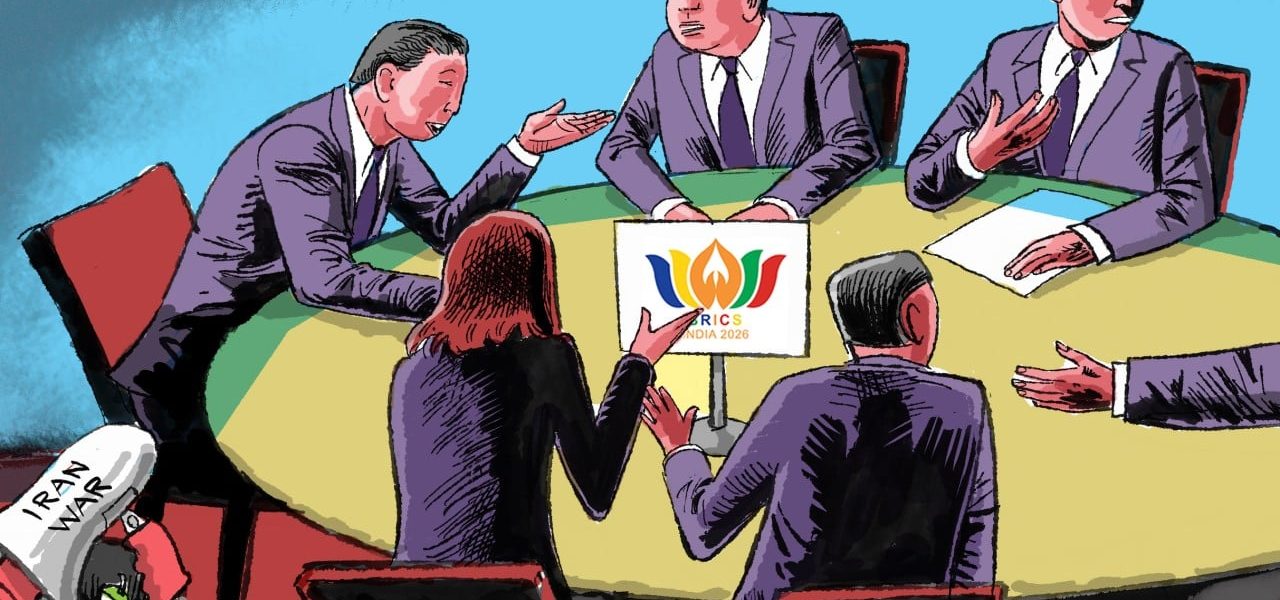
BRICS’s Shaky Foundation: When Bloc Members Point Missiles, Not Policy, at Each Other
POLICY WIRE — Geneva, Switzerland — Imagine inviting ten distinct individuals to a high-stakes poker game, only to discover two of them are already trying to kick each other under the...

POLICY WIRE — Geneva, Switzerland — Imagine inviting ten distinct individuals to a high-stakes poker game, only to discover two of them are already trying to kick each other under the table. That’s pretty much the BRICS playbook right now, as the war in the Middle East has entered its third month. You’d think a group styling itself as a counterweight to Western hegemony might, you know, have some semblance of accord. Instead, what we’re getting is a geopolitical pantomime where members often act more like adversaries than allies.
It’s not just an academic observation; this is messy, real-world stuff. The truth is, the so-called 10-member grouping isn’t held together by shared beliefs. Not really. It’s defined less by a clear set of common values and more by contingently overlapping interests
—a bureaucratic way of saying they’re an alliance of convenience, not conviction. They’ve joined the club for their own individual perks, and when push comes to shove, those individual interests invariably elbow out any notion of collective solidarity. And they can’t—absolutely cannot— speak with one voice on the conflict
racking the Middle East. It’s a cacophony, not a chorus, which, for a wire journalist like me, always makes for a better story, doesn’t it? [QUOTE_PLACEHOLDER]
Consider the glaring issue: Two Brics members, Iran and the United Arab Emirates (UAE), are at loggerheads.
It’s not just rhetorical sparring. Tehran has launched missile and drone
actions in the broader region, making diplomatic pleasantries, shall we say, a tad awkward for the bloc. This isn’t some abstract border skirmish. These are nations supposedly aligned in a new world order, yet they’re locked in their own strategic contests. It’s quite the paradox, wouldn’t you agree? How do you project global influence when your internal affairs are this volatile? For developing nations, particularly those in South Asia or the broader Muslim world, observing this internal dissonance must be, frankly, a bit disquieting.
Think about Pakistan, for instance, a nation constantly navigating intricate geopolitical currents—an Islamic republic with strong ties to both Saudi Arabia and Iran, also deeply invested in regional stability and economic partnerships, including those that might come via Russia or China. Its own geopolitical tightrope walk only becomes more treacherous when blocs ostensibly offering an alternative to the status quo demonstrate such profound internal division. The BRICS’s inability to present a united front means smaller, often more vulnerable, nations can’t lean on it for consistent, coherent policy—say, regarding economic sanctions or trade pathways. It becomes a loose affiliation, nothing more.
But there’s a stark reality here: Despite the diplomatic dance, the UAE, surprisingly, maintains robust economic links with Iran. According to data from the Islamic Republic of Iran Customs Administration (IRICA), bilateral trade between Iran and the UAE, excluding crude oil, reached over $22.7 billion in the Iranian fiscal year ending March 20, 2023. That’s a chunk of change, proof that even sworn regional rivals will keep their business channels open. But that also makes unified BRICS action, or even a unified statement, nigh impossible. Because when financial arteries are that intertwined, outright confrontation becomes financially devastating—a fact often overlooked in the diplomatic bluster.
And let’s not forget the sheer scale of the BRICS ambition. From an initial four, it swelled to five, then jumped to ten. It’s an unwieldy beast, covering continents — and cultures, economies rich in oil and those rich in labor. This diverse makeup means they’re not a monolithic entity. They can’t be. When you have Saudi Arabia—another new BRICS member—with its own historical rivalries and interests in play, you’re essentially aggregating regional fault lines under one expansive umbrella. It’s less a unified block — and more a large, occasionally volatile, committee. They aren’t trying to sing the same tune; they’re all conducting their own small, local symphonies, often clashing in key.
📄 POLICY WIRE WHITEPAPER PUBLISHED: PAKISTAN'S NATIONAL SECURITY POLICY PRIORITIES
👉 READ BY CLICKING HEREThen there’s the bigger picture—the ongoing conflict’s impact, and how it highlights an underlying reality that some seem keen to ignore. This isn’t a collective leadership; it’s a collection of leaders, each with their own complex agendas. You just don’t create a new global order by decree. It forms from consistent, aligned action, and right now, BRICS offers more inconsistent, misaligned inaction, or rather, multilateral individual action. We’re watching global dynamics shift, yes, but not always in the neatly packaged, ideological ways some think.
What This Means
The internal rifts within BRICS, particularly those highlighted by the current Mideast tensions, signal something significant for global politics: the romantic notion of a united South challenging Western dominance is, at best, premature, and at worst, a fantasy. The inability of BRICS members to forge a coherent position on a conflict as significant as the one in the Middle East cripples their ambition to act as a truly alternative power bloc. For smaller economies and nations reliant on a stable international framework, this BRICS fragmentation means they must continue to balance allegiances, rather than relying on a strong, unified voice to advocate for their collective interests.
Economically, it underscores that commercial ties often transcend political rivalries, providing a backchannel for continued engagement even amidst hostilities. But politically, it indicates that BRICS’s brutal dance of dominance will likely remain decentralized and self-serving rather than a cohesive effort. This absence of ideological unity—or even pragmatic policy unity—means that for countries like Pakistan, finding solid footing within a multipolar world isn’t getting any easier. You want consistency in international relations; what you’re often getting from BRICS is a lot of noise and individual posturing, especially when those individuals are pointing weapons at one another.