


Europe’s Eastern Edge: UK-Poland Pact Signals a Chilling Return to Cold War Logic
POLICY WIRE — London, UK — Forget the gentle diplomacy and the whispered negotiations; Europe, it seems, has decided to pull on its thickest overcoat for winter. And not just any winter, but one that...

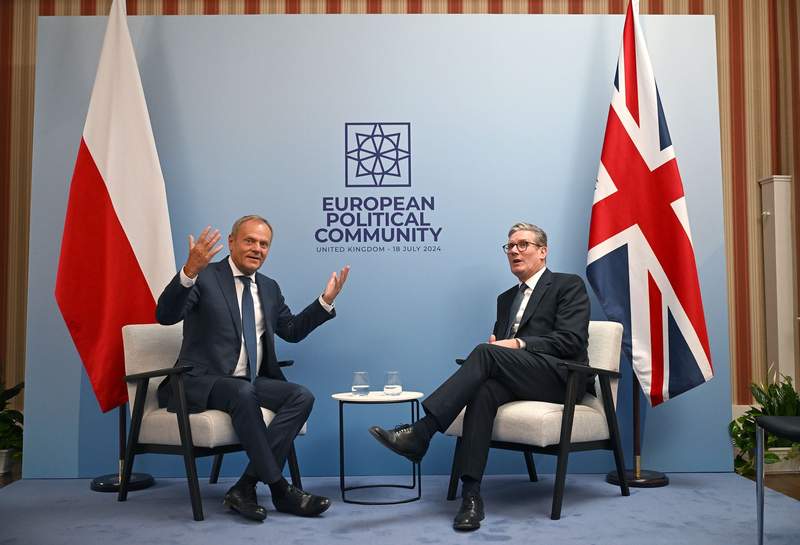
POLICY WIRE — London, UK — Forget the gentle diplomacy and the whispered negotiations; Europe, it seems, has decided to pull on its thickest overcoat for winter. And not just any winter, but one that feels increasingly like a chilling return to old battle lines. When Prime Minister Keir Starmer clasped hands with Polish counterpart Donald Tusk in London this week, it wasn’t just a photo op—it was a firm, even stark, reaffirmation of an Anglo-Polish security alliance. This isn’t just a treaty, folks; it’s a strategic embrace forged in the fires of eastern aggression, casting a long shadow across the continent, and beyond.
It’s all about solidarity, they say. About shared values. And, perhaps most honestly, about shared fears. Starmer’s Labour government, eager to project an image of global competence post-Brexit, is making a deliberate play here. They’re positioning Britain not as an island unto itself, but as an indispensable cornerstone in a rapidly hardening European defense architecture. A stark contrast, wouldn’t you say, to some of the UK’s more inward-looking phases? This newfound camaraderie with Warsaw serves multiple masters: reassuring Kyiv, warning Moscow, and subtly reminding Washington that Europe isn’t entirely a write-off.
Poland, bless its historically battered heart, doesn’t need much convincing. Living on Europe’s volatile eastern edge, they’ve seen empires rise — and fall, borders shift with terrifying frequency. So, when Tusk arrives, he comes not with hat in hand, but with an ironclad resolve. The planned security treaty, which I’m told is far more substantial than mere platitudes, focuses on joint military exercises, intelligence sharing, and bolstering defense industries. It’s practical stuff. Gritty stuff, even. Stuff you need when you’re watching geopolitical thunderstorms gather right outside your window.
Starmer, ever the careful orator, likely framed the pact in broad, sweeping terms. And he should. “Britain isn’t just a neighbor to Europe; we’re integral to its security architecture,” a senior Foreign Office official, briefed on the discussions, told Policy Wire. “This isn’t merely about signing a treaty; it’s about reasserting our shared defense and unequivocally showing adversaries that democracies don’t crumble, they consolidate.” Strong words, for sure, but then again, they’ve to be. Tusk, speaking earlier in the week in a remarkably blunt Warsaw press conference, didn’t pull any punches either. “The shadows on our eastern border demand more than rhetoric—they demand genuine commitment,” he declared, his voice firm. “Poland stands ready, and with partners like the UK, we’re building an impenetrable shield, because history, unfortunately, keeps echoing warnings.”
Because ultimately, these kinds of pacts aren’t just about tanks — and troops. They’re about signals. And this signal—loud and clear—is that the UK isn’t interested in retreating from European affairs. No, not anymore. This alliance cements what many foreign policy wonks have observed: a post-Brexit Britain still finding its global footing, choosing strategic partnerships over splendid isolation, especially with nations that share its deep-seated skepticism towards eastern adventurism. And frankly, this matters way beyond Europe. It’s all part of the shifting tectonics of global security. When European powers ramp up their defense alliances, it creates ripple effects across the globe. You see it in defense procurement, in intelligence priorities, even in the confidence (or lack thereof) displayed by countries balancing their own alliances from Ankara to Islamabad. For nations like Pakistan, navigating a complex geopolitical landscape with an eye on both regional threats and international aid, any major alliance realignment in Europe offers both challenges and opportunities, influencing everything from trade routes to counter-terrorism efforts.
Poland, feeling the geopolitical chill acutely, now commits over 3.9% of its GDP to defense, far exceeding NATO’s 2% target, according to recent figures from the Polish Ministry of National Defence. It’s a statistic that tells a story, doesn’t it? That narrative of an East European nation building serious muscle because it absolutely has to. The UK’s commitment, then, isn’t charity; it’s pragmatic self-interest, recognizing that Europe’s security is, at its core, Britain’s security. It’s a pragmatic return to some very uncomfortable geopolitical realities, realities that make partners in Asia’s quiet quiver feel a little less alone.
What This Means
This renewed alliance between London — and Warsaw has several layered implications, both politically and economically. Politically, it significantly reinforces the eastern flank of NATO, sending an unmistakable message to Russia about the resolve of European democracies. For the UK, it marks a confident—and some might say, aggressive—return to front-line European diplomacy, distancing itself from the previous government’s more insular post-Brexit stance. This is Starmer establishing a Labour stamp on foreign policy, proving Britain can be both independent and deeply interconnected. Internally for Poland, it provides a much-needed strategic ballast, allowing Tusk’s government to project strength and stability against internal political divisions, solidifying its place as a robust EU and NATO member, a bulwark on the very edge of geopolitical friction. But don’t misunderstand; while it’s a display of unity, it also underscores a growing divergence in European priorities, where some members are pushing for significantly increased defense integration, effectively accepting a semi-wartime footing.
Economically, the immediate impact will likely be seen in heightened defense industry collaboration. Both nations boast significant military manufacturing capabilities, and joint ventures in everything from cyber defense to ammunition production become much more probable. This translates into new contracts, potential job growth in specific sectors, and a strengthening of industrial ties that aren’t purely driven by EU membership. There’s also the broader economic stability angle: strong defense alliances are intended to deter conflict, and deterrence, messy as it can be, provides a foundational layer of security upon which trade and investment depend. Conversely, however, it points to a significant allocation of national resources towards military spending at a time when domestic budgets are already stretched—a choice with opportunity costs for public services and social welfare. This pact might not rewrite global trade overnight, but it certainly tweaks the geopolitical calculus for investors looking at Europe’s long-term stability and Britain’s redefined role within it. Ultimately, it means an Europe that’s perhaps safer, but undeniably, starkly more armed.