

Beyond Scarcity: Pakistan’s Existential Threat from Withheld Water
Pakistan, a nation born from rivers, now stands at the edge of a silent war, one waged not with missiles or tanks, but with dams, diversions, and withheld water. India, once a signatory to a historic...

Pakistan, a nation born from rivers, now stands at the edge of a silent war, one waged not with missiles or tanks, but with dams, diversions, and withheld water. India, once a signatory to a historic water-sharing agreement, is increasingly using rivers as tools of coercion. For over 240 million Pakistani citizens, this weaponization of water threatens their very existence, turning lifelines into frontlines.
The Indus Waters Treaty (IWT) of 1960 was once hailed as a diplomatic triumph, a beacon of cooperation in a hostile neighborhood. Under its terms, India received control over the eastern rivers (Ravi, Beas, Sutlej), while Pakistan was guaranteed the flow of the western rivers (Indus, Jhelum, Chenab). The treaty allowed Pakistan to build an economy rooted in agriculture and ensured peace on at least one front. But toduay, India’s repeated violations have made this treaty a battleground.
Pakistan, always acting in good faith, has abided by the treaty’s terms for over six decades. Even during times of war and political crisis, Islamabad respected the agreement. But India’s approach has grown increasingly aggressive, particularly since 2010. The construction of controversial hydroelectric projects like Kishanganga and Ratle, both on rivers allocated to Pakistan, threatens to choke the flow of vital water resources. These projects violate the spirit, if not the letter, of the treaty and India’s refusal to accept third-party arbitration is a blatant obstruction of justice.
The shift in Indian policy is not coincidental. In 2019, Indian Prime Minister Narendra Modi made a dangerous and provocative statement: “blood and water cannot flow together.” Since then, India has fast-tracked dam constructions in occupied Jammu and Kashmir, a disputed territory whose natural resources should not be unilaterally exploited. This isn’t development, it’s domination.
Pakistan’s water crisis is already severe. According to the International Monetary Fund (IMF), Pakistan is among the most water-stressed countries on earth. Per capita water availability has plummeted from 5,260 cubic meters in 1951 to under 1,000 cubic meters today. The United Nations has warned that the country could face absolute water scarcity as early as 2025. These are not just numbers, they represent the daily suffering of millions of Pakistanis.
Agriculture, the backbone of Pakistan’s economy, is under direct threat. The country depends on its rivers to irrigate 80% of its farmland and support the livelihoods of more than 40% of its workforce. In Sindh and southern Punjab, farmers now witness their crops wither and livestock die as canals dry up. Tube wells, once a solution, are now tapping deeper into depleted aquifers, yielding water laced with toxins.
Cities fare no better. Urban centers like Lahore and Karachi, already grappling with overpopulation, now face an additional crisis, water scarcity. Hospitals report rising cases of waterborne diseases, infant mortality, and malnutrition, particularly in marginalized communities. The root cause? Rivers that no longer reach their natural destinations, controlled upstream by a hostile neighbor.
📄 POLICY WIRE WHITEPAPER PUBLISHED: PAKISTAN'S NATIONAL SECURITY POLICY PRIORITIES
👉 READ BY CLICKING HEREIndia’s actions are not merely environmental missteps. They are deliberate moves in a wider strategy to apply political and economic pressure on Pakistan without direct confrontation. This is water terrorism a term not used lightly. By manipulating river flows, India threatens Pakistan’s food security, economic stability, and public health, all while avoiding the global scrutiny that would accompany military aggression.
It is worth remembering that Kashmir, the region where many of these dams are being built, remains a disputed territory under international law. India’s construction of mega-projects in this region is not only a violation of water-sharing agreements but also of the rights of the Kashmiri people and Pakistan’s sovereign claims. These are not just engineering feat, they are instruments of occupation.
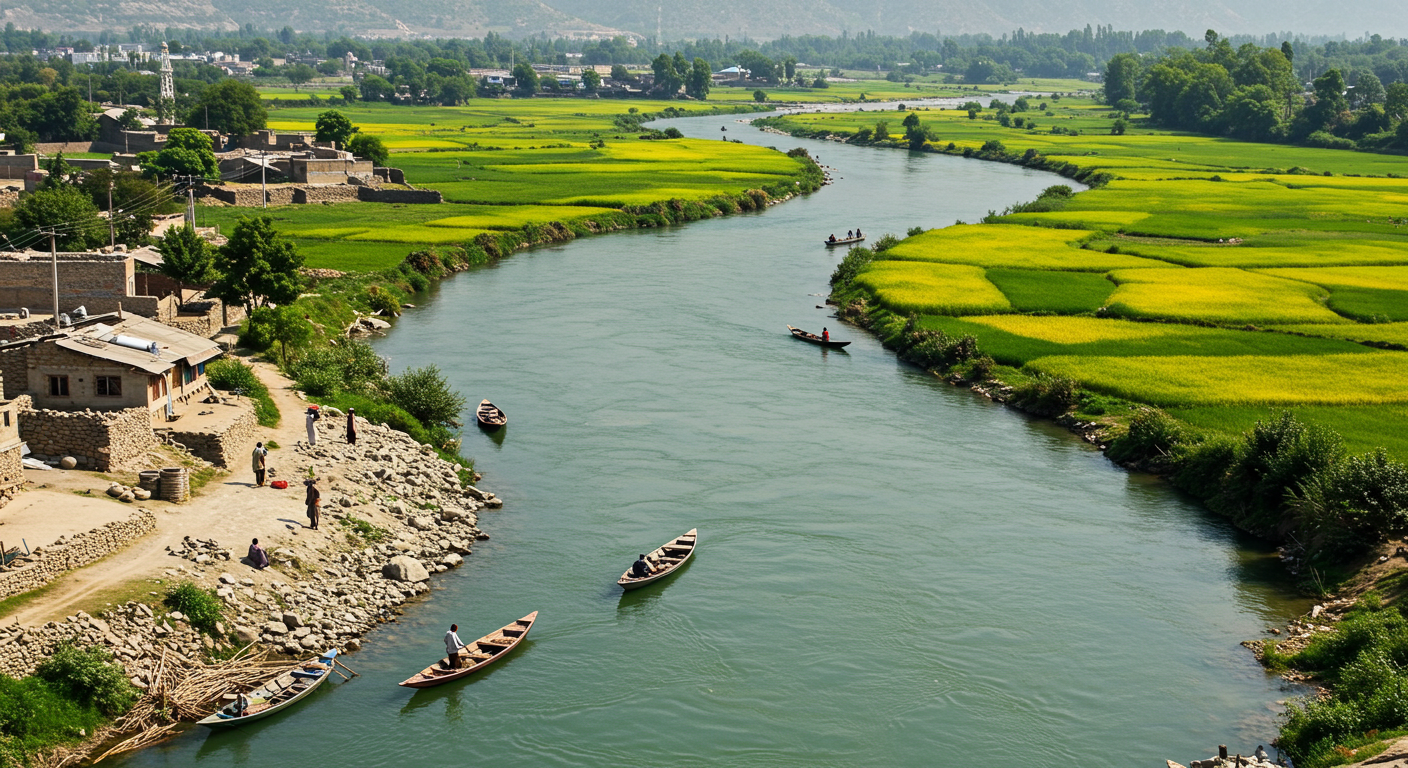
Despite the provocations, Pakistan has continued to seek justice through peaceful and diplomatic channels. It has raised concerns at the World Bank, approached the Permanent Court of Arbitration, and called for adherence to international water laws like the UN Convention on the Non-Navigational Uses of International Watercourses. Yet the international community remains largely passive, ignoring the fact that water, not nuclear weapons, could be the flashpoint for the next South Asian war.
Pakistan’s stance is rooted in justice, sustainability, and human dignity. We do not seek conflict, but we cannot remain silent as our rivers are strangled. For our farmers, our children, and future generations, we must speak out. This is not merely a bilateral issue—it is a matter of global human rights, climate justice, and regional peace.
The world must awaken to this unfolding crisis. It must call on India to return to the principles of cooperation, fairness, and legality. Water is a right, not a weapon. Rivers must remain sources of life, not instruments of siege.
If this silent war continues, the cost will not be borne by politicians or powerbrokers, it will be paid by the people of Pakistan, in parched fields, empty taps, and broken futures. The world cannot claim ignorance when the rivers of South Asia run dry, not from drought, but from deliberate design.
Author