


The Ghost of Goals Past: Putellas Exits Barcelona, But Her Revolution Lingers
POLICY WIRE — Barcelona, Spain — It wasn’t just a contract running out; it was an epoch. A mere detail on paper says Alexia Putellas is departing Barcelona, but that reduction misses the point...

POLICY WIRE — Barcelona, Spain — It wasn’t just a contract running out; it was an epoch. A mere detail on paper says Alexia Putellas is departing Barcelona, but that reduction misses the point entirely. This isn’t simply the transfer news of a football star, but rather the quiet closing of a volume in an accelerating societal shift—one written by a woman who, just a couple of decades ago, would have been an anomaly, maybe even an impossibility.
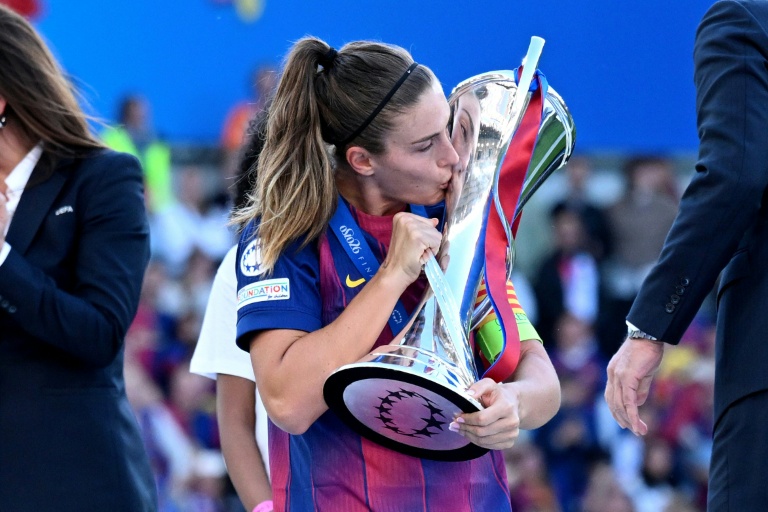
Putellas, the two-time Ballon d’Or winner, hasn’t just kicked balls around a pitch; she’s kicked open doors. Big, heavy ones. Her departure from the Catalan giants, confirmed Tuesday after 14 seasons of staggering play, signals the end of a narrative she herself called a “perfect story.” And what a story it’s been. From a sport largely unseen — and certainly underappreciated, she helped forge an empire. Her latest trophy, a fourth Champions League title clinched just recently against Lyon in Oslo, wrapped a quadruple that many male teams could only fantasize about.
She’s 32 now, — and by her own reckoning, it was time. As she articulated in an Instagram video, there’s an integrity to knowing when to step back: [QUOTE_PLACEHOLDER] But what she gave wasn’t just physical exertion. It was presence. It was validation. She offered up a blueprint for ambition and achievement for a generation of girls and women worldwide—even in places where sports for women remain an uphill, often unforgiving, battle.
Talk around the European circuits hints at a possible move to London City Lionesses, a club connected to Michele Kang, the owner of Lyon. A sensible progression, perhaps, for someone whose name alone carries heft. Her final home game as a Barca player against Real Sociedad on Wednesday in Liga F isn’t just a fixture; it’s a public reckoning with the end of an era. [QUOTE_PLACEHOLDER] Putellas noted, reflecting on a career defined by an unwavering loyalty — and success.
And loyalty’s a powerful thing. [QUOTE_PLACEHOLDER] But, she assures us, her connection runs deeper than a player’s contract. “But luckily, I was born a cule and I will die a cule. So we’ll see each other again.”
Her legacy extends beyond the dozens of trophies—ten Spanish top-flight titles, four Champions League medals. It’s in the sheer disbelief of her own success story. She remembers a time, back when she was just six, when [QUOTE_PLACEHOLDER] That figure isn’t just an attendance record; it’s a profound cultural shift made tangible by raw, roaring emotion. Because, as she reminds us, [QUOTE_PLACEHOLDER] It’s true. It simply wasn’t a job you could have, and now it’s—a lucrative, highly visible one.
📄 POLICY WIRE WHITEPAPER PUBLISHED: PAKISTAN'S NATIONAL SECURITY POLICY PRIORITIES
👉 READ BY CLICKING HEREThat kind of transformation, kickstarted by pioneers like Putellas, sends ripples far beyond Catalonia. Consider nations in South Asia, where societal pressures — and traditional roles often confine women’s athletic pursuits. While women’s football might not fill stadiums with the same ferocity in Karachi or Dhaka as it does in Barcelona, Putellas’s journey acts as a silent but undeniable argument for unlocking human potential. The global surge in women’s sports, fueled by talent and sheer grit, makes it increasingly harder to ignore the economic and cultural upside of empowering female athletes—even in regions slower to adapt. The cold calculus of commerce often follows inspiration, even if it’s decades behind.
Putellas’s absence leaves a void, certainly. Barcelona’s squad sees other departures, with Mapi Leon, Ona Batlle, — and Marta Torrejon expected to exit too. But her individual contribution, the shattering of expectations for what a woman footballer could achieve and represent, won’t be leaving the collective memory anytime soon. It’s just not how legends work.
What This Means
The retirement of a sports icon like Alexia Putellas is never just about a player hanging up her boots; it’s a bellwether for larger societal and economic currents. For Barcelona, it’s a talent drain that could destabilize their immediate dominance, forcing a significant rebuild even as the women’s game consolidates its global footprint. Economically, the valuation of women’s football—from broadcast rights to sponsorship deals—continues its aggressive ascent. The spectacle Putellas provided, her very existence as a marketable global star, draws eyes — and money. Her departure might, in the short term, dent a club’s brand value, but it opens avenues for new talent to capture the spotlight, keeping the engine of women’s sports monetization humming. And, this is crucial: it shows the churn, the evolution. It’s no longer just a hobby; it’s an industry with player movement, negotiations, and the same career arc considerations as its male counterpart.
Politically and culturally, Putellas’s trajectory, moving from an unrecognized pursuit to packing out Camp Nou with [QUOTE_PLACEHOLDER] provides undeniable proof of concept. For nations grappling with gender inequality in sports, particularly across parts of the Muslim world or South Asia, her story isn’t just a curiosity; it’s a powerful case study. It’s evidence that investing in women’s sports—or at the very least, allowing it to flourish—can yield incredible returns, both in soft power and economic opportunity. It becomes harder to deny the demand, the enthusiasm, the sheer aspirational pull. Putellas has inadvertently contributed to a global conversation on female empowerment through her athletic prowess—a dialogue that echoes wherever the game is watched. It doesn’t mean immediate policy shifts in Islamabad or Jakarta, but it certainly strengthens the hand of local advocates pushing for similar freedoms and funding for women’s sports. The tide, for better or worse, continues to rise.