


Foul Play or Fair Game? The Crucible of Legacy in NBA’s Public Court
POLICY WIRE — Cleveland, USA — It’s a particularly cruel rite of passage in professional sports, one played out not just on polished hardwood but across the unforgiving expanse of digital...

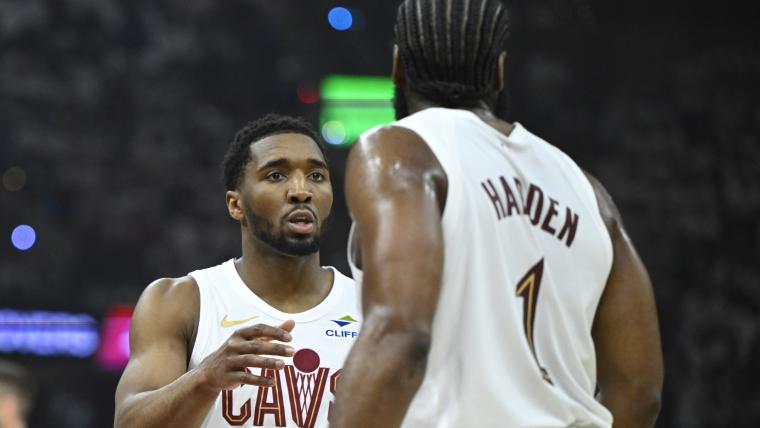
POLICY WIRE — Cleveland, USA — It’s a particularly cruel rite of passage in professional sports, one played out not just on polished hardwood but across the unforgiving expanse of digital headlines: the post-elimination post-mortem. The body’s still warm, so to speak, yet the vultures are already circling, picking apart every perceived misstep, every unfulfilled expectation. For the Cleveland Cavaliers, dispatched summarily from the 2026 NBA Playoffs, the cold dissection began instantly. And it’s James Harden, the perennial target, who found himself once again pinned to the slab. But Donovan Mitchell, his backcourt running mate, just wasn’t having it.
Because the public’s memory is notoriously short, the nuances of a mid-season acquisition — the frantic attempt to build chemistry on the fly, the desperate dash towards contention — often get conveniently swept under the rug. Harden, after all, joined Cleveland midway through the 2025-26 season, a bold gamble meant to propel a promising team into the upper echelon of the Eastern Conference. And for a spell, it kinda worked. They clawed through some tough early rounds, a testament to Mitchell and Harden forming a surprisingly potent offensive engine, navigating past the Toronto Raptors and Detroit Pistons in what were far from walk-overs.
But the New York Knicks, it turns out, weren’t Toronto. Or Detroit. The Cavaliers found themselves in a bind, struggling to keep pace, eventually succumbing to a 4-0 sweep. Four games, gone. No chance to course correct. No saving face. The silence after Game 4 was deafening, the frustration palpable. And naturally, as is the cyclical nature of celebrity and scrutiny, the focus narrowed, often unjustly, onto the most polarizing figure.
Mitchell, who’d arguably been Cleveland’s main offensive catalyst through the series, albeit in a losing effort that will likely be forgotten faster than last season’s trade deadline rumors, understood the dynamics at play. But he also understood something deeper. He stepped up at the post-game press conference, a scene usually reserved for terse regrets and mumbled promises, and fired a salvo directly at the heart of the sports media beast.
“I think y’all ignore his greatness in a major way,” Mitchell declared, his voice tight with a mix of loyalty and exasperation. “This man changed the game of basketball in ways we’ve never seen before. We live in such a ring-dominant culture that we write guys off. It’s truly unfair.” It was less a defense of Harden’s recent performance – which, granted, wasn’t spectacular – and more a scathing critique of the collective tendency to boil down a storied career to a single, gleaming piece of jewelry, or its absence. This relentless focus on ultimate team success above individual contribution can feel incredibly reductionist.
And Mitchell’s sentiment resonates far beyond the North American sports landscape. Think of the intense national scrutiny faced by cricket legends in Pakistan, where an entire nation’s mood can hinge on a single match outcome, or the pressure on athletes across the Muslim world. The reverence, — and conversely, the sharp public criticism, for those carrying the hopes of millions can be staggering. Their careers become parables, scrutinized for perceived failings, their legacies endlessly debated through the lens of a single, collective triumph – or failure.
📄 POLICY WIRE WHITEPAPER PUBLISHED: PAKISTAN'S NATIONAL SECURITY POLICY PRIORITIES
👉 READ BY CLICKING HEREIndeed, the business of professional sports is brutal. While players like Harden represent monumental financial investments for franchises — his contract, for instance, averages upwards of $40 million annually over its term — their personal legacies remain firmly in the public’s fickle hands. “You can’t ignore a decade of dominance just because of a few rough weeks, you just can’t,” quipped Leon Rose, the Knicks’ President of Basketball Operations, when pressed on the prevailing narrative after his team’s triumph. A subtle nod, perhaps, to the broader implications of such high-stakes drama.
For the Cavaliers, it’s back to the drawing board, a summer of self-assessment — and personnel tweaks. The journey from playoff contention to champion is a grinder, something their conquerors, the Knicks, learned over several arduous seasons. Mitchell’s rallying cry about sticking together and working hard is standard locker room fare, but the underlying challenge remains: convincing a ‘ring-dominant culture’ that collective effort and individual brilliance can coexist, even in defeat. The question lingers: does anyone remember the arduous climb if you stumble at the summit?
What This Means
The post-playoff fallout for the Cavaliers highlights more than just athletic performance; it exposes the brutal economic and political realities of modern sports. Franchises invest colossal sums into individual players, not just for their on-court skills, but for their marketability, their ability to draw eyeballs and fill arenas. When a star fails to deliver ultimate success, the return on that investment, at least in terms of public goodwill and long-term narrative, is called into question. It becomes a policy parable, a lesson in public relations — and brand management as much as basketball.
For players, this dynamic means their professional identity becomes intertwined with abstract concepts of ‘greatness’ largely defined by external, often commercial, metrics. Mitchell’s impassioned plea wasn’t just for Harden; it was a broader pushback against a system that swiftly commodifies and discards narratives. The swiftness with which a player’s perceived value can plummet after a playoff exit directly impacts future contract negotiations, endorsements, and ultimately, a team’s financial calculus. It speaks to a sports-industrial complex where ‘what have you done lately’ overshadows historical impact, forcing teams and individual athletes to navigate an ever-shifting sea of public opinion and media-driven narratives. This creates a challenging environment for team strategists and PR experts alike, especially when facing something as definitive as a “Cavalier Catastrophe.”