

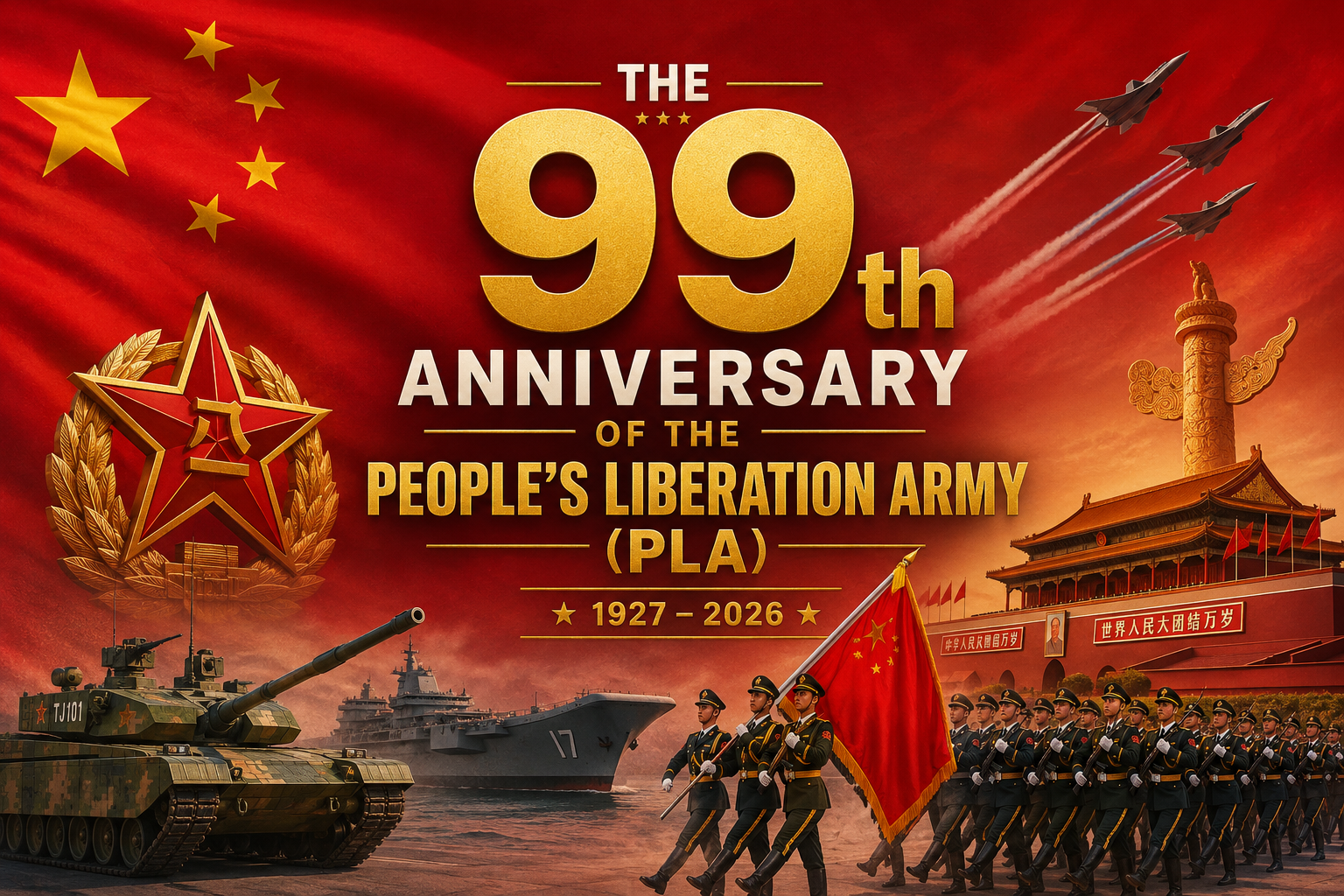
The 99th Anniversary of the PLA
Every anniversary of the People’s Liberation Army invites the world to measure how far Chinese military power has travelled since its founding, and this year that measurement carries an...

Every anniversary of the People’s Liberation Army invites the world to measure how far Chinese military power has travelled since its founding, and this year that measurement carries an unusually literal weight. On August 1, the PLA turns 99, a milestone that sits one year short of the modernization deadline President Xi Jinping has set for the force. For most capitals, the date is simply a foreign observance. For Islamabad and Rawalpindi, it reads as something closer to a family occasion, because the story of the PLA’s rise is, in a very real sense, the story of Pakistan’s own defense.
That rise began under conditions few modern militaries have had to endure. China entered the missile age with a fledgling industrial base and almost no outside support to draw on, yet Chinese engineers pressed forward regardless, and within a single generation they produced results that startled the world: a working atomic bomb in October 1964, a nuclear-armed ballistic missile two years after that, and a hydrogen bomb by 1967. The Dongfeng missile family born of that effort, running from the short-range DF-1 through the intercontinental DF-5 tested in 1980, became the foundation of a fully indigenous strategic arsenal. China built self-reliance, and out of self-reliance, deterrence. That founding instinct still runs through the PLA’s modernization today, as the force pushes further into jointness, cyber operations, artificial intelligence, and space capability in pursuit of Xi’s 2027 target.
For Pakistan, the PLA’s evolution has never been a distant curiosity, and the past year turned that closeness into hard evidence on the battlefield. During the four-day clash that followed India’s Operation Sindoor in May 2025, Pakistan Air Force pilots flew J-10C fighters armed with PL-15 missiles against the Indian air fleet and prevailed remarkably. At an official news briefing, the Director General of Inter-Services Public Relations, Lieutenant General Ahmed Sharif, confirmed that Pakistan’s forces had shot down five Indian Air Force jets, including three French-made Rafales, and said the aircraft were engaged from within Pakistani airspace in retaliation for India’s earlier strikes. Islamabad’s account has since found support beyond its own statements: Reuters cited US officials confirming that a Pakistani jet downed at least two Indian aircraft with a PL-15 fired from roughly 200 kilometres, France’s own air chief and a Dassault executive separately acknowledged a Rafale loss, and India’s own military chief eventually admitted an unspecified number of aircraft losses; by January 2026, Beijing had officially confirmed the J-10CE’s first combat victory. What twenty years of skeptics had called an unproven, budget alternative to Western hardware settled the argument in a single engagement.
That single night sits atop a far older and broader foundation of cooperation, one that runs well beyond any single jet or missile. The clearest example is the JF-17 Thunder, developed jointly since the 1990s by the Pakistan Aeronautical Complex at Kamra and China’s Chengdu Aircraft Corporation under the name “Joint Fighter-17.” Pakistan holds a 58 percent work share in the aircraft’s airframe production, assembling the front fuselage, wings, and vertical stabiliser at Kamra, and has now produced more than 200 of the jets across three evolving Blocks, the latest fitted with an AESA radar and electronic-warfare systems. The programme has grown into an export success story in its own right, with governments beyond Pakistan now exploring the aircraft as an affordable, combat-proven option.
The partnership runs just as deep beneath the waves. Pakistan’s navy commissioned its first Chinese-built Hangor-class submarine in April 2026, the initial delivery under a 2015 agreement for eight boats, four to be built in China and four assembled in Pakistan with a transfer of technology to Karachi Shipyard & Engineering Works. Those submarines join four Tughril-class frigates, based on China’s Type 054A design, that Pakistan’s naval chief has called among the most advanced surface combatants in the fleet, credited with strengthening the navy’s air defence, anti-submarine warfare, and maritime surveillance reach across the Arabian Sea. Beyond hardware, the two countries have layered in the China-Pakistan Economic Corridor, a flagship of the Belt and Road Initiative that has drawn the two militaries into cooperation on infrastructure and maritime-route security, reinforcing a relationship that already spans joint training, officer exchanges, and defence-industrial collaboration.
None of this rests on a handful of headline deals. SIPRI’s 2025 data show Pakistan’s arms imports rising 66 percent between 2021 and 2025, making it the world’s fifth-largest importer, with China supplying roughly 80 percent of the total, while a Pentagon report confirmed China delivered 36 J-10Cs to Pakistan since 2020, with the full fleet operational by early 2026. The two militaries reinforce that industrial bond with a steady calendar of joint exercises, the Warrior series for their armies, Sea Guardians for their navies, and Shaheen for their air forces, with the ninth Warrior exercise held at Pabbi from late November into December 2025. In May 2026, both defence ministries recommitted to deepening this cooperation under what Beijing describes as an iron-clad friendship, a bond resting on decades of accumulated trust rather than a single signed pact.
Pakistan’s battlefield performance has, in turn, become China’s most persuasive advertisement. AVIC Chengdu’s 2025 revenue reached roughly 11 billion dollars, up nearly 16 percent, and first-quarter 2026 sales climbed close to 80 percent. Indonesia is moving toward acquiring more than 40 J-10Cs in a deal valued above 9 billion dollars, while interest from Iraq and Bangladesh continues to grow. An AVIC Chengdu engineer summarized the record plainly in a May 2026 state media interview, describing multiple kills and zero losses, and acknowledging that Chinese specialists had supported Pakistan throughout the conflict.
As the PLA marks its 99th year and looks toward its 2027 centenary, the message for the region is unambiguous: a more modern PLA translates directly into a more capable partner for Pakistan, and a partnership that has already reshaped the skies over South Asia shows every sign of only deepening from here.
Author