


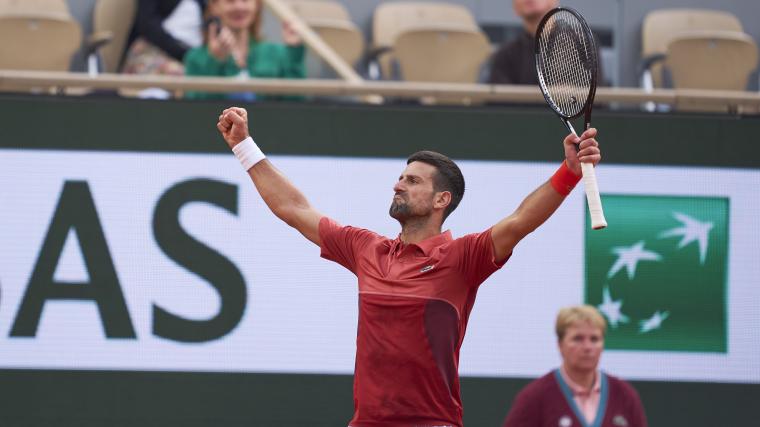
Clay’s Last Stand? Djokovic’s Roland-Garros Gambit Ignites Whispers of an Empire’s Sunset
POLICY WIRE — Paris, France — The crimson dust of Roland-Garros tells a thousand stories, but few resonate with the quiet, unsettling hum of a fading empire quite like the saga of Novak Djokovic....

POLICY WIRE — Paris, France — The crimson dust of Roland-Garros tells a thousand stories, but few resonate with the quiet, unsettling hum of a fading empire quite like the saga of Novak Djokovic. Forget the pristine white flannels of Wimbledon or the brash energy of the US Open; here, on the brutally unforgiving clay, the Serbian maestro—an athlete who’s bent the sport to his will for a decade and a half—isn’t merely fighting opponents. No, he’s in a bruising, bare-knuckled brawl with Father Time himself.
It’s an inconvenient truth for a man synonymous with relentless victory. The twenty-four major singles titles he’s collected over his career—a statistical Everest few will ever even gaze upon, much less conquer—stand as monuments to an almost extraterrestrial endurance. But even titans aren’t exempt from biology’s merciless hand. Lately, we’ve watched him. His once-impervious body, that finely tuned machine, has started to stutter. A lingering shoulder issue, bad enough to pull him from high-profile contests in Miami, Monte Carlo, and Madrid, isn’t just an injury; it’s a public, undeniable fissure in the armor of a legend. And now, he’s back on clay—a surface that demands Herculean physical and mental stamina, punishing every flaw, every lapse, every ache.
“One can only marvel at the sheer will it takes for an athlete of his stature to continue,” observed Madame Amélie Mauresmo, tournament director for the French Open, from her usually unruffled perch. “His legacy isn’t just in the trophies, it’s in the sheer longevity. But the draw, the new generation… they don’t respect old gods, do they?”
He’s 38 now, an age where most have traded sweatbands for executive boardrooms or commentator booths. But Djokovic persists. His first-round scrap against Giovanni Mpetshi Perricard—a four-set grind, 5-7, 7-5, 6-1, 6-4—was less a declaration of dominance and more a cautionary tale. A narrow escape, really, against a big-serving young gun who likely saw an opportunity, a scent of vulnerability in the king. The next challenger, Valentin Royer, waits. But so does Jannik Sinner, lurking on the other side of the draw, a rapidly ascending star with youth, speed, and ambition on his side.
Because, make no mistake, this isn’t just a sporting event; it’s a multi-million-dollar industry. The narratives of triumph and potential fall carry weight, influencing everything from sponsorship deals to television ratings across the globe. Sports, particularly at this elite level, is as much about the human drama as it’s about forehands — and backhands. His presence alone draws massive audiences, not just in Europe or North America, but across populous markets. Pakistan, for instance, a nation often captivated by the prowess of individual athletes who transcend their sport—be it cricket or a global tennis phenomenon like Djokovic—contributes significantly to the global viewership metrics. The International Tennis Federation (ITF) noted in a recent market report that broadcasts of Grand Slams registered a viewership spike of approximately 18% in the South Asia region during matches featuring top-ranked players over the last five years, solidifying the economic and cultural impact of these athletes beyond traditional tennis markets. That’s serious business. Even with the mounting struggles, his name still moves needles.
📄 POLICY WIRE WHITEPAPER PUBLISHED: PAKISTAN'S NATIONAL SECURITY POLICY PRIORITIES
👉 READ BY CLICKING HEREMr. Miroslav Popović, Deputy Minister for Sport in Serbia, wasn’t pulling punches on state television this week. “Novak is not merely an athlete; he’s a walking, breathing symbol of our nation’s fighting spirit,” Popović declared, his voice firm. “But one cannot ignore the physical toll. The world changes, — and even the greatest must sometimes yield to the natural order. We expect excellence, but we understand the cost.” It’s a statement loaded with cautious hope and, perhaps, a hint of resignation.
But can he truly win his fourth title at Roland-Garros this year? It’s a question less about skill now and more about sheer grit—or perhaps, stubborn refusal to yield. And in a landscape increasingly populated by younger, faster gladiators, that refusal might not be enough.
What This Means
This isn’t just about whether a tennis star wins another trophy; it’s a live-action study in legacy management and the merciless economics of aging in professional sports. For France and the tournament organizers, Djokovic’s continued participation—even a hobbled one—remains a significant commercial boon, guaranteeing eyeballs and prestige. His battles, perceived or real, feed into a larger, more dramatic narrative, keeping global interest piqued. But the increasing frequency of his withdrawals and physical struggles hints at a coming transition phase for the sport, a post-Djokovic era that’s closer than anyone cares to admit. The industry’s challenge won’t just be finding new champions; it’ll be maintaining that same global appeal, that unique mix of dominance and drama he so perfectly embodies.
Economically, sponsors begin a quiet re-evaluation. A dominant, healthy Djokovic is one thing; an ailing, intermittently present one is another. The strategic masterclass required to maintain relevance in competitive arenas isn’t limited to the court; it extends into marketing departments. For Serbia, the implications are more subtle: a national hero transitioning from the battlefield inevitably prompts introspection about future sources of soft power and national pride. The ‘next great hope’ always exists, but a successor to a legend of Djokovic’s magnitude—one who transcends sport into global statesmanship—is incredibly hard to find. His decline, if this indeed marks its acceleration, forces a hard look at where the narratives of dominance come from next. It’s a story playing out on red clay, but with repercussions far beyond the baseline.
📖 GET YOUR FREE COPY NOW OF POLICY WIRE DIGITAL MAGAZINE JULY 2026 EDITION
👉 READ & DOWNLOAD FREE MAGAZINE