


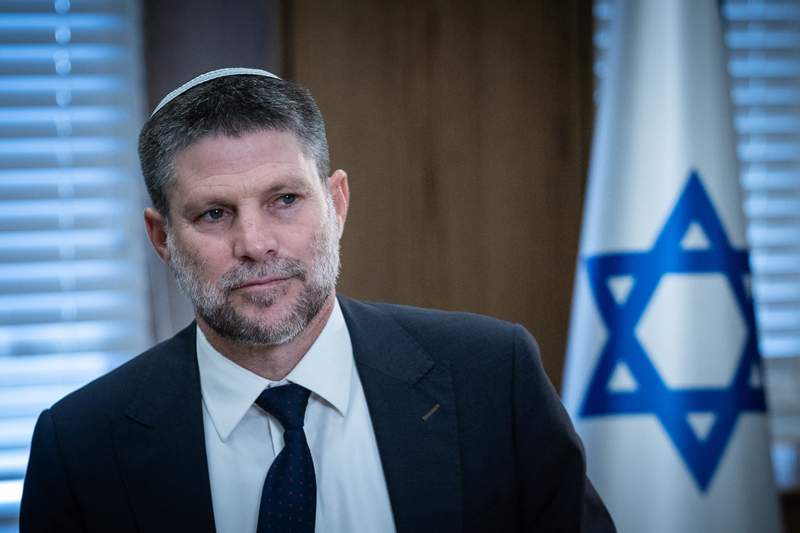
ICC’s Unseen Salvo: Why Smotrich’s Shadow Looms Larger Than Netanyahu’s in the Hague’s Gaze
POLICY WIRE — The Hague, Netherlands — The legal machinery of the International Criminal Court, never one to rush its judgments, has recently rumbled to life with a quiet yet profoundly unsettling...

POLICY WIRE — The Hague, Netherlands — The legal machinery of the International Criminal Court, never one to rush its judgments, has recently rumbled to life with a quiet yet profoundly unsettling resonance. While global headlines fixate on the possible indictment of Benjamin Netanyahu, Israel’s long-serving prime minister, a subtler, arguably more seismic development is unfolding just beyond the public’s immediate attention: the potential targeting of Bezalel Smotrich, Israel’s far-right finance minister.
It’s an overlooked distinction, sure, but a weighty one. See, if the prosecutor’s lens swings heavily toward Smotrich, it isn’t just about the current conflict, or specific military operations—it’s about something far more embedded, far more foundational to the ongoing Israeli-Palestinian impasse. This isn’t just about allegations of wartime conduct; it’s about the very architecture of occupation, the legal scaffolding, and the long-term demographic ambitions that have reshaped the West Bank over decades. And that’s where the true geopolitical quake lies.
Smotrich, a vocal proponent of Israeli sovereignty over Judea and Samaria (the West Bank, in international parlance), and a former leader of the ultranationalist Religious Zionism party, represents the unapologetic ideological vanguard of the settlement movement. His potential inclusion in any ICC investigation doesn’t simply broadside Israel’s current wartime leadership; it challenges a political and demographic project decades in the making. But it’s not an accident; this focus suggests a broadening of scope, an institutional recognition of alleged offenses that transcend the immediate brutal exigencies of battle.
Consider the official stance: “They can scribble on paper all they want. We answer to no foreign court for our biblical land, nor for defending our people against terrorists,” Smotrich once defiantly declared in a radio interview, reflecting his long-held dismissal of international legal bodies. That’s his consistent position—an unshakeable rejection of external judicial oversight. His perspective, shared by many on Israel’s religious-nationalist right, views such proceedings as purely political theater, divorced from any legitimate jurisdiction or moral authority.
And yet, the court presses on. Its investigations rarely proceed without extensive, laborious evidence gathering. Targeting an ideologue-statesman like Smotrich isn’t just about what he’s said; it’s about policies implemented, resources allocated, and direct orders given that materially alter the ground, quite literally. This could well touch on the forced displacement of Palestinians, the systematic dismantling of their economy, and the expansion of Israeli settlements, which international law largely considers illegal.
For nations in the Global South, especially those in the Muslim world, like Pakistan, this distinction might offer a fleeting—perhaps even cynical—glimmer of hope for more even-handed justice. While deeply critical of perceived Western bias and historical impunity regarding Israeli actions, a focus on settlement architects could resonate differently than previous ICC engagements. It highlights not just kinetic conflict but the quieter, grinding reality of everyday life under prolonged occupation, something that Pakistan and its neighbors observe with intense scrutiny, particularly given regional humanitarian crises—think the plight of Pakistanis caught in Gulf geopolitics, often perceived as invisible to global legal institutions.
📄 POLICY WIRE WHITEPAPER PUBLISHED: PAKISTAN'S NATIONAL SECURITY POLICY PRIORITIES
👉 READ BY CLICKING HEREAccording to UN figures, a striking 475,000 Israeli settlers currently reside in the West Bank, a population that has consistently grown since the 1967 war, often supported by governmental policies Smotrich champions. This isn’t abstract; it’s concrete expansion, one building, one bypass road, one outpost at a time. The legal community sees this. “This move signals an intent to hold political figures accountable for the structural apparatus of occupation, not just military commanders for battlefield actions,” notes Dr. Layla Hassan, an international law expert at Cairo University. “It’s a distinct, perhaps more consequential, front.”
Because ultimately, while the images of war dominate, the slow-motion annexation by settlement expansion fundamentally alters the landscape, making any two-state solution a theoretical construct rather than a practical pathway. And that, folks, is the real long game.
What This Means
If the ICC moves forward with charges against Bezalel Smotrich, it isn’t just a headache for Israel; it’s a profound strategic blow to the legitimacy of the entire settlement enterprise. It complicates things. Hard. Unlike a prime minister, whose legal woes might be framed as politically motivated attacks on a wartime leader, Smotrich’s ideological bedrock means any indictment would be seen as a direct challenge to the very idea of Israeli presence in the West Bank as something other than an occupation, as something sanctioned by national-religious principles.
Economically, it could deter foreign investment in West Bank projects, complicate financial transactions with institutions that deal with settlers, and force tougher scrutiny from international banks. Politically, it deepens Israel’s isolation among countries that recognize the ICC’s authority and adhere to international law. But there’s also the internal ripple effect: it galvanizes Smotrich’s base, who will undoubtedly double down on their convictions, seeing the ICC as further proof of an anti-Israel global conspiracy. They’re not going to roll over; they’ll dig in deeper. It’s a high-stakes chess match where the pieces aren’t just generals and politicians, but entire ideological frameworks and territorial aspirations.
📖 GET YOUR FREE COPY NOW OF POLICY WIRE DIGITAL MAGAZINE JULY 2026 EDITION
👉 READ & DOWNLOAD FREE MAGAZINE