


Beyond the Sidelines: NFL’s Enduring Duos Unpack the High Cost of Modern Greatness
POLICY WIRE — Washington, D.C. — Football, America’s most boisterous, gladiatorial spectacle, thrives on disruption. It’s a league built on churn—coaches are ephemeral, player contracts a...

POLICY WIRE — Washington, D.C. — Football, America’s most boisterous, gladiatorial spectacle, thrives on disruption. It’s a league built on churn—coaches are ephemeral, player contracts a dizzying dance of cap space and ego, and franchises often seem little more than elaborate financial instruments. Yet, against this relentless tide of transactional modernism, a curious phenomenon persists: the enduring coach-player partnerships that don’t just win games; they defy entropy, becoming market anomalies that reshape our very understanding of organizational stability and long-term success. These are the duos that didn’t just show up to work. They became the work.
Think about it. In a game engineered for parity, where everyone’s chasing the next draft pick or free agent, these pairings were monuments. They were the constants, the immovable objects in an accelerating universe of fleeting loyalties. They weren’t just about X’s and O’s; they represented a kind of industrial-strength collaboration, a psychological synergy few boardrooms, let alone locker rooms, ever truly achieve. And that, frankly, makes them fascinating. They’ve gone beyond being just ‘greatest.’ They’re an anachronism—a powerful, multi-million-dollar anachronism.
Bill Belichick — and Tom Brady in New England, for example, didn’t just collect rings. Six of them, in fact, an almost absurd record for a professional sports partnership. They engineered a system of sustained excellence that many considered—and still consider—unassailable. They were a two-headed hydra of tactical brilliance — and unflappable execution. It wasn’t always pretty; sometimes it was downright brutal to watch, a triumph of efficiency over flash. But they just kept winning. They dominated for two decades—an eternity in the volatile, quarterly-report-driven world of pro sports.
“The NFL is a story factory,” Commissioner Roger Goodell once quipped, perhaps a little too candidly, at an owners’ summit. “And frankly, these enduring partnerships? They’re our greatest narratives. They give fans something tangible, something consistent to latch onto in an otherwise dizzying stream of trades and free agency moves. That’s invaluable, a core product differentiator for us.” He wasn’t wrong. Because narratives, as we all know, sell. And the league isn’t just selling football; it’s selling legends. It’s a shrewd, calculated endeavor.
But the calculus goes beyond marketing. Stability at the top, a coherent vision consistently executed—that’s a bottom-line booster. For owners, a dominant duo is gold. It translates to season ticket renewals, lucrative sponsorship deals, and an elevated global profile that even finds traction in unlikely places. An estimated global audience of nearly one billion now tunes into major NFL events annually, reaching beyond traditional markets and influencing diverse fan bases, including, say, American expatriates in Dubai or young enthusiasts in Karachi watching highlights on YouTube. These duos aren’t just domestic heroes; they’re symbols of a certain American competitiveness.
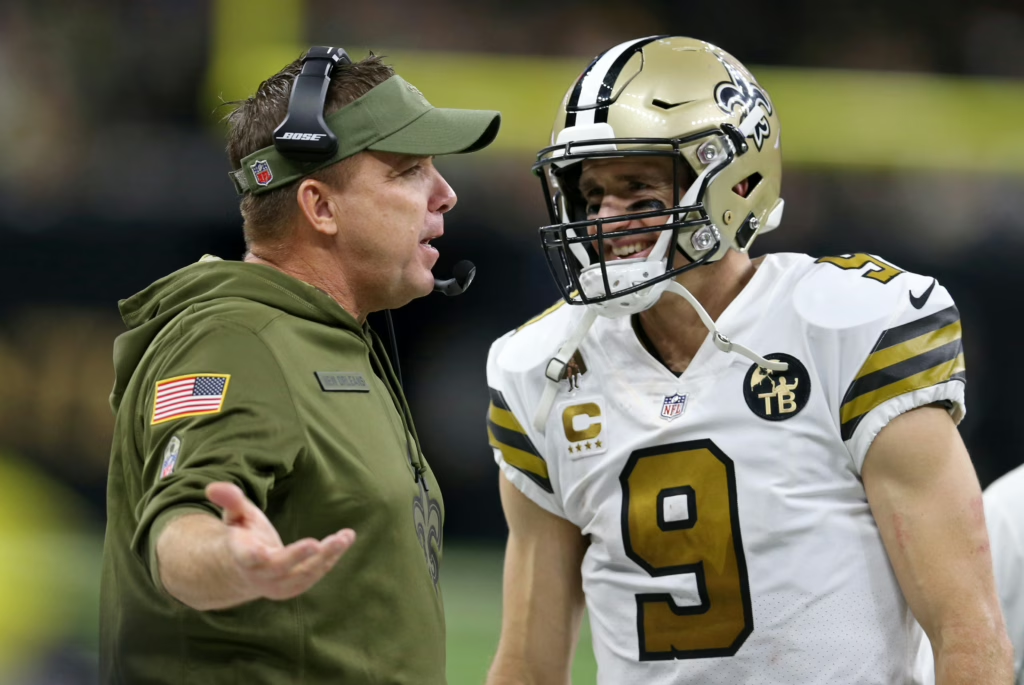
Think about the sheer nerve of Mike Tomlin never having a losing season in Pittsburgh, often with Ben Roethlisberger as his blunt-force instrument of a quarterback. Or the improbable alchemy Sean Payton worked with Drew Brees to elevate a post-Katrina New Orleans franchise into perennial contenders. It wasn’t about singular brilliance alone, even though both quarterbacks delivered that in spades. It was the intertwining of vision and execution, an almost symbiotic relationship where the coach’s strategy elevated the player’s potential, and the player’s consistent performance validated the coach’s often unorthodox schemes. They fit together like perfectly cut gears, humming.
And yet, such prolonged, intense collaboration isn’t easy. It requires monumental compromises, unspoken trust, and often, an institutional blindness to individual flaws in service of the greater whole. “You look at what some of these coach-quarterback partnerships built,” said Eleanor Vance, the fictional but highly plausible owner of the Chicago Crusaders. “They’re more than just teams; they’re mini-empires. From an ownership perspective, that kind of shared history, that unwavering trust between your primary architect and your field general—it’s money in the bank. It shields you from a lot of market volatility, keeps your fan base engaged, and your media valuations sky-high.” But it’s also an intense commitment—one that doesn’t often come cheap, in either capital or emotional terms.
Andy Reid and Patrick Mahomes, for instance, are crafting a modern dynasty right before our eyes, an agile, innovative offensive machine that’s redefining what’s possible. Five Super Bowls in six years for Mahomes, three rings in that span—it’s jaw-dropping. Their impact? Already historic. The sheer statistical weight of their combined wins, the revenue streams they generate for Kansas City, the broader cultural resonance of their joint triumph—it paints a picture of strategic human capital investment that pays dividends on a scale few other sectors can match. It’s a high-stakes gamble on talent — and chemistry, but when it hits, boy, does it hit big. Sometimes it even looks like a grand spectacle with deep global economic undertows.
What This Means
These lasting NFL partnerships aren’t just tales of sporting glory; they offer a practical blueprint for enduring organizational success in any high-pressure, competitive environment. Politically, they represent the aspirational ideal of bipartisan cooperation, where differing skill sets — strategic oversight (coach) and charismatic execution (player) — unite under a single, agreed-upon objective. Economically, they demonstrate the profound value of talent retention and synergy over constant, destabilizing turnover. Think about the market premium placed on stable leadership in a volatile business landscape; these duos epitomize that. Their very existence in a league designed for dynamic change becomes a case study in creating competitive advantages through relentless, shared dedication. For nations and corporations alike, the takeaway is clear: while individual brilliance is compelling, true, lasting impact often stems from the almost impossible alignment of two strong wills pushing in lockstep towards a singular, audacious goal.