

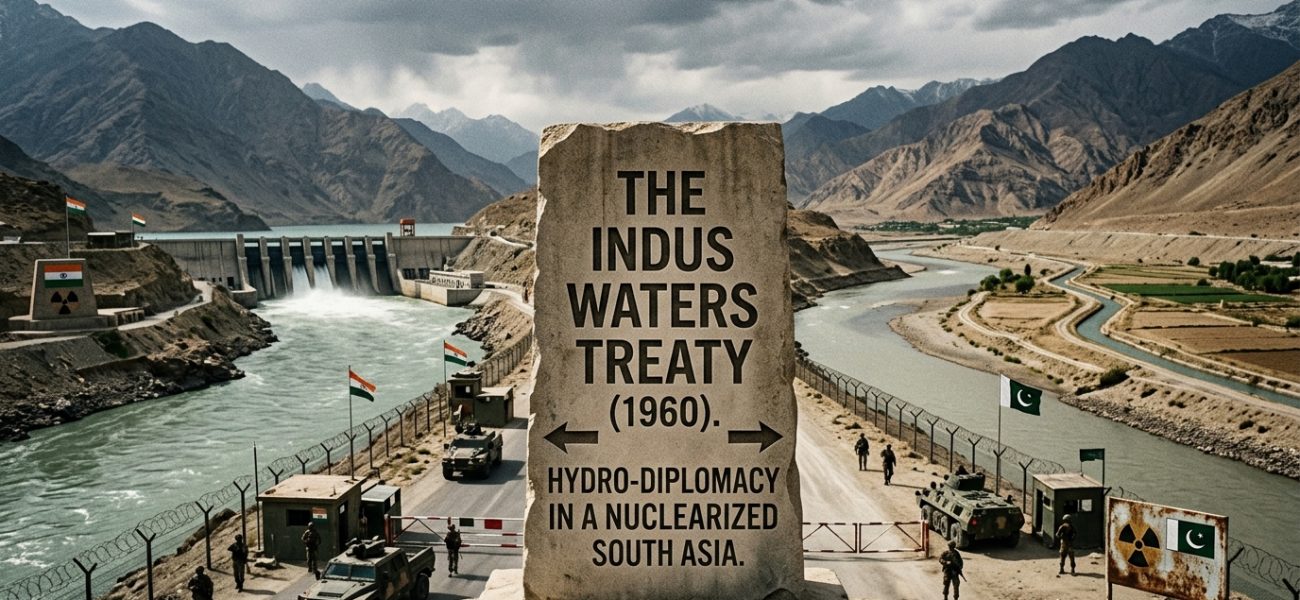
Water as a Weapon in the Nuclearized South Asia: The Relevance of Indus Waters Treaty
The latest decision of the Permanent Court of Arbitration in favor of Pakistan in its hydroelectric projects at Ratle Hydroelectric Plant and Kishanganga Hydroelectric Plant is much more than just a...

The latest decision of the Permanent Court of Arbitration in favor of Pakistan in its hydroelectric projects at Ratle Hydroelectric Plant and Kishanganga Hydroelectric Plant is much more than just a legal controversy. It is the reaffirmation of a basic tenet of international law, which states that no state, irrespective of its status or geographical location, can arbitrarily change the terms of treaties concerning shared natural resources.
For Pakistan, the decision is proof of its consistent stand over the past several years, according to which Indian infrastructure development upstream in the western rivers goes against the technical and legal provisions of the Indus Waters Treaty. Most importantly, it underlines a new threat for the region, which is the securitization and possible militarization of water in the region characterized by military rivalry, unstable nuclear deterrence, and worsening climate conditions.
It is not “Development”, It is about Control
There have been attempts made deliberately to misrepresent the Pakistani objections as an opposition to the Indian hydroelectric development. This is wrong.
Pakistan has never objected to the legal construction of hydroelectric power plants based on the treaty provisions. Rather, it is about the kind of control incorporated in the design of those projects.
According to the Indus Waters Treaty, India had been allowed conditional and technical rights to build run-of-the-river hydroelectric projects on the Western rivers which belonged mainly to Pakistan. Such projects were intended to make it impossible for the upper riparian country to control the upstream storage.
Yet, Pakistan has persistently contended that the projects like Kishanganga and Ratle incorporate design features which are out of the acceptable limits of the treaty.
Pondage means water storage for operational regulation in hydroelectric power projects. Although limited pondage is required for technical reasons, excess pondage gives the ability to control flow timings. Likewise, gated spillways give upstream countries the capability to manipulate discharges more flexibly.
While this may still be a purely technical consideration for normal rivers, in a strategic setting where there are two countries with nuclear capabilities, it becomes an issue of national security.
Temporary upstream manipulation at sowing times, in dry periods, or even at politically sensitive times can cause serious problems for Pakistan in terms of agriculture, irrigation, and food security.
Here the problem is not one of power generation but of hydrological coercion.
Upper Riparian Advantage and the Politics of Hydro-Hegemony
The issue of water between India and Pakistan essentially revolves around the riparian asymmetry. India enjoys the status of an upper riparian country regarding the western rivers in the Indus basin, whereas Pakistan is the lower riparian country, which is highly dependent on these rivers. The geographic disparity brings in the element of power asymmetry. Upper riparian nations enjoy certain strategic advantages in terms of international river politics because of their physical control over the water that flows upstream. It is this very reason behind the concerns of Pakistan.
The logic behind international water laws also stems from this very power asymmetry existing between the upper and lower riparian nations. Naturally, the upper riparian nations have greater physical control over the transboundary rivers as the origin of these rivers and upstream flow processes remain under their control. Otherwise, such geographic advantage can easily turn into a form of political coercion.
This is the very reason why international regimes have been put in place regulating the sharing of rivers so that the use of power by an upstream nation against a riparian nation whose existence is dependent on the uninterrupted flow of water is curtailed. Water is not just a strategic resource; it is the basis of human survival, agriculture, food production, environmental sustainability, and economic survival. For nations like Pakistan, whose very existence depends upon agriculture and irrigation dependent on the river, using water for strategic reasons becomes an issue of national survival rather than mere technicality.
Thus, the Indus Waters Treaty is not simply an agreement for sharing water between India and Pakistan; it is a regime aimed at ensuring that the natural geography is not used by one nation to dominate another strategically.
Almost 80% of the agriculture in Pakistan depends upon the Indus river system. Thus, the food production, irrigation system, and overall survival of Pakistan is based on uninterrupted flows of the Indus River. It is for this reason that even slight forms of upstream control mechanisms trigger grave concern in Islamabad.
The practice of hydro-politics can be well understood using the term “hydro-hegemony,” where states that enjoy geographical advantages use infrastructural superiority to gain political advantage over downstream states. The control of water becomes both an environmental and a political tool in such cases. It is in this regard that India’s efforts to put the treaty “in abeyance” further fuel the same perception.
Water, Climate Change, and Nuclear Instability
The biggest risk associated with this crisis is that it occurs in a context of a region that is both nuclear and highly vulnerable to climatic change. The South Asian region is one of the most climate-sensitive regions in the world. The Himalayan glaciers, which feed the Indus River Basin, are under tremendous ecological pressure because of high temperatures, melting glaciers, erratic monsoons, and precipitation changes. Water scarcity not only becomes an issue of developmental concern but also of political sensitivity.
For Pakistan, uncertainty about the flow of the rivers means uncertainty about agriculture, livelihood, power production, and even economic stability. It is already suffering from climatic disasters like floods and droughts; it cannot afford to face uncertainties about the major river system. Water becomes a matter of strategic security.
In contrast to normal political conflicts, the issue of water insecurity strikes directly at people’s psychology. Once the lower riparians perceive the upstream activities as a form of economic strangulation and/or environmental pressure, the problem is likely to escalate beyond diplomatic discourse and become a matter of national security conflict.
Against the background of a rivalry between two countries, both of which have nuclear arsenals and a record of fighting wars, standoffs, and crises, the potential of irresponsible politics of water could lead to the emergence of another very dangerous source of escalation.
The Indus Waters Treaty served as the firewall that prevented just such an escalation from happening. During the wars of 1965, 1971, and even the Kargil crisis, the treaty was preserved because both parties were aware of the fact that undermining the regime of shared water governance could lead to uncontrollable consequences. Thus, the attempts to undermine the treaty become even more irresponsible than they might otherwise seem.
The PCA Ruling and the Crisis of International Order
This decision of the Permanent Court of Arbitration is important as it reiterates the principle of international law which states that treaties cannot be suspended on political grounds alone.
The rejection of this ruling by India poses many more issues for the future of international law-based system. When the state recognizes only those legal processes which suit their interests, it leaves the international treaty system itself open to questioning.
The decision of the Permanent Court of Arbitration works greatly in favor of Pakistan. It shows that the concerns raised by Pakistan were real and not just for political purposes.
Most importantly, it proves that the vulnerability of a downstream state can be an issue of international importance especially when the upstream country takes strategic action.
Lessons from Other International River Disputes
The Indus basin is not the only area that faces the threat of upstream coercion. This is evident from the case of the Grand Ethiopian Renaissance Dam project where Egypt has continuously been worried about Ethiopia’s ability to coerce through its control of Nile flows. This does not mean that Egypt is against development; it simply worries about the fact that the ability to dominate upstream will give them power over downstream life. The same is true for the Southeast Asian countries who are constantly worried about the Chinese upstream dams being built along the Mekong River.
These examples prove that in today’s world of geopolitical fragmentation and climate change, water is increasingly being used as an instrument of strategic pressure.
Beyond Law: A Question of Regional Stability
The true importance of the Indus issue, however, goes far deeper than engineering details or legal processes. Essentially, the Indus issue is about whether strategic restraint can hold up in an atmosphere of distrust and geographical imbalance.
For Pakistan, the response has been essentially legalistic, based on arbitration and treaty enforcement. India’s tendency to disregard existing treaty obligations can bring significant instability to the region. In the volatile context of a nuclear rivalry, even threats concerning water issues can create a whole new level of security concerns.
Water resources are now essential for food security, economic stability, climate change, and survival in South Asia. Thus, the Indus Water Treaty is not only an agreement to share water. It is one of the few remaining strategic balances between two rival nuclear nations. Violating it might not necessarily mean stopping the flow of rivers. However, it will inevitably weaken the already tenuous strategic restraint that has prevented water from becoming the next major cause of conflict.
Author