


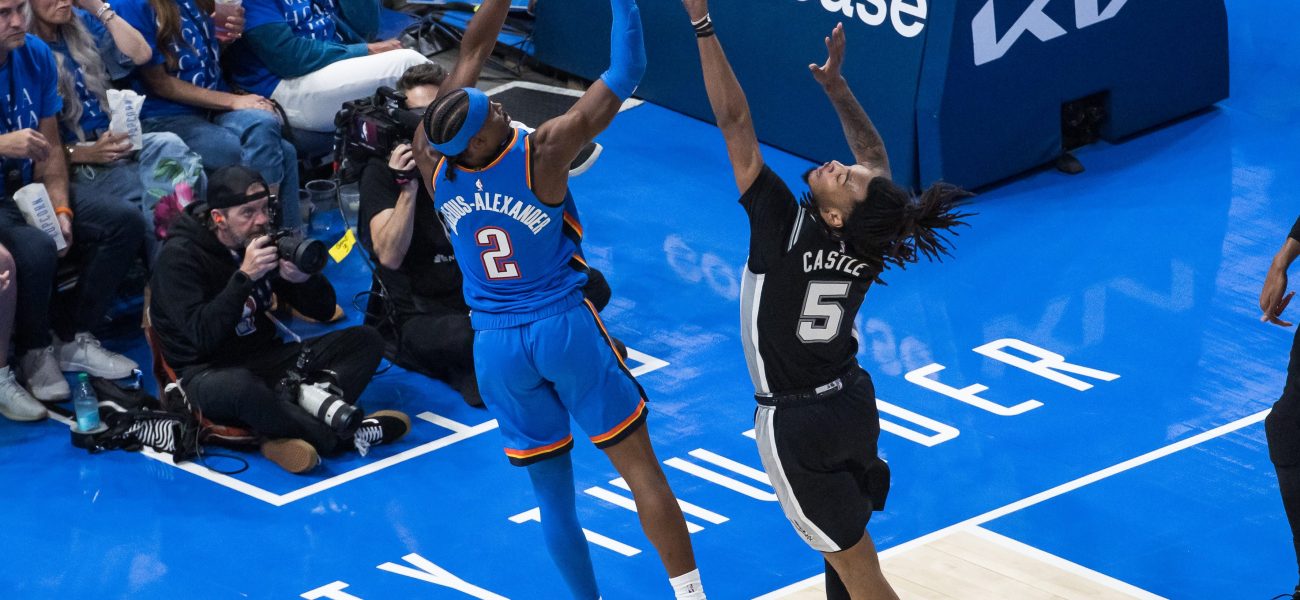
Oklahoma’s Fading Star: Shai Gilgeous-Alexander’s Crucible of Command
POLICY WIRE — Oklahoma City, USA — It wasn’t the roar of the crowd that lingered; it was the abrupt, almost violent silence that descended after yet another desperation heave went astray. You...

POLICY WIRE — Oklahoma City, USA — It wasn’t the roar of the crowd that lingered; it was the abrupt, almost violent silence that descended after yet another desperation heave went astray. You don’t often see a player of Shai Gilgeous-Alexander’s caliber so utterly flummoxed, certainly not when the Western Conference Finals are just kicking off. But then, greatness isn’t simply defined by what happens when everything clicks, is it? It’s about what happens when the universe conspires to throw a wrench in the machinery, when the stakes are so high they feel like a physical weight, crushing performance under their relentless burden.
Oklahoma City’s thrilling, yet ultimately disheartening, 122-115 double-overtime Game 1 loss to the San Antonio Spurs wasn’t just a defeat on the scoreboard. It felt like a psychological tremor for a team that, until now, had navigated the season with youthful bravado. And Gilgeous-Alexander, the man upon whose slender shoulders much of this youthful empire rests, bore the brunt of that failure, delivering a performance so uncharacteristic it bordered on the surreal. One could argue he had what statisticians politely term ‘an inefficient outing,’ but for those who watched, it was a waking nightmare of missed opportunities and inexplicable struggles. He wasn’t simply off; he was, for stretches, almost invisible.
Consider the cold, hard numbers: According to official game reports, Gilgeous-Alexander shot a jarring 7-of-23 from the field. Seven makes out of twenty-three attempts. That’s a grim 30.4% — an abysmal figure for a player touted as an MVP candidate. He missed open looks. He bricked step-backs that usually find nothing but net. He looked like a man trying to solve a Rubik’s Cube with oven mitts on. And, naturally, you can’t help but wonder if the towering presence of Victor Wembanyama, the Spurs’ French phenom, loomed larger in SGA’s periphery than perhaps he’d admit. Because avoiding the paint is one thing; utterly losing your offensive rhythm is quite another. Gilgeous-Alexander, normally a wizard at carving lanes, was reduced to hunting mid-range jumpers — and finding precious little success. He netted a meager four points in the first half. Four. This isn’t the guy we’ve watched all season.
But the pressure, let’s not forget, is global now. Basketball isn’t just an American sport anymore. It’s a spectacle devoured by millions, from the bustling street markets of Manila to the quiet villages nestled in Pakistan’s Khyber Pakhtunkhwa province, where aspiring athletes pore over highlight reels, dreaming of mimicking their idols. That scrutiny amplifies every misstep, turns every bad pass into a referendum on talent. It’s an unrelenting, almost political level of expectation that these players inherit with their megacontracts and superstar status. They’re not just athletes; they’re brand ambassadors for entire cities, economic engines. You screw up in a Game 1 like that, and you’re not just letting down the fans in the arena; you’re letting down the kid in Karachi who stayed up until 3 AM just to watch. It’s a tough, lonely weight.
Even so, the mark of a true competitor is how you react when the edifice begins to crack. ‘That’s what this time of year is about. It’s the highest level of basketball,’ Gilgeous-Alexander conceded after the game, sounding more like a CEO analyzing quarterly losses than a dejected hoop star. ‘You’re going to find out exactly which type of player you are, what type of competitor you are and exactly what you need to get better.’ It’s a pragmatic, almost clinical assessment. Coach Mark Daigneault echoed the sentiment, perhaps a little too calmly. ‘We’ve built this team on resilience, not on flawless execution every night,’ Daigneault remarked, trying to project confidence for the assembled press. ‘But I expect our leaders, especially Shai, to rediscover that killer instinct. There’s a difference between learning — and faltering.’
It’s true; they’ve been in this spot before. The Thunder has rallied from Game 1 deficits in previous rounds. But this is the Conference Finals. This is a different animal, with bigger claws — and a sharper bite. They’re facing not just another good team, but a burgeoning dynasty-in-waiting spearheaded by a generational talent. And if Gilgeous-Alexander doesn’t get his swagger back, doesn’t regain that relentless drive to the basket that so often generates points — or at least good looks — then this young OKC squad might find its grand ambitions abruptly curtailed. It’s an existential question, isn’t it? Because the crown of leadership, particularly in professional sports, is only yours so long as you can carry its immense weight.
What This Means
From an economic standpoint, an early exit for the Thunder—especially with their marquee player underperforming—could have cascading effects. We’re talking millions in potential playoff revenue lost for the organization, a significant blow to local businesses thriving on playoff buzz, and even a dampening effect on future merchandising and season ticket sales. A deep playoff run isn’t just about athletic glory; it’s a financial windfall, attracting investments and cementing brand loyalty that can last years. Conversely, failure at the top, even for a single series, can prompt uncomfortable questions about player contracts, coaching strategies, and the long-term viability of the current roster. There’s a quantifiable ‘cost of losing’ here, far beyond the intangible disappointment. For players, their market value shifts, agents start calling, and the pressure to perform becomes even more intense, a cycle that mirrors the relentless demand for efficiency and accountability in the broader corporate or political sphere. Consider the high stakes inherent in any major policy rollout or infrastructure project; a single misstep can erode public trust and financial backing, much like an unexpected loss impacts the trajectory of a season. You can’t just lose momentum in an economy that thrives on buzz — and success. Just look at how investment reacts to uncertainty—it pulls back. And nobody wants to be on the receiving end of that particular reality. A good run would boost their stock, but a quick exit would create hesitancy among potential investors. “Hoop Dreams and Hard Cash” are inherently linked. This isn’t just about points; it’s about profit.