


London’s Bifurcated Fury: A Tale of Two Protests, Unseen Bridges
POLICY WIRE — London, United Kingdom — Trafalgar Square, once the stage for triumphant announcements and state pageantry, has lately become a contested chessboard. Not for the first time,...

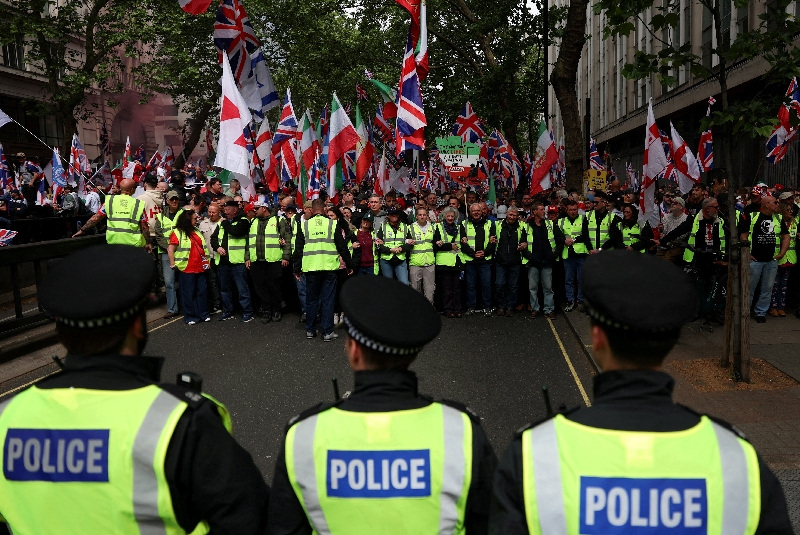
POLICY WIRE — London, United Kingdom — Trafalgar Square, once the stage for triumphant announcements and state pageantry, has lately become a contested chessboard. Not for the first time, London’s beating heart found itself bifurcated this past weekend, simultaneously echoing demands for tightened borders and calls for justice across distant geographies. It wasn’t one unified roar against a common foe, mind you. Instead, it was a discordant symphony, two separate narratives clamoring for attention, existing side-by-side but rarely touching—a perfect encapsulation of the island nation’s contemporary angst.
Down one avenue, a vociferous contingent marched, its message clear as a winter’s dawn: stop the boats, control the borders, reclaim a sense of national self that many feel is eroding. Their banners, some homemade, spoke of perceived demographic shifts — and strained public services. But don’t misunderstand, it’s not simply a raw xenophobia—not for all of them. It’s often a visceral frustration, a feeling that things are simply… out of control. Brenda Cartwright, a seasoned spokesperson for the ‘Britain’s Future’ movement, didn’t mince words. “Look, we’re not asking for the moon here,” she told Policy Wire. “Just for some basic sanity, some control over our own borders. People are fed up, plain and simple.” It’s a sentiment echoing across the continent, finding expression in places like Andalusia, where a conservative ‘win’ increasingly empowers the far-right.
Meanwhile, on another trajectory, a different multitude swelled, their anger burning just as hot, their gaze fixed on Gaza. Chants for Palestine vibrated through the crisp air, signs condemning what many consider an unfolding humanitarian disaster. This wasn’t about domestic policy; it was a furious indictment of international inaction, a demand for global conscience. And for many of Britain’s substantial Muslim communities—many with ties stretching to Pakistan and the broader South Asian diaspora—these events hit a profoundly personal note. They’re watching the images, reading the news, feeling the disconnect between global diplomacy — and immediate suffering.
Layla Al-Jazrawi, Director of Middle East Advocacy at the London Centre for International Rights, didn’t hold back. “The conscience of the global community, it’s screaming in the streets of London,” she asserted, her voice tinged with both defiance and fatigue. “Ignoring it, that’s not just policy failure, it’s a moral abdication. From Karachi to Kensington, people feel this injustice.” But what does this kind of sustained public outcry truly achieve beyond a photo opportunity for news desks?
It’s an interesting exercise, this modern public protest. Two distinctly different concerns, both massive, both deeply felt, yet they operate in entirely separate lanes, rarely merging, save for sharing a police presence and a patch of tarmac. The political apparatus—largely conservative at the moment—finds itself navigating this duality, attempting to appease one faction while deftly sidestepping the other. This isn’t easy work, not by a long shot.
📄 POLICY WIRE WHITEPAPER PUBLISHED: PAKISTAN'S NATIONAL SECURITY POLICY PRIORITIES
👉 READ BY CLICKING HEREConsider the raw numbers, for a moment: Net migration to the UK hit a record 745,000 in 2022, according to official figures from the Office for National Statistics. That’s a hefty data point, one fueling considerable rhetoric — and public angst. Yet, it sits beside an equally fervent passion for a conflict thousands of miles away. It shows you the sheer range of issues pulling at the societal fabric here, doesn’t it?
What This Means
This weekend’s dual demonstrations aren’t merely about headcount; they’re a noisy barometer of British politics at a fractious juncture. The distinct ideological silos on display indicate a populace that, while vocal, often lacks a unifying national narrative, even in protest. For the governing party, this presents a tricky tightrope walk: how do you address legitimate domestic concerns about infrastructure and social cohesion without alienating diverse voter segments, especially when international crises resonate so profoundly with some? The danger isn’t just about losing an election; it’s about the increasing normalization of a public discourse that avoids uncomfortable truths by retreating into ideological echo chambers.
Economically, persistent, large-scale protests, particularly those hinting at social unrest, don’t exactly broadcast ‘stability’ to international investors. While London has a long history of public demonstrations, their sustained frequency and intensity over increasingly varied issues—from climate to healthcare to geopolitics, often simultaneously—suggest a deeper malaise, a frayed trust in institutional problem-solving. This isn’t just noise; it’s a symptom. And for leaders, ignoring this clamor, or attempting to spin it away with practiced soundbites, might well prove to be their greatest miscalculation, akin to ignoring the quiet power shifts gripping countries from Brazil to Tehran, where Tehran’s iron grip tightens under the shadow of conflict.