


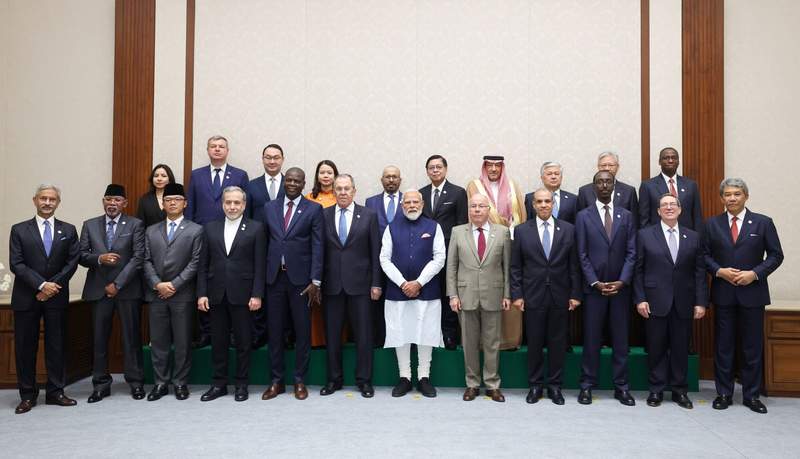
BRICS Block Hits Diplomatic Snag: Grand Ambitions Collide With Middle East Realities
POLICY WIRE — Cape Town, South Africa — They’d gathered with such grand ambitions, you know? To redraw the maps of global influence, to challenge old orders. The expanded BRICS bloc—now...

POLICY WIRE — Cape Town, South Africa — They’d gathered with such grand ambitions, you know? To redraw the maps of global influence, to challenge old orders. The expanded BRICS bloc—now stretching its fingers across four continents—convened recently with talk of a burgeoning multipolar world. But those high-flying aspirations took a rather noticeable dive right into the fraught realities of the Middle East, ultimately failing to even manage a unified declaration. It seems that a club built on economic camaraderie can still buckle under the sheer weight of intractable geopolitical squabbles.
The confab, intended to showcase the collective might of Brazil, Russia, India, China, South Africa, and its newly invited members—Egypt, Ethiopia, Iran, Saudi Arabia, and the UAE—was supposed to be a loud, clear declaration of their rising dominance. Instead, what emerged was a stark illustration of just how fragile ‘solidarity’ can be when faced with issues that carve nations not just along political lines, but deeply personal, ethical, and religious ones too. They just couldn’t agree on a collective stance regarding the simmering cauldron of conflict in Gaza and the wider Levant. It’s a complicated business, nation-states trying to present a united front when their interests diverge.
Because, while the West scrambles to manage its own complex foreign policy postures, BRICS had aimed to project an alternative, more coherent narrative for the so-called Global South. Didn’t happen this time. Their inability to issue a joint statement speaks volumes; it’s a silent confession that despite shared frustrations with existing global governance, their individual geopolitical calculations, especially when it comes to regional conflicts, are still paramount. That’s a rough pill for a bloc trying to assert itself as a cohesive unit. You’d think with that kind of roster—nations representing approximately 45% of the world’s population and roughly 28% of global GDP, according to International Monetary Fund (IMF) figures from 2023—they could whip something up. But they didn’t.
“It’s a tough room. Everyone agrees on de-dollarization, on multipolarity, sure. But when actual lives are on the line, when there are deeply rooted historical and ideological positions at play, suddenly the ‘Global South’ isn’t so monolithic,” commented Deputy Foreign Minister Jia Li, a seasoned diplomat from Beijing, hinting at the difficulties faced in securing consensus among such diverse membership. His words betray a subtle weariness that only those who’ve sat through endless rounds of fraught diplomatic negotiations can truly understand.
But that doesn’t mean the dream is dead, apparently. Some are keen to emphasize continued collaboration. “These aren’t easy conversations. No one ever said they would be,” remarked Arindam Bagchi, spokesperson for India’s Ministry of External Affairs, in a prepared statement after the gathering. “But our commitment to a more equitable, multipolar world endures, differences notwithstanding. We’ll keep at it. Progress is rarely linear.” He’s not wrong, of course. Rome wasn’t built in a day. Neither is a new world order.
And for a nation like Pakistan, not a current member but a close observer with deep cultural and political ties to the Muslim world and a neighbor to multiple BRICS states, this diplomatic stutter resonates. The absence of a unified voice from a group purporting to champion the global periphery leaves a vacuum—a distinct lack of cohesive pressure on established powers regarding conflicts that deeply affect Muslim communities worldwide. It leaves them asking: if not BRICS, then who speaks for a genuinely collective, non-Western conscience when it comes to crises in places like Gaza? They’re watching, weighing alliances, always looking for stability in a shaky world.
📄 POLICY WIRE WHITEPAPER PUBLISHED: PAKISTAN'S NATIONAL SECURITY POLICY PRIORITIES
👉 READ BY CLICKING HEREWhat This Means
The failure of the BRICS nations to forge a joint statement on the Middle East isn’t merely a diplomatic embarrassment; it’s a sharp reminder of the internal centrifugal forces at play within a bloc that has swelled rapidly in ambition, if not always in immediate coherence. Economically, they might share aspirations—think reduced reliance on the dollar or reformed global financial institutions. But politics, especially when tied to humanitarian crises, has a nasty habit of exposing cracks in even the most carefully constructed alliances.
This episode implies that the much-touted rise of a ‘multipolar world,’ supposedly championed by BRICS, isn’t going to be a clean, orderly transition. It’s going to be messy, fragmented, and prone to the same geopolitical fault lines that have always characterized international relations. The internal fissures exposed by the Middle East crisis—countries like Iran and Saudi Arabia now both members, each with vastly different, and sometimes adversarial, regional interests—present significant hurdles. How can they act as a truly unified counterbalance to the West if they can’t even agree on what to say about a major international crisis affecting their own ranks and broader global south? It’s the cost of consensus, or rather, the lack thereof, as some policywire.com analyses have previously noted.
Economically, this might slow their momentum, making it harder to coordinate on things like alternative payment systems or development banks. But politically, it reinforces the notion that BRICS, while numerically imposing, isn’t a singular political entity. It’s more of a collective of disparate powers, each playing its own game—an inconvenient truth for those who thought the age of Western dominance was drawing a simple, straightforward close. Expect more individual statements and bilateral actions than grand, sweeping BRICS pronouncements for the foreseeable future. That, frankly, is often the way of things, even for emergent powers battling old titans like those seen in The Coral Chessboard in the Solomon Islands. Complex, indeed.