


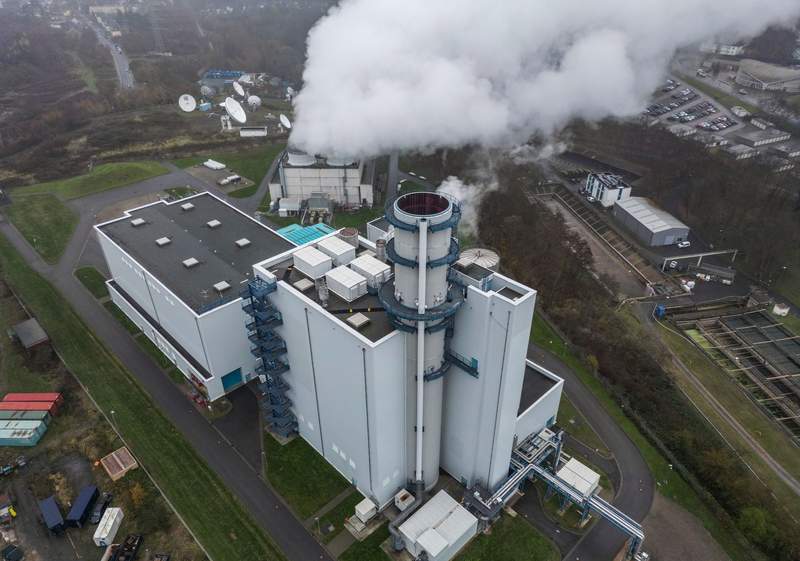
Berlin’s Cold Truth: Germany Embraces Gas in Gritty Energy Pivot
POLICY WIRE — Berlin, Germany — It’s a bitter truth, isn’t it? Germany, the green conscience of Europe—a nation that zealously decommissioned nuclear reactors and promised a renewable revolution—is...

POLICY WIRE — Berlin, Germany — It’s a bitter truth, isn’t it? Germany, the green conscience of Europe—a nation that zealously decommissioned nuclear reactors and promised a renewable revolution—is now building gas-fired power plants. Not as a temporary stopgap, mind you, but as the perceived bedrock of its future energy stability. Because, sometimes, cold, hard reality—and a hostile petrostate on your border—trumps decades of eco-friendly rhetoric.
Chancellor Olaf Scholz, usually a man of measured pronouncements, recently framed the necessity with a stark simplicity that bordered on resignation. The ambition for a purely green grid by 2030, once a mantra, has apparently bowed to the immutable laws of physics and geopolitics. They’re constructing them now, these gas guzzlers, at a pace that suggests a nation suddenly very, very aware of the consequences of its energy dependency. It’s a pragmatic concession, one suspects, less about genuine desire and more about dodging blackout bulletins and economic meltdown.
For years, Germany banked on Russian gas. It was cheap. It was (seemingly) reliable. Then, Putin decided to turn the tap into a weapon, and suddenly, the grand German Energiewende looked less like a glorious transition and more like a tightrope walk over a chasm. So, here we’re: a multi-billion-euro initiative to construct new, highly efficient gas plants, designed to burn natural gas initially, but eventually transition to hydrogen. That’s the hopeful part, anyway. The future, always just around the corner, will solve today’s problems.
“We can’t wish our energy security into existence,” Chancellor Scholz reportedly stated, a line that cut through the ideological fog like a razor. “Our industries, our citizens, they need a constant, reliable power supply. These plants are the pragmatic answer to an undeniable challenge. We remain committed to renewables, but this is a bridge we simply must build, not a permanent home.” His words, steeped in governmental necessity, acknowledge a hard shift, one not lost on his Green Party coalition partners.
But the Greens, for all their anguish, appear to be playing along. Winfried Kretschmann, the veteran Green Party Minister-President of Baden-Württemberg, articulated the painful compromise, albeit with a green tinge. “It’s far from ideal, a temporary necessary evil if you like,” he sighed, probably privately. “We have to ensure supply as we expand renewables, but the absolute, non-negotiable imperative is that these facilities are genuinely hydrogen-ready. They cannot, — and must not, lock us into a fossil fuel future. The transition has a price, — and sometimes that price includes pragmatism.” You hear the struggle in that, don’t you?
The push signals a new scramble for Liquefied Natural Gas (LNG) on the global market. Germany, a fresh face at the LNG procurement table, is now competing with established importers and energy-starved developing economies alike. This increased demand, logically, drives up prices — and exacerbates supply constraints worldwide. It means nations like Pakistan—already wrestling with profound energy poverty and the crushing weight of global inflation—find themselves in an even tougher spot. Their ability to secure adequate and affordable LNG for power generation and industrial needs is directly impacted by major economies like Germany suddenly, and voraciously, entering the fray. Just last year, South Asia’s nations faced a particularly dry spell, economically speaking, in large part due to spiraling global commodity costs.
A look at the numbers tells a story: before 2022, Germany imported approximately 55% of its natural gas from Russia. That figure plunged to nearly zero post-invasion, according to experts at the German Association of Energy and Water Industries (BDEW). That’s an industrial-sized hole to fill, and renewables, for all their rapid growth, just can’t plug it alone, not yet anyway. The country needs something quick, something dispatchable, something reliable when the wind doesn’t blow and the sun doesn’t shine. Enter gas, a rather convenient villain, now temporarily indispensable hero.
What This Means
This isn’t just a flick of a switch; it’s a profound strategic recalibration for Europe’s economic powerhouse. Politically, it complicates Berlin’s moral high ground on climate action, especially in forums where it encourages less developed nations to embrace immediate green solutions. It’s tough to preach abstinence while buying cigarettes in bulk. And within the fragile three-party coalition government, it’s a constant tightrope walk between the fiscally conservative FDP, Scholz’s centrist Social Democrats, and the ideologically committed Greens. Any perceived backtrack from the hydrogen promise could unravel that uneasy alliance quicker than you can say “climate neutrality.”
Economically, the implications ripple far. These new plants represent significant investment, diverting funds that could ostensibly flow into accelerating genuine renewable infrastructure or hydrogen research. And there’s the longer-term bet on hydrogen. If hydrogen production doesn’t scale up efficiently, or its transport remains prohibitively expensive, Germany risks locking itself into a fossil fuel technology under the guise of transition. That could mean higher energy prices for German industry and consumers for decades to come, affecting competitiveness on a global scale—not to mention the lingering carbon footprint until that magical hydrogen flip.
So, Berlin is making its choice. It’s a choice born of necessity, of war, — and of the blunt force of reality. Idealism, for now, takes a back seat. And Europe watches, perhaps learning its own lessons about the often-unromantic demands of energy security.