


Beyond the Barbed Wire: Elledge Sentence A Stinging Indictment of Recidivism
POLICY WIRE — ALBUQUERQUE, N.M. — It’s a chilling calculus, isn’t it? The public square often obsesses over justice delivered, the gavel falling with finality. But what about justice deferred—the...

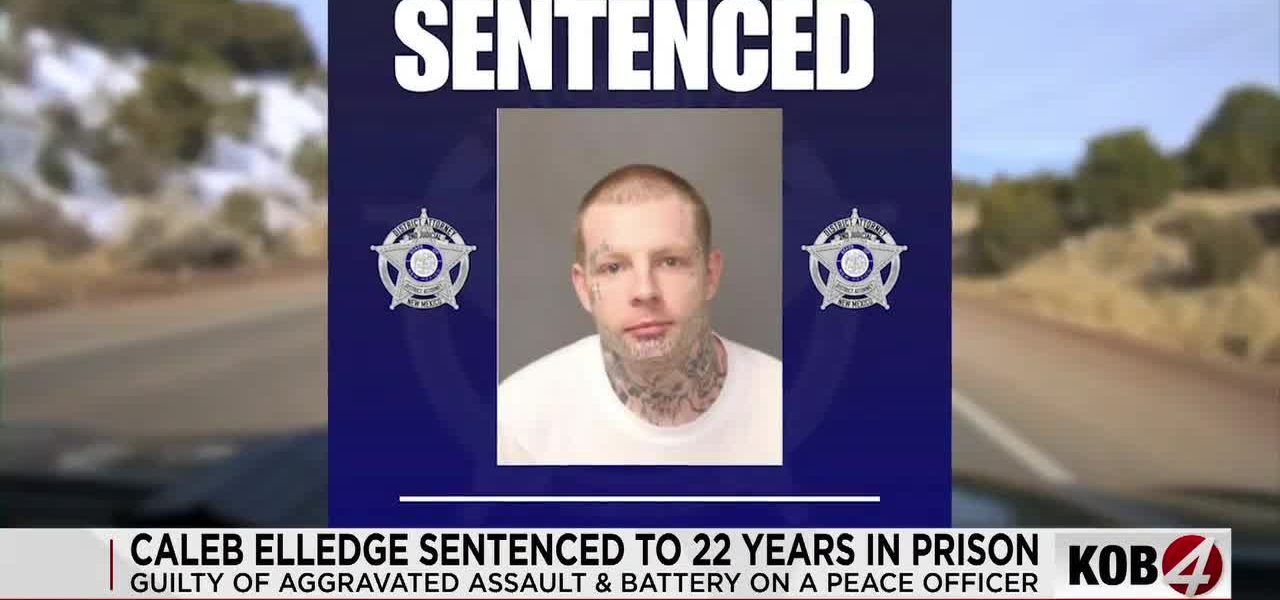
POLICY WIRE — ALBUQUERQUE, N.M. — It’s a chilling calculus, isn’t it? The public square often obsesses over justice delivered, the gavel falling with finality. But what about justice deferred—the failures accumulating long before the violent crescendo? Caleb Elledge, now facing a quarter-century in the slammer for nearly ending a New Mexico State Police officer’s life and pulverizing a squad car, didn’t just emerge from thin air. He was, to put it plainly, a known quantity.
For three years, from 2005 to 2008, nearly two-thirds of state prisoners released were rearrested, according to a 2018 Bureau of Justice Statistics report. Elledge, by that metric, is unfortunately part of a well-trod, tragic path. Court documents don’t just whisper; they shout about a history of parole violations. Three times. Before the fateful 2022 incident near Edgewood. One might call it a series of societal warning flares, ignored, until they culminated in a bullet striking an officer’s neck. He survived, thankfully, a small mercy in a tale otherwise devoid of them.
The incident itself was a whirlwind of mayhem: state police attempting a routine stop, Elledge deciding flight was his best option. He slammed his vehicle into a patrol car, then led officers on a hair-raising, high-speed chase. And somewhere in that adrenaline-fueled chaos, a gun came out. An officer went down. It wasn’t an isolated, spur-of-the-moment lapse, not really. It was, rather, the inevitable consequence of a system struggling—often failing—to contain those who repeatedly thumb their nose at it. A New Mexico judge, last Tuesday, slapped Elledge with the maximum sentence: 22 years behind bars. This stacked neatly atop a prior 9-year federal stint for being a felon toting a firearm. Thirty-one years, all told. One can only hope this time it sticks.
“Every time an officer puts on that uniform, they’re signing up to protect us all, but they shouldn’t have to face individuals who’ve repeatedly shown a blatant disregard for the law and the public’s safety,” said New Mexico Attorney General Raúl Torrez, in a statement to Policy Wire. “This verdict, while grim, underscores the necessity of a justice system that doesn’t just prosecute, but prevents this kind of recurring threat. We can’t keep patching holes; we’ve got to rebuild stronger, a more consistent framework of accountability for repeat offenders.”
And that’s the rub, isn’t it? The constant tension between reform — and raw public safety. The New Mexico State Police, a thin blue line often stretched taut, frequently find themselves in these deadly high-stakes confrontations. NMSP Chief W. Edward Williams weighed in, stating, “My officers deserve to come home at the end of their shift. Period. This incident wasn’t just a crime; it was an assault on the very fabric of order. We appreciate the court’s strong stance. It sends a message, one hopes, that there are lines you simply don’t cross with our frontline responders.” Because when those lines are blurred, when parole becomes a revolving door for violent offenders, everyone suffers.
These challenges aren’t unique to New Mexico, of course. Across the globe, from the burgeoning metropolises of Latin America to the densely populated, complex regions of South Asia, the effectiveness of criminal justice systems to deter recidivism remains a perpetual headache for governments. Countries like Pakistan, for instance, frequently grapple with their own endemic issues of policing reform, public trust, and a judiciary often perceived as struggling to consistently uphold the rule of law. It’s a universal battle for institutional integrity—one incident, however local, echoing concerns across distant borders.
📄 POLICY WIRE WHITEPAPER PUBLISHED: PAKISTAN'S NATIONAL SECURITY POLICY PRIORITIES
👉 READ BY CLICKING HEREWhat This Means
Politically, Elledge’s sentencing will undoubtedly be leveraged by politicians advocating for ‘tough on crime’ measures, fueling debates over the efficacy of parole systems and sentencing guidelines. It feeds into a narrative of an overburdened, sometimes underperforming, correctional framework that struggles to rehabilitate and instead recycles individuals back into the criminal pipeline. This puts pressure on judicial oversight bodies and corrections departments to tighten protocols, potentially leading to fewer paroles and longer sentences, irrespective of whether such approaches address the root causes of crime. It also impacts law enforcement morale and recruitment—who wants a job where they’re constantly dodging bullets from individuals who shouldn’t even be on the street?
Economically, the cost implications are stark. The public bears the immense financial burden of repeated incarceration—from policing to prosecution, detention, and the healthcare expenses for injured officers. This isn’t a one-time fee; it’s an ongoing tax on society for every offender who slips through the cracks. It siphons resources that could be directed towards preventative measures, education, or community programs designed to interrupt cycles of violence. A more holistic, yet equally stringent, approach to criminal justice could, hypothetically, save significant public funds and prevent future victims.
But make no mistake: this maximum sentence, harsh as it sounds, is more than just about punishing one man. It’s a societal sigh of exasperation—an admission that sometimes, after all the chances are given, after all the programs fail, some individuals simply must be removed from the equation. It’s a grim acknowledgement of the fragile boundary between order and chaos, policed by men and women who often pay the highest price. And don’t we forget it.