


Gridiron Grievances: When NFL Rivalries Mirror Nations, Not Just Neighbourhoods
POLICY WIRE — Washington, D.C. — Forget the pristine turf and corporate sponsorship for a moment. Strip away the orchestrated pomp of Sundays, — and what remains isn’t merely a...

POLICY WIRE — Washington, D.C. — Forget the pristine turf and corporate sponsorship for a moment. Strip away the orchestrated pomp of Sundays, — and what remains isn’t merely a game. It&rsquos something far older, a raw, primal declaration of ‘us against them’ that echoes from schoolyards to national borders. We cheer. We jeer. And, heaven help us, we invest an alarming amount of emotional capital into grown men in padded costumes vying for a peculiarly shaped ball.
Because let’s be honest, — these weren’t just contests on the schedule. They’re cultural flashpoints. The National Football League’s marquee rivalries, often highlighted on lists like one compiled by Kalshi Football, aren’t simply about winning or losing. No, they’re a controlled skirmish, a communal venting of tribal passions usually reserved for much grimmer conflicts. They give fans permission to hate with a sanctioned, almost therapeutic intensity.
It’s easy enough to dismiss it as simple sport, a harmless pastime. But try telling that to someone from Green Bay when the Bears roll into town, or a Dallas faithful squaring off against Washington – or Commander, as the nomenclature currently stands. That’s centuries of ingrained local identity, civic bragging rights, and a bizarre, unyielding sense of justice playing out in four quarters. Former U.S. Secretary of State Madeline Albright once famously remarked, “The United States is the indispensable nation.” While she wasn’t talking about football, her sentiment — that sense of an elevated self and the importance of ‘our’ identity — perfectly captures the mindset. This isn’t just about sporting dominance; it’s a microcosm of human nature’s less pretty inclinations, packaged neatly for mass consumption.
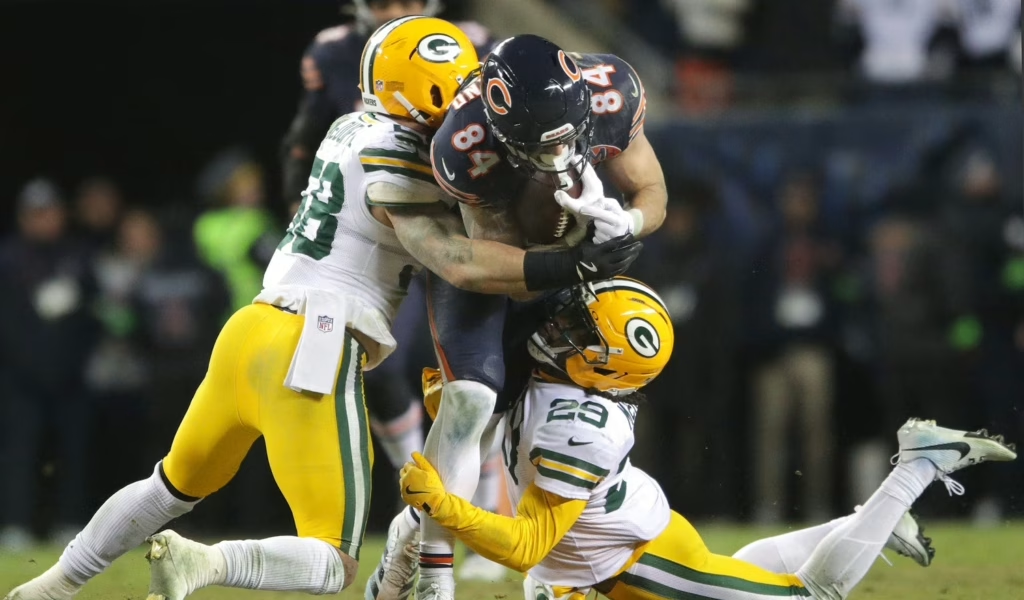
Consider the Chicago Bears versus the Green Bay Packers. It’s not just America’s oldest NFL feud, stretching back to 1921 — an almost absurd longevity for a modern sporting institution. It’s a clash of mythologies: the grit of Chicago against the small-town defiance of Green Bay. George Halas versus Vince Lombardi. Brett Favre versus — well, Brett Favre, once he swapped allegiances to Minnesota. But, every clash reanimates old grudges — and cements new ones. These aren’t fleeting moments; they’re carved into the civic consciousness, a shared narrative of triumph and betrayal that transcends mere points on a scoreboard. And that’s what gives it weight.
For some, these rivalries, with their deep historical roots and passionate fan bases, mirror the cultural pride and often simmering resentments found across global fault lines. Think of the visceral reaction when India plays Pakistan in cricket; it’s not just a match. It’s often viewed as a proxy for historical grievances and national pride, amplified by hundreds of millions of eyes across the Subcontinent and the broader Muslim world. “These games aren’t merely revenue generators,” quipped an anonymous NFL senior vice president we spoke to off the record. “They’re living traditions. You don’t manage a balance sheet; you manage — and leverage — generations of deeply embedded social and regional sentiment. It’s far more complex, — and frankly, more lucrative, than a standard marketing campaign.”
📄 POLICY WIRE WHITEPAPER PUBLISHED: PAKISTAN'S NATIONAL SECURITY POLICY PRIORITIES
👉 READ BY CLICKING HEREAnd for good reason. They’re spectacles. According to Nielsen figures from the 2023 season, prime-time NFL rivalry matchups often pull in an average of 19.3 million viewers, significantly outperforming non-rivalry games and dominating other broadcast programming. That’s a captive audience. But it also suggests a populace hungering for some organized catharsis.
The Cowboys versus the Commanders — formerly the Redskins — is another splendid example. A conflict built on ‘America’s Team’ glamour versus the defiant, old-school grit of the nation’s capital. Then you’ve got the bruising NFC East slugfests involving the Giants, and the storied, almost cinematic playoff battles between the Cowboys and 49ers, which defined a generation of football in the 1980s and 90s. The “Immaculate Reception,” even now decades later, still fuels — for better or worse — the Raiders-Steelers animosity, showing just how long these historical touchpoints resonate.
What This Means
These NFL rivalries, far from being a trivial sporting diversion, serve as significant cultural and socio-economic markers. Politically, they act as a controlled environment for citizens to express tribal loyalties and aggressions that, in other contexts, might escalate. They provide a shared narrative, forging community bonds — often at the expense of another community’s. Economically, they’re golden geese; tickets to rivalry games consistently fetch higher prices, broadcast rights are inflated by guaranteed viewership, and local economies surrounding these events see substantial boosts. they’re potent tools for brand identity and regional allegiance, creating cultural anchors that tie people to their cities and teams, regardless of win-loss records. It’s a fascinating interplay of profit — and primal instinct, carefully cultivated, and consistently consumed. Even beyond traditional sports, the psychology of ‘our team’ versus ‘their team’ runs deep, mirroring the very foundation of electoral politics or nationalistic fervor. What happens on the gridiron isn’t just entertainment; it’s a profound, if indirect, reflection of society’s complex divisions and unifying passions. And we keep showing up for it.