


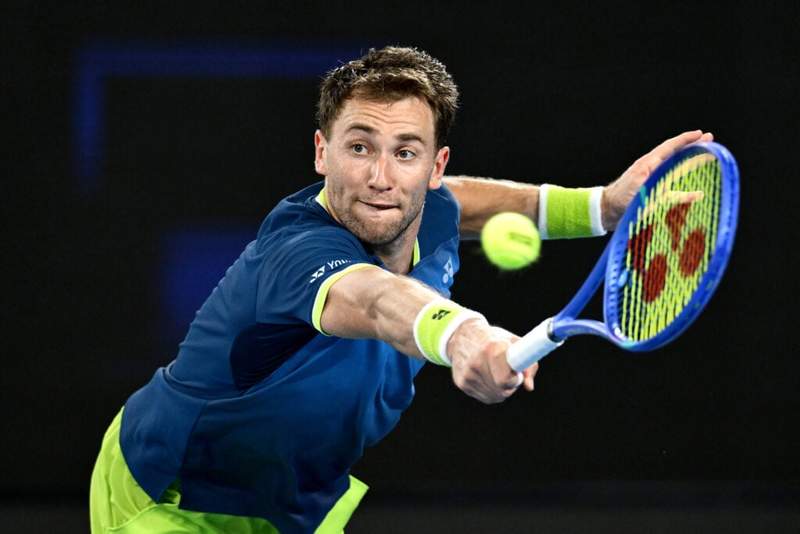
The Mechanical Messiah: Jannik Sinner’s Ascent Reboots Tennis, Sparks Debate Over ‘Soul’
POLICY WIRE — Rome, Italy — It wasn’t just the clay dust settling in Rome; it was the entire premise of modern men’s tennis, meticulously arranged and then dramatically overturned by a young...

POLICY WIRE — Rome, Italy — It wasn’t just the clay dust settling in Rome; it was the entire premise of modern men’s tennis, meticulously arranged and then dramatically overturned by a young Italian who seems to embody a singular, unsettling future for the sport. Jannik Sinner, in a season of relentless triumphs, has smashed records with the quiet, methodical precision of a cyborg – a performance so flawless it’s paradoxically invited critique, or perhaps, misunderstanding, from the very fans he aims to enthrall.
His recent victory over Sebastian Ofner in Rome, itself another notch in a growing legend, came amid murmurs of his perceived lack of ‘flair’. But even as Sinner chalked up yet another win—this time dropping Ofner in straight sets after the Austrian managed just seven winners and had his serve broken thrice—Norwegian rival Casper Ruud, often a pragmatic voice on the tour, was stepping up to offer an unexpected defense. Ruud wasn’t just defending a peer; he was dissecting a modern phenomenon. And what he’s seeing has the purists scratching their heads.
“I played him [Sinner] last year in Rome and I can already think at that point, I said quite openly that was a crazy level that I felt and saw and was a witness of, and also playing the match,” Ruud told Dutch broadcaster Ziggo Sport. But the conversation isn’t really about raw skill anymore. It’s about optics. It’s about emotion, or the perceived lack of it, in a sport that thrives on narrative. Sinner’s groundstrokes, consistently labeled “robotic,” provoke an almost existential debate about the art of tennis itself.
Because, seriously, think about it: if someone plays so perfectly that it looks easy, that’s not a knock; that’s mastery. “I see a lot of people kind of, not criticising, but saying that Jannik is a little bit too much of a robot,” Ruud continued, clearly baffled by the framing. “When you realise how difficult tennis is — and you can make tennis look robotic, it shows how good you are. So it honestly should be just a compliment.” He’s got a point. To make something as complex as a top-tier tennis match appear so simple, so devoid of human struggle (even if the struggle is immense internally), is profoundly impressive. And now everyone’s chasing him. They’re just catching dust.
Sinner’s been on a tear, completing the elusive ‘sunshine double’ with titles in Indian Wells and Miami back in March, an achievement only seven men before him could claim. He reclaimed the world number one spot from Carlos Alcaraz after a convincing Monte Carlo Masters final. He then did something nobody else has ever done, becoming the first player in history to win five consecutive Masters 1000 events. The numbers speak for themselves. In 2024 alone, Sinner secured a remarkable 93% of his matches across ATP tournaments and Grand Slams, according to ATP Tour data, a performance almost unheard of in the modern era.
“His game isn’t just about hitting hard; it’s about making opponents feel redundant,” noted veteran tennis analyst Prakash Amritraj in a recent commentary. “He strips away their options, making them overthink, overplay. And that relentless pressure, that’s a type of drama in itself, even if it’s not always about shattered rackets or dramatic tantrums. It’s an internal kind of torture for his competitors, week in, week out.” That kind of observation gets right to the core of what Sinner is doing.
It’s a peculiar thing, this hunger for vulnerability in our heroes. We demand perfection, but then question its authenticity if it lacks visible cracks. In parts of the world where sports idols often serve as national standard-bearers—think of cricket icons in Pakistan, where heroes are forged not just on skill, but perceived grit and public persona—Sinner’s almost impassive domination presents an intriguing case study. His rise challenges established notions of what defines a ‘great’ or even ‘lovable’ athlete. Does he need a compelling origin story? A fiery on-court temper? Or does clinical victory simply speak for itself across cultures, whether in Islamabad or Monte Carlo?
📄 POLICY WIRE WHITEPAPER PUBLISHED: PAKISTAN'S NATIONAL SECURITY POLICY PRIORITIES
👉 READ BY CLICKING HEREThis dynamic was brought into sharper focus by Ruud’s own Rome journey. The Norwegian, a consistent force, found himself out of the Italian Open in the second round, unexpectedly dispatched by Miomir Kecmanovic. But he’d had past successes here, reaching the semi-finals in 2020, 2022, and 2023, showcasing a more traditional career arc of steady ascent and hard-won progress. His contrast with Sinner’s sudden, overwhelming supremacy couldn’t be starker.
Sinner’s method suggests a recalibration of what we expect from top-tier athletes. The relentless training, the data-driven precision, the quiet confidence – it’s a blueprint that emphasizes efficiency over theatrics. And, frankly, it’s paying dividends.
What This Means
Sinner’s quiet, devastating march up the rankings signals a potential paradigm shift in global sports stardom. The romanticized ideal of the emotionally volatile, visibly struggling genius—a character arc that once resonated globally—is facing serious competition from the ‘new generation’ player. This is a player who embodies total control, even over their own persona. It suggests that, in an increasingly connected yet data-obsessed world, sheer, undeniable performance may trump the need for overt ‘personality’.
Economically, this implies that the commercial appeal of athletes could shift. Endorsements might pivot from seeking ‘relatable’ figures to those who project an image of unshakeable competence, appealing to brands that value reliability and consistent victory above all else. For tennis, in particular, Sinner’s dominance could mean a revitalization, drawing new viewership intrigued by raw power and statistical anomalies, even if some critics yearn for the ‘old days’ of showmanship. It’s a subtle but significant reframing of the celebrity athlete in an era obsessed with analytics and objective metrics. How countries embrace these new-era heroes—think about the national pride sparked by figures who don’t necessarily play to the cameras, but dominate on the global stage, sometimes even in unexpected arenas like the economic grandiosity hinted at by discussions around the Shadow of Hormuz or geopolitical flexing. That subtle connection to national prestige via quiet sporting excellence can’t be discounted. Because sports, even a singular player’s ascent, always tells a story about broader global aspirations.