


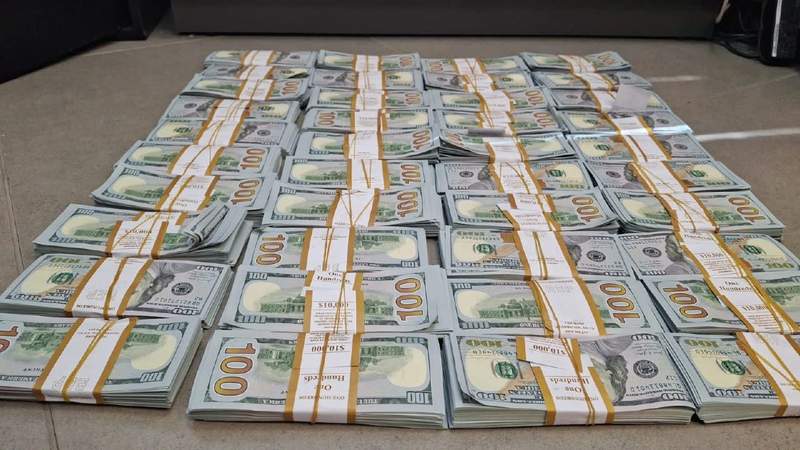
Shadow Currencies: The $400k Haul That Exposed a Frayed Financial Underbelly
POLICY WIRE — [Your City], [Your Country] — There’s a particular kind of quiet hum underlying the daily grind, the constant, nearly invisible movement of capital. But every so often, a simple...

POLICY WIRE — [Your City], [Your Country] — There’s a particular kind of quiet hum underlying the daily grind, the constant, nearly invisible movement of capital. But every so often, a simple roadside encounter yanks back the curtain, exposing a shadow economy where cash, not credit, still reigns supreme. We’re talking about money that doesn’t like receipts, doesn’t fancy bank statements. Money that just *is*.
It was exactly this kind of stark revelation that hit when authorities—we’re not getting specific on location, mind you, the principles here are universal—pulled over a car under circumstances one could charitably describe as ‘suspicious’. The usual dance ensued: license, registration, a bit of probing. But then, they found it. Not a weapon, not narcotics in plain sight, but stacks of cold, hard currency. We’re talking nearly half a million dollars—$400,000, to be precise—stashed away. Just sitting there. Begging for a story.
And what a story it seems to be. This wasn’t some quick drug deal or pocket change from a high-stakes poker game. Investigators are pretty certain this particular haul points directly to something far more systemic: money laundering and serious tax offenses. But why is it always cash? Because cash leaves no digital footprints. It’s clean, it’s fungible, — and when it’s hidden well enough, it might as well be a ghost.
“We chase paper trails, certainly,” remarked a senior official from the Treasury Department’s Office of Financial Crimes Enforcement Network (FinCEN), who preferred to remain unnamed given the ongoing nature of such investigations. “But sometimes, you just gotta get lucky — and find the paper itself. It’s a relentless, low-visibility fight. People don’t realize the sheer volume of dirty money sloshing around. It poisons markets, warps competition, — and finances real nasty stuff, you know?” He’s not wrong. Because every dollar laundered chips away at the integrity of everything else.
This single bust, while a drop in a very large ocean, illuminates an uncomfortable truth: our financial gatekeepers, for all their digital sophistication, still grapple with an analog problem. And it’s a big one. The United Nations Office on Drugs and Crime (UNODC) estimates that the amount of money laundered globally each year stands between 2% and 5% of global GDP—that’s roughly $800 billion to $2 trillion. A truly eye-watering figure, isn’t it? Just imagine that kind of capital playing by its own rules.
Consider the international flavor this kind of illicit finance often picks up. A cash-heavy transaction, especially one of this magnitude, raises all sorts of questions about its origin and ultimate destination. Pakistan, for instance, a nation grappling with its own internal economic pressures and a deeply entrenched informal economy, has long been a country scrutinized for illicit financial flows, both as a source and a transit point. Whether it’s through traditional ‘Hawala’ systems—a legitimate funds transfer method that can be exploited by illicit actors—or more sophisticated routes, vast sums of money bypass formal banking channels daily, shaping fortunes (and misfortunes) far beyond the gaze of national treasuries. They’re called untraceable for a reason, right?
“Detecting cash transactions, especially when they’re designed to be covert, is more art than science,” offered Police Chief Anya Sharma, whose department wasn’t directly involved but faces similar challenges. “It takes intelligence, persistence, — and frankly, a bit of luck to connect the dots. These funds, if truly tied to criminal enterprises or tax dodging, aren’t just missing numbers on a spreadsheet. They’re resources stripped from public services, or worse, fueling organized crime. It’s a continuous, often thankless task trying to shut off the tap.”
And so, while a particular car, driver, and a hefty pile of cash make headlines for a day, the larger apparatus of financial opacity keeps humming along. For many—especially in regions where formal banking access is limited—the informal financial networks remain a lifeline, ripe for exploitation by those seeking to move dark money, obscuring its origins and avoiding official scrutiny. This dynamic speaks to a broader policy paradox where attempts to control financial flows often push them further into the shadows, making the job even harder.
What This Means
This bust isn’t just about a specific criminal case; it’s a stark reminder of the deep, almost existential challenge facing global financial oversight bodies. On one side, governments and international organizations pour resources into combating money laundering and tax evasion, enacting stricter regulations and bolstering surveillance. But on the other, the sheer ingenuity of those seeking to obscure their wealth—or rather, the origin of that wealth—constantly adapts. A $400,000 cash seizure signals that even relatively mundane, seemingly low-tech methods remain highly effective. Economically, this uncaptured capital distorts markets, funnels resources away from legitimate investments, and drains public coffers of tax revenue badly needed for infrastructure or social programs. Politically, the persistent ability of large sums to operate beyond the reach of law enforcement undermines public trust in financial institutions and government efficacy. It also suggests that, despite all the talk of digital finance, good old-fashioned paper money remains a potent tool for illicit actors, particularly where international borders are easily crossed, and informal networks thrive.