


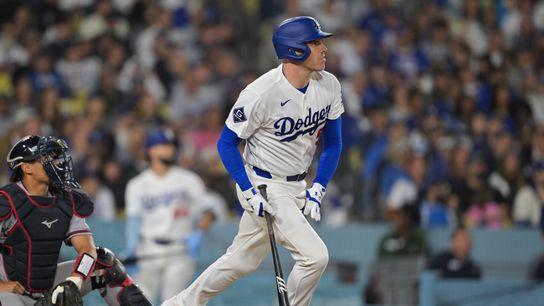
Freeman’s Century Mark: A Quiet Statement Amidst Chavez Ravine’s Early October Chill
POLICY WIRE — Los Angeles, CA — There was a certain inevitability to the whole affair. Not necessarily the long ball itself, but the almost clinical precision with which Freddie Freeman navigated the...

POLICY WIRE — Los Angeles, CA — There was a certain inevitability to the whole affair. Not necessarily the long ball itself, but the almost clinical precision with which Freddie Freeman navigated the evening, adding another, quite significant, decimal to his Dodgers ledger. Long before the crack of the bat reverberated across Chavez Ravine on Friday, something deeper was at play; a palpable tension born of a marquee matchup in what should, by all meteorological and calendrical rights, be early summer. Instead, it felt like October. And baseball, as we all know, makes its own rules about seasons.
It began as ‘Miguel Rojas Bobblehead Night’ — a charming, decidedly minor-league touch for a franchise dripping with generational talent and eye-watering valuations. The early crowd, swelling to a stated 51,255 souls (as reported by Major League Baseball attendance figures), descended not for high drama but for a plastic likeness of a dependable shortstop. And yet, this seemingly pedestrian event became the unlikely precursor to a masterclass in controlled aggression. Rojas, bless him, got his moment, soaked in the crowd’s adoration for a hardscrabble career — a professional athlete, utterly un-ironically, grateful. “It’s humbling, isn’t it?” Rojas mused later. “To know folks come out, spending their hard-earned cash, just for a moment—and then you give them your best. It means everything.”
Then the real business started. Emmet Sheehan, the young hurler whose last outing was, frankly, a bit of a wobble, took the mound. He wasn’t perfect, nobody is against the Braves, but he was sharper, hitting his spots with a renewed authority, velocity returning. The Dodgers weren’t exactly clobbering Braves ace Chris Sale. But they chipped away, Kyle Tucker providing a critical RBI double, and Shohei Ohtani doing what Shohei Ohtani does — finding a way through. He knocked in a run, setting a table with surgical precision.
Because that’s what this club does. And then, there it was. The sixth inning. Freeman, facing his old employer, Atlanta. The swing, economical. The trajectory, unquestionable. His 100th home run as a Dodger. Four hundred thirteen feet, center field. A hundred blasts. Just numbers on a scoreboard to some, but to an organization that spends like a small nation-state, it’s a validation.
“You’re not just swinging for a hit; you’re challenging the league’s top arms,” Freeman told reporters after the game, that familiar earnestness cutting through the celebratory din. “It’s a statement, every single at-bat, against a team with their record. It changes everything when you connect like that.” And it truly did; giving the Dodgers breathing room and, frankly, turning a tight contest into a neatly wrapped 3-1 victory. The bullpen, those unsung architects of so many wins, buttoned it up. They always do, don’t they?
What This Means
📄 POLICY WIRE WHITEPAPER PUBLISHED: PAKISTAN'S NATIONAL SECURITY POLICY PRIORITIES
👉 READ BY CLICKING HEREThe Los Angeles Dodgers operate as a finely tuned economic engine disguised as a baseball team. This isn’t just about sports anymore; it’s about strategic asset acquisition — and portfolio management. The continued, almost ruthless, efficiency of their roster — featuring a mix of astronomical salaries and developmental talent — reflects a broader trend in global capital: concentrating value. For regions like South Asia, where the national sport often commands little international broadcast revenue, the sheer financial disparity in professional leagues such as MLB is a stark reminder of uneven economic development and entertainment consumption patterns. Pakistan, for instance, adores cricket; but does it export its stars at this scale, or attract capital like this?
The Dodgers’ recent victory, anchored by Freeman’s milestone, highlights more than just athletic prowess. It showcases the delicate balance of maximizing investment in established stars while cultivating burgeoning talent. The brutal arithmetic of sustained genius requires constant optimization, and the Dodgers are a prime example. The continued dominance in the regular season also sets up their future market positioning, influencing everything from future broadcast deals to global merchandising strategies. They’re not just selling baseball; they’re selling a winning narrative—a policy choice in itself. But perhaps the most telling aspect is how quickly expectations reset. A milestone becomes a footnote. A big win simply, another building block. It’s a relentless, perhaps unsustainable, pursuit of the ultimate prize, often irrespective of the financial or emotional costs along the way.
But the true policy implications here aren’t just about financial might. They extend to player development models, salary cap philosophies (or lack thereof, in baseball), and even global talent migration. These big league franchises are increasingly global entities, scouring every corner of the planet for talent that can drive returns—even if the sport itself remains a niche interest in many potential markets. They’re, after all, competing not just for championships, but for eyeballs — and dollars. And they aren’t losing. They can’t afford to.