

One Year after Marka-e-Haq: DG ISPR’s Message to the Region
A year following what what Pakistan officially calls as Marka-e-Haq, the Director General ISPR gave one of the most politically loaded and stratumatically dense press conferences in recent history....

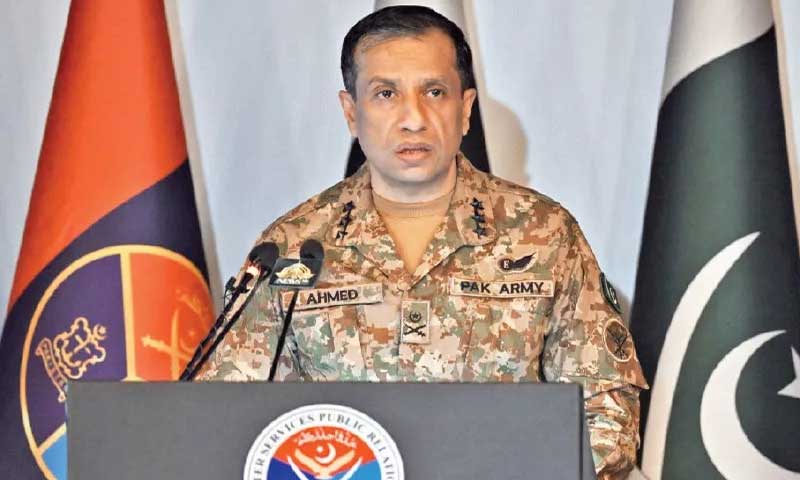
A year following what what Pakistan officially calls as Marka-e-Haq, the Director General ISPR gave one of the most politically loaded and stratumatically dense press conferences in recent history. It was more of a declaration than a military briefing on how Pakistan wants the world to see the consequences of the 2025 crisis with India not just as a battlefield skit, but as a game-changer in regional power dynamics, information warfare, diplomacy, and national cohesion. The press conference detailed what he termed as ten strategic effects of the conflict- all aimed at strengthening the status of Pakistan as a stable capable and confident state in South Asia.
Central to the message was the argument that the decades-long effort of India to paint Pakistan as a terror sponsor has failed. DG ISPR claimed that the global public sees that not Pakistan is the aggressor, but rather an externally backed terror victim. He kept referring to the still unanswered questions about the Pahalgam incident and the following Indian claims that narrative war has obtained the significance equal to regular warfare.
The second significant theme was the quest by Pakistan to establish itself as the stabilizer of the region. The military spokesman said that when India was doing things to heighten tensions with the use of rhetoric and military positioning, Pakistan also on its part played the mature, restrained and measured deterrence. This was a message: Islamabad wants to be perceived not as a problem maker, but as a state that can responsibly deal with crises within a nuclearized neighborhood.
The civil-military environment of India was perhaps the harshest criticized. DG ISPR alleged that New Delhi politicized its military command and militarized its political rhetoric and that this is not good in terms of regional peace. He compared this with the Pakistani model of professional armed forces being consistent with national policy as opposed to partisan theatrics.
The alteration of the nature of war also consumed a lot of time during the press conference. DG ISPR defined modern conflict to be no longer restricted on a boundaries or battlefield. Rather, war is transitanl and crosses cyber operations, space assets, drones, information networks, economic pressure, and even psychological realms. All these fronts, he said, Pakistan was prepared. This framing was established to indicate that Pakistan was a contemporary military power that revolves around the 21st century warfare as opposed to being dependent on traditional soldier formations.
The message on deterrence was clear and straightforward. He claimed that the war of 2025 had restored the deterrence with volume and clarity that showed that there could be no full scale war between the two nuclear neighbors. Any opinion that such a war had any chance of being controlled, he warned, would be insanity. It is still among the most significant indications of the briefing, i.e., Pakistan seeks its potential enemies to understand that there are fewer escalation limits, quicker responses, and more extensive implications than previously encountered.
Another major area in the address was military modernization. New Rocket Force Command of the Pakistan Army, the continuous tri-service integration, the development of more cyber capability, the creation of indigenous systems, and future acquisitions of the Pakistan Air Force were all covered. Air ViceMarshal Tariq Ghazi had gone to greater lengths describing plans such as next-generation platforms, long-range precision-guided weapons, modernized JF-17 fleets, extra J-10C weapons, and over 160 development projects in the pipeline. It was a clear message: Pakistan does not consider the 2025 crisis a final goal but a step towards the rapid modernization.
Diplomatically, the conference aimed at highlighting the growing relevance of Pakistan. The government cited increased relationships with East and Western powers, such as, China, the United States, Saudi Arabia, Türkiye, Egypt and Russia. The supposed mediation efforts by Pakistan towards tensions more broadly in the region was argued to be evidence that the country is now being recognized as a responsible middle power whose strategic utility extends beyond South Asia.
📄 POLICY WIRE WHITEPAPER PUBLISHED: PAKISTAN'S NATIONAL SECURITY POLICY PRIORITIES
👉 READ BY CLICKING HEREHowever, the fact of domestic unity was the most emotionally-charged one. DG ISPR valedictly award numerous times what he termed the Bunyan-um-Marsoos effect- the relationship between the people, the government and the armed forces. He characterized this unity to be the greatest product of the last year, saying that divisive fears and extrinsic anticipations were vindicated.
To a large degree, this press conference was not such a visit to the past of the military exchanges but rather the creation of the political memory of this. It tried to outline the role of Pakistan when the region is post 2025: militarily ready, diplomatically dynamic, technologically flexible and nationally unified.
Regardless of whether critics believe every one of the claims or not, there is one fact, which cannot be denied: the military leadership of the Pakistani society is no longer talking the language of defense only. It is talking the language of strategic story, geopolitical power, and deterrence of the future. A year later, Marka-e-Haq, the message of Pakistan, was unambiguous: it feels that it has come out stronger than ever.
Author