


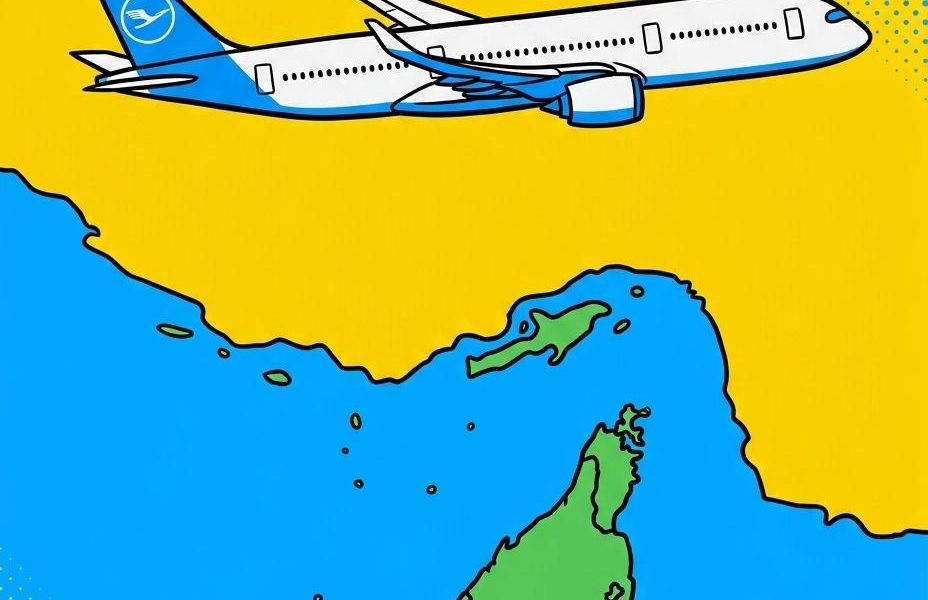
Turbulence Beyond the Horizon: Lufthansa Navigates a Geopolitical Minefield
POLICY WIRE — Frankfurt, Germany — The subtle shift of an airline’s flight path, a barely perceptible adjustment on a radar screen, might seem a prosaic detail in the grand tapestry of...

POLICY WIRE — Frankfurt, Germany — The subtle shift of an airline’s flight path, a barely perceptible adjustment on a radar screen, might seem a prosaic detail in the grand tapestry of international relations. Yet, it’s often in these granular operational changes that the true cost of geopolitical friction becomes most palpable. As global powers continue their delicate, often belligerent, dance around the Strait of Hormuz, Lufthansa—Germany’s venerable flag carrier—isn’t just flying above it all; it’s meticulously navigating around the brewing tempest, quietly redrawing the very lines of the sky.
It’s not the thunderous pronouncements from Tehran or Washington that truly define the Strait’s current volatility for the world’s airlines. It’s the silent, calculated recalibration of flight plans, a logistical ballet performed daily to ensure safety and maintain schedules. Lufthansa, like many other carriers, has taken decisive action, eschewing the airspace immediately adjacent to the Strait of Hormuz. This strategic avoidance isn’t merely about perceived risk; it’s about the cold, hard calculus of operational prudence.
And what does this mean for the everyday traveler, or the broader economic fabric? Longer flight times, naturally. Increased fuel consumption, invariably. But behind the headlines, it’s a stark reminder that even the most advanced commercial aviation systems remain profoundly vulnerable to earthly squabbles. “Our mandate remains passenger safety and operational efficiency; geopolitical turbulence, while challenging, necessitates agile adaptation,” shot back Carsten Spohr, CEO of Lufthansa Group, in a recent interview. “We’ve optimized routes, yes, but the hidden costs, both financial — and logistical, are substantial.”
The Strait of Hormuz, a narrow waterway connecting the Persian Gulf to the Arabian Sea, remains a lynchpin of global trade, particularly for oil. Its strategic significance means that any escalation here sends immediate tremors through financial markets and logistics networks worldwide. For aviation, it creates an operational headache. Flights from Europe to Asia, — and vice-versa, traditionally traverse segments of this region. When that corridor tightens, alternatives must be found, often extending routes over safer, albeit longer, airspace.
Still, the impact isn’t confined to Western carriers. Countries like Pakistan, for instance, with its own national carrier and burgeoning regional connections, depend heavily on stable air corridors through and around the Gulf. Pakistani flights to Europe and North America often utilize airspace that could be indirectly affected by Hormuz tensions. A surge in fuel prices due to a perceived threat in the Strait, or even the necessity of longer flight paths for regional carriers like Pakistan International Airlines (PIA), directly impacts their already strained balance sheets and ultimately, ticket prices for their populace. It’s a localized tension with thoroughly global — and specifically regional — repercussions.
The ramifications extend beyond mere mileage. Every extra minute in the air translates to more fuel burned, more crew hours, — and increased maintenance cycles. Aviation analytics firm OAG reported a 1.5% increase in flight distances for some carriers avoiding the immediate vicinity of the Strait of Hormuz, which, for a major airline group like Lufthansa, can translate into millions in additional operational expenditure annually. That’s a sum not easily absorbed, especially when airlines are still recalibrating after years of pandemic-induced losses (and considering the soaring hydrocarbon costs they already face).
📄 POLICY WIRE WHITEPAPER PUBLISHED: PAKISTAN'S NATIONAL SECURITY POLICY PRIORITIES
👉 READ BY CLICKING HERE“The Strait of Hormuz isn’t just a chokepoint for oil; it’s a barometer for regional instability,” observed Dr. Fatima Zahra, Senior Fellow at the Gulf Policy Institute, speaking from Islamabad. “When airspace over such critical arteries becomes contested, it sends ripples far beyond the immediate theatre, impacting everything from cargo insurance to consumer prices globally. This isn’t just about Lufthansa; it’s about the systemic vulnerability of our interconnected world, where a whisper of tension in one strategic location can subtly shatter oil markets and re-map flight paths.”
At its core, Lufthansa’s quiet re-routing is a corporate pragmatism lesson: adapt or face potentially catastrophic consequences. They’ve opted for a longer, costlier path over a shorter, riskier one. This isn’t about profit maximization in the short term; it’s about fundamental business continuity in an increasingly unpredictable world. It’s a stark illustration of how commercial decisions are increasingly dictated by geopolitical currents, transforming flight operations into a continuous exercise in risk assessment.
What This Means
The ongoing adjustments by major carriers like Lufthansa in response to Hormuz-related tensions underscore a critical shift in global commercial strategy. Politically, it highlights how regional flashpoints can hold the wider world hostage, forcing private entities to bear the brunt of nation-state disagreements. It also quietly empowers states that control alternative air corridors or offer stable refueling points (Saudi Arabia, UAE, and Oman becoming increasingly pivotal in this re-routing). Economically, these longer routes aren’t just about added fuel costs; they contribute to higher air freight charges, potentially impacting supply chains and consumer goods prices globally. For air travel, it normalizes longer journey times and higher ticket prices, embedding a ‘geopolitical premium’ into the cost of flying. it serves as a wake-up call for nations heavily reliant on air travel and trade—like many in South Asia—to diversify their logistical dependencies and perhaps invest more deeply in regional security cooperation. This isn’t just an airline’s problem; it’s a global symptom.
So, the next time you track a flight, consider the invisible forces at play. Those seemingly small deviations on a flight map aren’t arbitrary; they’re the calculated outcomes of an intricate dance between commerce and conflict, a visible manifestation of unseen pressures. It’s a delicate balance, indeed.