


The Fragile Calculus: When a Faltered Shot Exposes Systemic Vulnerability
POLICY WIRE — Los Angeles, CA — Sometimes, the grandest ambitions unravel not with a bang, but with the quiet thud of a missed three-pointer. While headlines fixate on box scores and playoff...

POLICY WIRE — Los Angeles, CA — Sometimes, the grandest ambitions unravel not with a bang, but with the quiet thud of a missed three-pointer. While headlines fixate on box scores and playoff narratives, Tuesday night’s Western Conference semifinals opener between the Los Angeles Lakers and the Oklahoma City Thunder offered a stark, unvarnished glimpse into the perilous calculus of systemic vulnerability. It wasn’t merely a basketball game; it was a clinical study in how a singular point of failure, amid swirling expectations and high stakes, can derail an entire meticulously constructed strategy.
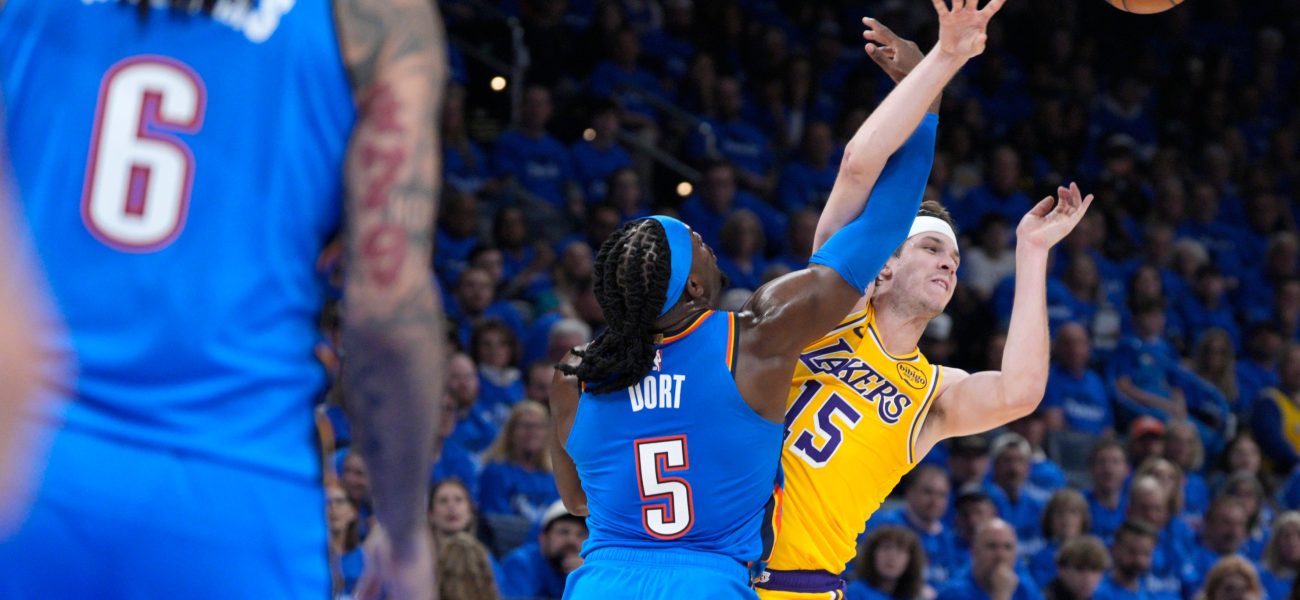
The moment itself was innocuous enough: five minutes and eight seconds left in the third quarter, the Lakers trailing by a manageable six points. Austin Reaves, a perimeter threat of demonstrable caliber, found himself open for a shot that could have halved the deficit, imbuing his struggling squad with much-needed psychological oxygen. He typically buries such opportunities. But this time, he didn’t. The ball caromed off the rim, a silent harbinger of the collapse to follow. Jaxson Hayes, scrambling for the rebound, promptly turned the ball over. OKC’s Lu Dort capitalized with an immediate three-pointer. An instant six-point swing. And the cascading failures weren’t over; Reaves, moments later, coughed up a bad pass, gifting Cason Wallace a steal and a layup. That’s an eight-point momentum shift, cementing an 11-point Thunder lead that, despite Coach JJ Redick’s post-game assertion that it never felt out of reach “until the very end,” effectively sealed the Lakers’ fate in the 108-90 drubbing.
Behind the headlines of athletic prowess and team dynamics lies a more profound narrative: the disproportionate impact of a critical node’s performance. Reaves, recently returned from an oblique injury that sidelined him for a month, was visibly off. He connected on a paltry 3 of 16 shots, scored a meager eight points in 36 minutes, and missed all five of his attempts from beyond the arc. His self-assessment was brutal, if laconic: “Nobody cares about that. I gotta go out there and play better.” This pithy declaration cuts to the core of performance-driven environments, where personal adversity — however valid — is often secondary to output.
The Lakers, for their part, shot a dismal 41% from the field — and a particularly chilling 33% from three-point range. The Thunder, conversely, converted 49% of their field goals and 43% from deep – a statistical chasm that left no margin for error for the Lakers. This chasm, however, wasn’t solely attributable to Reaves’ off-night. It was exacerbated by the lingering absence of superstar Luka Doncic, whose hamstring injury against the Thunder in April continues to render him unavailable. His prodigious scoring and playmaking — he averages 34 points, 8 rebounds, and 9 assists per game — leave an irreplaceable void.
LeBron James, the undisputed patriarch of the Lakers’ contingent, acknowledged the systemic challenge. “We’re playing against the No. 1 defensive team in the NBA as far as the ratings,” he observed, pointing to the gaping hole left by Doncic. “When you play against great defenses, you have to have guys that can attract multiple defenders on the floor at all times.” This isn’t just sports-speak; it’s a commentary on strategic depth, on the necessity of diverse capabilities to overwhelm an opponent’s resilience. Without Doncic, the burden on others, particularly Reaves, became untenable, exposing a critical structural weakness.
And so, while the Lakers managed to contain reigning MVP Shai Gilgeous-Alexander to 18 points — a tactical victory in isolation — it ultimately proved inconsequential. The offensive engine sputtered. The team simply couldn’t find consistent pathways to scoring, illustrating the perilous analytics of potential when surface numbers mask systemic rot. Their defensive effort, while commendable, couldn’t compensate for the pervasive offensive drought.
📄 POLICY WIRE WHITEPAPER PUBLISHED: PAKISTAN'S NATIONAL SECURITY POLICY PRIORITIES
👉 READ BY CLICKING HEREWhat This Means
The Lakers’ predicament, stripped of its sporting veneer, serves as a compelling microcosm for broader geopolitical and economic challenges. The reliance on a singular, indispensable talent like Doncic mirrors the vulnerability of nations whose economies are overly dependent on a single commodity or a handful of key industries. When that primary engine falters — be it through injury, market shock, or geopolitical upheaval — the ripple effects can be catastrophic, exposing the fragility of an entire system. Just as the Lakers scrambled for offensive solutions without their primary playmaker, governments find themselves scrambling for diversification or alternative strategies when core pillars unexpectedly crumble.
Consider, for instance, the immense pressure on individuals and institutions within emerging economies, particularly across South Asia and the Muslim world. The expectation for seamless performance, for overcoming structural disadvantages, is profound. A misstep, like Reaves’ critical misses, can magnify perceived weaknesses, undermining investor confidence or geopolitical standing. It’s not simply a matter of individual failure but the cumulative effect on an ecosystem already operating under immense duress. The hope invested in a rising star or a promising policy initiative can quickly dissipate if foundational elements, however seemingly minor, prove unreliable. This game, ultimately, wasn’t just about baskets; it was a potent reminder that even the most formidable entities harbor silent fissures, and that the illusion of control can vanish in the blink of an eye when a crucial link in the chain breaks.
Still, the narrative of recovery — and adaptation persists. LeBron’s faith in Reaves, despite the rough outing — “He’s been out a month… But his presence alone helps us no matter what” — underscores the long-term investment in human capital, even when short-term returns are disappointing. It’s a testament to the belief that resilience, and not just immediate perfection, dictates ultimate success in any high-stakes arena.