


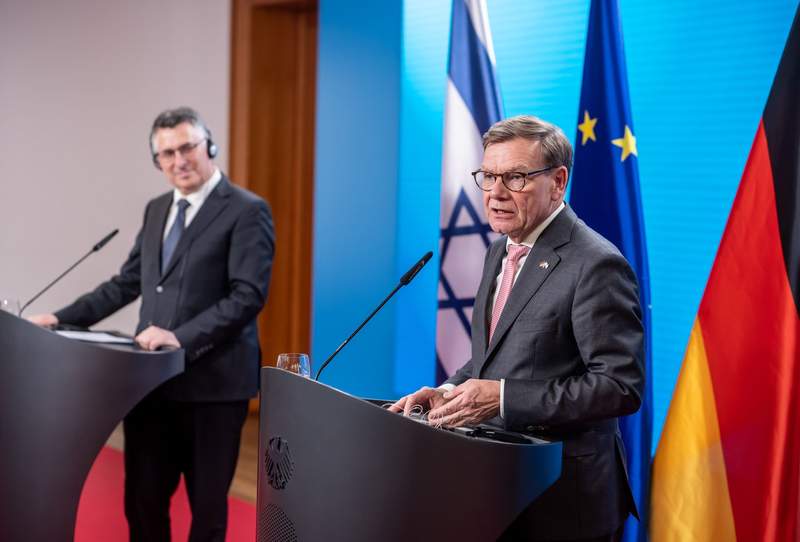
Beirut’s Tightrope: Germany Cautions Against Lebanon Becoming a New War Theatre
POLICY WIRE — Beirut, Lebanon — It’s a familiar, chilling echo in the halls of Lebanese diplomacy: the persistent thrum of regional instability threatening to engulf a nation perpetually teetering on...

POLICY WIRE — Beirut, Lebanon — It’s a familiar, chilling echo in the halls of Lebanese diplomacy: the persistent thrum of regional instability threatening to engulf a nation perpetually teetering on the precipice. Beirut, a city scarred by cycles of external interference and internal schism, finds itself once again clinging to that precarious edge, its fate often dictated by forces beyond its immediate control. So, when Germany’s top diplomat, Annalena Baerbock, touched down this week, her mission wasn’t merely to issue a formal caution; it was to articulate a frantic, almost desperate, plea against the very historical currents that have so often consumed this delicate Levantine state.
Baerbock’s visit unfolded against a backdrop of escalating cross-border skirmishes between Israel and Hezbollah, an unsettling drumbeat that’s grown louder since October. It’s a volatile equation, one where a misstep — or a deliberate provocation — could detonate a much wider conflagration. And Germany, keenly aware of Europe’s own fragile security architecture, isn’t keen on seeing another inferno blaze in its immediate neighborhood.
“Lebanon cannot, and must not, be allowed to become the theater for a regional conflagration,” Baerbock asserted during her Beirut visit, her tone betraying a profound apprehension as she addressed officials. “The consequences for its people — who’ve already endured so much — and for the wider Middle East would be catastrophic, a cascade we simply cannot afford to unleash. We’re here to offer our unequivocal support for a path of de-escalation, of diplomatic resolution.” It wasn’t just diplomatic niceties; it felt like a genuinely impassioned appeal.
But the tightrope Lebanon walks isn’t solely defined by external pressures. Its own political paralysis, coupled with an economic meltdown of historic proportions, leaves it uniquely vulnerable. For years, the country has been mired in governmental gridlock, unable to elect a president or implement meaningful reforms. This internal fragility, a persistent national trauma, amplifies the risk of any external shock reverberating disastrously through its already fractured society.
“We’re caught, as ever, between powerful currents,” remarked Abdallah Bou Habib, Lebanon’s caretaker Foreign Minister, in a terse exchange with reporters following Baerbock’s departure. “Our survival hinges on de-escalation, on a path that recognizes our sovereignty, not one that demands we choose sides in a conflict that isn’t inherently ours to ignite. It’s a balance few outside our borders truly grasp.” He spoke with a weariness that’s become a hallmark of Lebanese political discourse.
Still, the stakes are undeniably high. Hezbollah, a heavily armed political party and militant group, effectively operates as a state within a state, its allegiance often divided between its national obligations and its ties to Tehran. Its ongoing exchanges of fire with Israel have already displaced tens of thousands of civilians on both sides of the border, painting a grim picture of what a full-blown conflict would entail. And, one might argue, this isn’t just about Lebanon; it’s about the broader trajectory of regional stability.
At its core, the situation in Lebanon resonates far beyond its immediate geographical confines. Across the Muslim world, from Cairo to Islamabad, the specter of a widening conflict in the Levant elicits deep-seated anxieties. Concerns about civilian casualties, the potential for yet another devastating refugee crisis, and the perceived infringement on national sovereignty often dominate headlines. Countries like Pakistan, while geographically distant, watch with a particular apprehension, aware of how regional flashpoints can destabilize broader geopolitical balances and ignite fervent, sometimes unpredictable, public sentiments. It’s a constant reminder that the destinies of these nations, however disparate, are frequently interwoven by shared histories and religious identities.
📄 POLICY WIRE WHITEPAPER PUBLISHED: PAKISTAN'S NATIONAL SECURITY POLICY PRIORITIES
👉 READ BY CLICKING HEREThe economic toll, too, is devastating. The World Bank reported in October 2023 that Lebanon’s economy has contracted by 39.9% since 2018, marking one of the worst economic collapses globally in over a century. Imagine, for a moment, a nation enduring such a downturn, then facing the immediate threat of full-scale war. That’s Lebanon’s stark reality. So, Baerbock’s intervention isn’t just humanitarian; it’s a strategic maneuver to prevent a complete societal breakdown that would inevitably send ripples of instability throughout the Mediterranean and beyond.
Behind the headlines, diplomatic shuttles like Baerbock’s underscore a desperate, multinational effort to avert the seemingly inevitable. But without a genuine commitment to de-escalation from all involved parties — and that’s a big ‘without’ — Lebanon may yet find itself sacrificed on the altar of regional power plays. It’s a testament to the enduring challenges of the Middle East, where peace often feels like a fleeting whisper against the roar of conflict. And frankly, the world can’t afford another humanitarian catastrophe there.
What This Means
Germany’s fervent diplomatic push reflects a stark recognition: the regional stability of the Middle East is inextricably linked to European security. A full-scale conflict in Lebanon wouldn’t just be a localized tragedy; it’d trigger a massive refugee influx into Europe, further strain global economies, and potentially empower extremist elements. Politically, it would solidify an already dangerous trend of proxy warfare, undermining international norms and institutions. The collapse of Lebanon’s state apparatus, already reeling, would create a vacuum, fostering lawlessness and potentially allowing other non-state actors to flourish, exacerbating the broader security landscape of the Mediterranean.
Economically, for Lebanon itself, a war would be nothing short of an annihilation. Its tourism sector, once a glimmer of hope, would evaporate. The already hyperinflated currency would become utterly worthless. International aid efforts, while robust, wouldn’t compensate for the fundamental destruction of infrastructure and human capital. For the wider region, shipping lanes could be imperiled, energy markets would undoubtedly spike, and the fragile economies of neighboring states would face immense pressure. Germany’s concern, therefore, isn’t altruism alone; it’s a pragmatic defense of its own, and Europe’s, strategic interests against a contagion of chaos.