

Orchestrated Ascent: The Subtle Art of Power Projection in the Modern Entertainment-Industrial Complex
POLICY WIRE — Washington D.C., USA — It wasn’t the brute strength, nor even the dazzling aerial theatrics, that truly captured the discerning eye during Oba Femi’s recent...

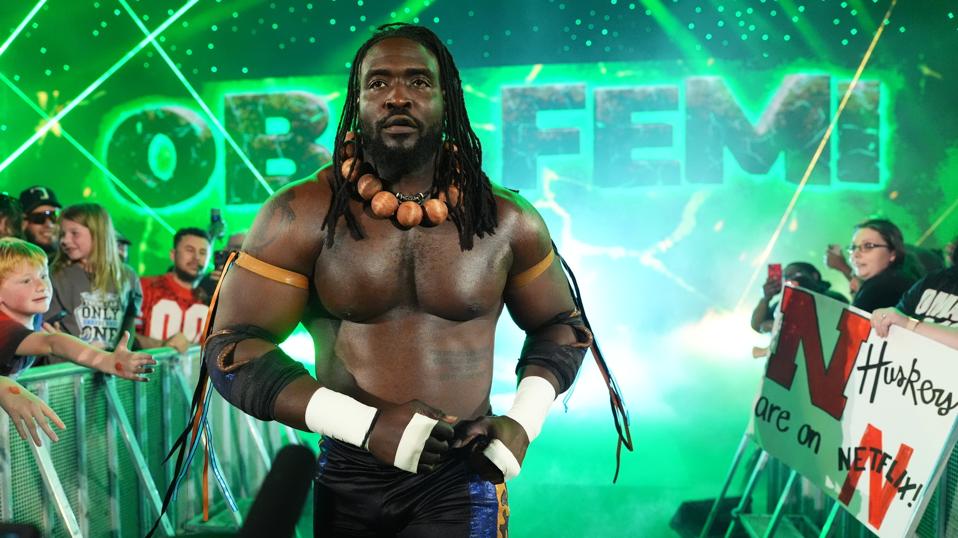
POLICY WIRE — Washington D.C., USA — It wasn’t the brute strength, nor even the dazzling aerial theatrics, that truly captured the discerning eye during Oba Femi’s recent outing on Monday Night RAW. Rather, it was the meticulous architectural precision of his public emergence — a masterclass in strategic narrative construction seldom seen with such deliberate efficacy in today’s frenzied media ecosystem. We’re observing a carefully calibrated ascent, not an accidental one.
The spectacle unfolded in Omaha, Nebraska, where Femi — a figure of imposing physicality — engaged in an ‘open challenge’ that, behind the scenes, was anything but impromptu. This wasn’t just a wrestling match; it was a carefully plotted policy paper on brand development, delivered with bone-jarring impact. The opponent, Otis, a former tag team champion of considerable girth and unexpected agility, was no mere sacrificial lamb. He was, in fact, the perfect foil, designed to amplify Femi’s perceived dominance without diminishing his own credibility. It’s a delicate balance, one policymakers often struggle to strike in rivalrous political landscapes.
At its core, this ongoing narrative isn’t about raw talent alone, though Femi possesses that in spades — a fact underscored by his diving spinning elbow, an improbable maneuver for a man weighing upwards of 300 pounds. It’s about a disciplined, almost academic approach to building a public persona, eschewing the common pitfalls of premature promotion. Many a promising career — in sports, politics, or corporate leadership — has been irrevocably derailed by an organization’s impatient rush to crown its next champion. Not so here. This push is a clinic in delayed gratification, ensuring that when the metaphorical ‘title’ is eventually within reach, it feels utterly deserved, not arbitrarily bestowed.
“We’re not merely creating stars; we’re cultivating institutions,” a senior WWE executive, who requested anonymity to speak frankly about internal strategy, recently conceded. “Every segment, every opponent, every narrative beat — it’s all part of a larger schema to build enduring legitimacy.” And isn’t that the perpetual quest of any entity striving for long-term influence? To transform fleeting popularity into resilient authority?
The decision to feature Femi as more than just a monolithic strongman — injecting elements of comedic timing and nuanced body language — broadens his appeal immeasurably. It signals a depth beyond surface-level attributes, a trait crucial for any figure aiming for sustained public engagement. He’s not just a big, strong guy; he’s a formidable, versatile performer. It’s a strategic diversification of his public portfolio, if you will, ensuring market resilience.
The ‘open challenge’ format itself is a time-honored mechanism for validating ascendancy. It allows for a rotational series of competitive encounters, each testing a different facet of the contender’s capabilities without committing him to a single, potentially exhausting, long-term rivalry too early. It’s a calculated gauntlet, building a compelling resume that, come title contention, speaks for itself. One could draw parallels to Babar Azam’s meticulously managed career trajectory in cricket, where consistent performance against varied opposition cements a star’s stature — a dynamic keenly understood in the competitive sporting cultures of South Asia and the broader Muslim world.
“Authenticity, even when meticulously engineered, resonates. The public, they crave a narrative of earned success,” quipped Dr. Arsalan Khan, a Lahore-based political communications analyst with a keen eye on global media trends. “They want to believe the triumph is a consequence of trials overcome, not merely a decree from on high. It’s a global phenomenon, this demand for perceived meritocracy.” Indeed, the perception of merit — even when guided by astute booking — is paramount.
This strategic push is playing out against a backdrop of robust financial performance. WWE’s Q4 2023 revenue reached $385.7 million, an increase of 14% year-over-year, according to TKO Group Holdings’ official reports — a clear indicator that intelligent talent development directly correlates with economic dividends. The product’s appeal, global in its reach, ensures such narratives transcend geographical boundaries. So, what’s next? Probably a swift, agile heel with a cadre of associates — perhaps an Austin Theory — to offer a different sort of challenge, one rife with the potential for external interference, further diversifying Femi’s narrative arc. That’s just good policy planning, isn’t it?
What This Means
The curated rise of Oba Femi offers a compelling blueprint for how any institution, from political parties to multinational corporations, can meticulously engineer and project power in an increasingly fragmented and skeptical public sphere. It underscores that organic growth is often a myth, replaced by strategic cultivation. The ‘open challenge’ format, far from being a simple wrestling trope, serves as a potent metaphor for a series of carefully managed public tests — policy debates, market penetrations, or electoral campaigns — designed to legitimize a burgeoning force.
Economically, this approach safeguards investment in talent. Prematurely elevating a figure can lead to burnout or rejection, squandering significant capital. By patiently building Femi’s profile through diverse challenges, WWE minimizes risk — and maximizes long-term value. Politically, it’s a lesson in building a durable mandate: expose a leader to varied challenges, allow them to demonstrate adaptability and resilience, and ensure their triumphs are perceived as hard-won victories. This method — a blend of strategic planning, controlled exposure, and narrative diversification — is ultimately about creating not just a popular figure, but a consequential one. It’s an affirmation that even in the most theatrical of arenas, the principles of astute statecraft still prevail.