


The Portable Wall: Vietnam’s Enduring Shadow Traverses Small-Town America
POLICY WIRE — King, USA — The granite pilgrimage began again, not on the hallowed grounds of Washington’s National Mall, but in a modest town square — a stark, portable echo of a nation’s...

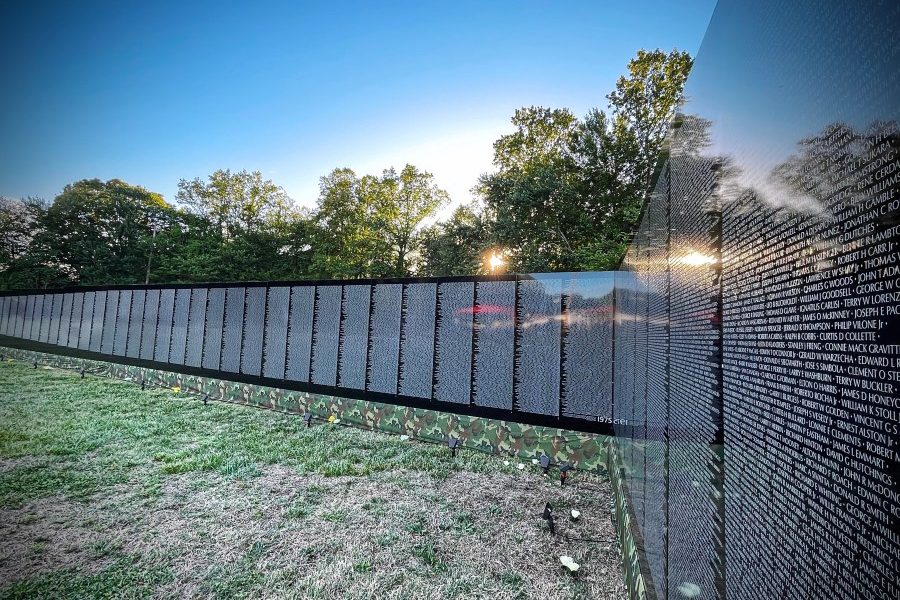
POLICY WIRE — King, USA — The granite pilgrimage began again, not on the hallowed grounds of Washington’s National Mall, but in a modest town square — a stark, portable echo of a nation’s enduring, contentious wound. It’s a wall, you see, but it’s far more than mere stone; it’s a canvas for grief, a register of names, a mobile confessional for a war America has never quite reconciled with itself. And now, a scaled-down rendition of the Vietnam Veterans Memorial has unfurled its solemn presence in King, North Carolina, drawing visitors who carry decades-old burdens, or perhaps, simply a gnawing curiosity.
It’s dubbed ‘The Wall That Heals,’ an innocuous enough title, but its impact is anything but placid. Measuring 375 feet long and 7.5 feet high at its apex, this touring replica doesn’t just display the 58,281 names etched into its black panels; it resurrects a moment in history, compelling communities to confront what was often sidestepped, forgotten, or intentionally buried. The air around it often feels heavy — thick with unspoken memories, punctuated by the occasional sob or the quiet clinking of dog tags laid at the base. It’s a deliberate provocation, a gentle but insistent demand for remembrance.
Behind the headlines of its arrival lies a deeper policy conversation about national memory and the persistent cost of military engagements. These traveling tributes aren’t just monuments; they’re mobile confessionals, argued Mayor Evelyn Reed of King, her voice a low register against the hum of passing traffic. “They force us to confront what we’d rather forget, but desperately need to remember,” she shot back, her gaze fixed on the unfolding panels. “It’s about understanding the human toll, not just the strategic gains or losses.” For many, it’s a first, or perhaps final, opportunity to trace a name, to leave a memento, to finally say a proper goodbye.
And then there are the veterans themselves — the silent witnesses, the ones who returned to a country often hostile or indifferent. Sergeant Frank Miller (Ret.), a veteran of the 101st Airborne, his eyes distant, shared a familiar sentiment. “For many of us, this wall—any wall with those names—is the only place we’ll ever truly find closure. It’s not about the politics; it’s about the names,” he offered, his hand hovering over a panel as if to find an old comrade by touch alone. His words, though quiet, resonated with the weight of generations, a testament to the fact that wars don’t end when the last shot is fired; they merely transition into a different, more insidious form of attrition.
The echoes of such sacrifice aren’t confined to American soil, you see. From the unforgiving mountains of Afghanistan, where Pakistan’s own complex history intertwines with global power plays, to the battle-scarred landscapes of Syria and Yemen, the toll of protracted conflict inscribes itself similarly onto a nation’s psyche — and its ledgers. The universal language of loss, it’s rarely translated with nuance.
📄 POLICY WIRE WHITEPAPER PUBLISHED: PAKISTAN'S NATIONAL SECURITY POLICY PRIORITIES
👉 READ BY CLICKING HEREStill, the King installation, organized by local veteran groups and community volunteers, isn’t just about solemn reflection. It’s also an act of collective absolution, a communal embrace decades overdue. The official tally of American service members who died in the Vietnam War, according to the National Archives, stands at a staggering 58,281 — a data point that, while numerically precise, fails to capture the immeasurable ripple effect of grief, trauma, and societal upheaval. That’s a statistic, isn’t it, that transcends mere digits, morphing into a testament to lives cut short and futures erased.
What This Means
The consistent touring of ‘The Wall That Heals’ across America isn’t a mere historical curiosity; it’s a significant, if understated, piece of public policy. It acts as a continuous, decentralized mechanism for societal healing, acknowledging a veteran population that often felt — and sometimes still feels — marginalized. Economically, while the direct cost of transporting and setting up such a monument is relatively modest (often borne by local organizations and grants), the broader implications are profound. It represents a small, yet visible, investment in the mental and emotional health of a generation, a tacit admission that the cost of war extends far beyond battlefield expenditures, influencing everything from healthcare budgets for veteran services to the fabric of community trust. Policy makers, whether they intend it or not, utilize these public displays to gauge the national mood, to assess the lingering effects of past military ventures, and to inform future decisions on intervention and veteran welfare. It’s a public accounting, a grim ledger, but also an indispensable one for a nation perennially grappling with the high cost of humanity.
And as we move further from direct involvement in large-scale conventional conflicts, these symbols of remembrance become even more crucial. They’re physical touchstones in an increasingly digital world, offering a tangible connection to a past that, for all its complexities, shaped the very contours of modern American identity. It’s a pilgrimage, this wall, that allows for an essential, ongoing dialogue between the living and the honored dead, an unspoken contract renewed with each name found and each silent tear shed.