


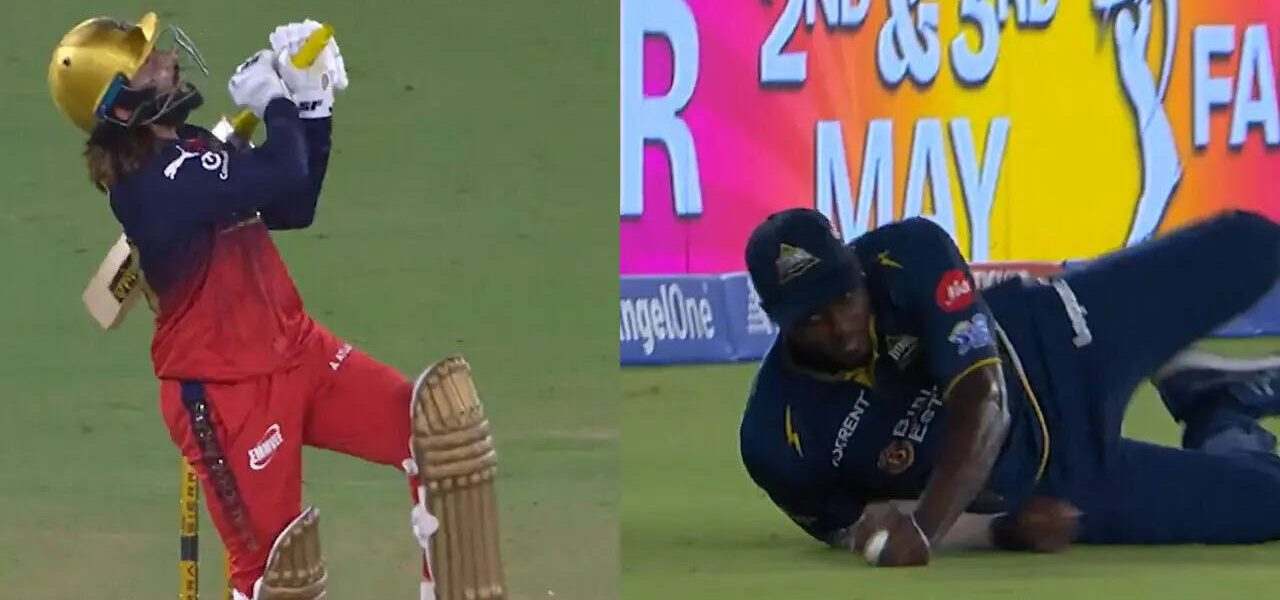
The Unseen Calculus of a Controversial Catch: IPL’s Enduring Umpiring Conundrum
POLICY WIRE — Ahmedabad, India — Not every seismic event announces itself with a tremor. Sometimes, it’s just a low catch — a fleeting moment of athletic prowess — that ignites a...

POLICY WIRE — Ahmedabad, India — Not every seismic event announces itself with a tremor. Sometimes, it’s just a low catch — a fleeting moment of athletic prowess — that ignites a conflagration of doubt, debate, and digital furor, exposing fault lines in the very bedrock of professional sport. Such was the case in the recent IPL 2026 clash at the Narendra Modi Stadium, where Gujarat Titans edged out Royal Challengers Bengaluru (RCB) by four wickets, but not before an umpiring decision — or lack thereof — became the evening’s most enduring talking point.
It wasn’t the blistering pace or the boundary-rattling shots that truly defined the contest; rather, it was a split-second judgment on Rajat Patidar’s dismissal that has since rippled through the cricketing world, prompting a broader reckoning with technology, human perception, and the immense stakes involved. Patidar, looking resolute at 19, attempted a pull off Arshad Khan. Jason Holder, a formidable presence, dived forward, snaring what appeared, in real-time, to be a spectacular catch. But — — and this is where the plot thickened — replays proved stubbornly inconclusive. Was the ball truly off the ground? Or did the grass, unseen by the naked eye, merely kiss its surface for a microsecond too long? This wasn’t merely a point of contention; it was an incandescent flashpoint for a league accustomed to high drama.
The third umpire, ensconced in a technological cocoon, weighed the pixels, the angles, the slow-motion — yet, uncertainty persisted. Still, the on-field decision stood: out. The RCB camp, predictably, didn’t take kindly to this verdict. Captain Virat Kohli, his face a canvas of seething frustration, engaged umpires in animated conversation, a familiar sight for anyone who’s followed his career. “It’s baffling, frankly,” Kohli shot back to reporters post-match. “You have all this technology, all these cameras, and still, a decision this consequential comes down to a sliver of doubt that benefits one side. We play with our hearts, — and moments like these, they just deflate you. Where’s the consistency?” His words encapsulate the perennial tension between sporting passion and bureaucratic adherence.
Law 33.3 of the Laws of Cricket stipulates that “A catch is only completed when the fielder has ‘complete control over the ball and his/her movement’. The ball cannot touch the ground before then.” Meanwhile, Law 33.2.2 offers some latitude, permitting a catch if “the ball is held in the hand or hands of a fielder, even if the hand holding the ball is touching the ground.” It’s a nuanced distinction, one that hinges on the ‘control’ and ‘lodgement’ of the ball — a distinction lost on many a fuming fan.
Former India spinner Ravichandran Ashwin, ever the analyst, attempted to demystify the ruling. “Jason Holder’s hands are twice as big as mine. In his hands, the ball almost disappears,” Ashwin opined on his YouTube channel. “So, even if you guys can see the ball through the gap in his fingers, that doesn’t mean that the ball has hit the floor. He has probably wrapped it around. The ball, perhaps, didn’t touch the ground.” His explanation offered a perspective rooted in practical physics, but it did little to quell the indignation of those convinced otherwise.
📄 POLICY WIRE WHITEPAPER PUBLISHED: PAKISTAN'S NATIONAL SECURITY POLICY PRIORITIES
👉 READ BY CLICKING HEREFor the league itself, such controversies are a double-edged sword. While they fuel engagement — controversial moments often amplify viewership, as evidenced by a 2023 surge — they also test the public’s trust. “The umpiring protocols are exhaustive, designed to ensure fairness within the framework of the Laws of Cricket,” remarked Mr. Suresh Kumar, a spokesperson for the Board of Control for Cricket in India (BCCI), when queried on the matter. “While we understand the immediate emotional response from players and fans, the third umpire’s role is to apply those laws objectively, based on the available visual evidence. It’s a high-pressure environment, but the integrity of the game is paramount.”
At its core, this incident underscores the immense cultural footprint of cricket across South Asia. In a region where the sport transcends mere entertainment, becoming a proxy for national pride and identity, a dubious decision isn’t just a misstep — it’s perceived as an affront. From Karachi to Colombo, Dhaka to Delhi, every contentious call is dissected with an intensity usually reserved for geopolitical shifts. This ubiquitous passion means that such moments, even if fleeting, invariably reverberate far beyond India’s borders, fostering discussions not just about sport, but about fairness, governance, and the often-elusive nature of objective truth in an increasingly subjective world.
What This Means
The Patidar controversy, far from being an isolated blip, serves as a micro-study in the macro-economics and politics of modern sports. The Indian Premier League, a juggernaut valued in the billions, relies heavily on its perceived fairness and the unshakeable belief that “the best team wins.” When that belief is shaken, even by a nuanced interpretation of a rule, it poses a subtle yet significant threat to its brand equity and its immense global appeal. Data from Broadcast Audience Research Council (BARC) India reveals that in 2023, the IPL recorded an average concurrent digital viewership of 16 million during high-stakes matches, a figure that often surged significantly — sometimes by over 20% — during contentious umpiring decisions.
But that’s a double-edged sword. While such controversies can generate immediate spikes in engagement — people love to debate — a pattern of perceived inconsistencies could erode long-term fan loyalty. And that’s a profound economic risk. For teams like RCB, a club with a massive following but no IPL title, such moments aren’t just frustrating; they carry real financial implications, affecting everything from sponsorship deals to merchandise sales. The investment in cutting-edge umpiring technology, ostensibly meant to eliminate error, instead often highlights the irreducible human element — the interpretation — that still governs the game. So, what’s the solution? Perhaps less reliance on perfect clarity from imperfect technology and more acceptance of the human drama that, paradoxically, keeps us all watching. It’s a complex interplay, this pursuit of justice on a cricket field, and it reflects — sometimes starkly — the broader challenges of governance and accountability in our interconnected world, even for something as ostensibly simple as a ball and bat.
📖 GET YOUR FREE COPY NOW OF POLICY WIRE DIGITAL MAGAZINE JULY 2026 EDITION
👉 READ & DOWNLOAD FREE MAGAZINE