


Ohio State’s Gridiron Gambit: Post-Spring Depth Chart Illuminates Collegiate Football’s Precarious Power Play
POLICY WIRE — Columbus, Ohio — The scent of fresh-cut turf had barely dissipated from the spring scrimmage, yet the internal machinations of college football’s perennial titans already churned with...

POLICY WIRE — Columbus, Ohio — The scent of fresh-cut turf had barely dissipated from the spring scrimmage, yet the internal machinations of college football’s perennial titans already churned with the cold, hard logic of a geopolitical strategy session. It isn’t merely about who can throw a spiral or block a blitz; it’s about the ruthless, calculated deployment of human capital in a landscape as fluid as global financial markets. And for Ohio State, America’s sporting behemoth, the projected post-spring depth chart on offense isn’t just a roster — it’s a provisional blueprint for dominion, subject to immediate, brutal revision.
Fifty-one new faces now populate the Buckeyes’ program, a statistic that speaks volumes about the sport’s ceaseless churn. This isn’t your grandfather’s collegiate game, where loyalty was etched in stone — and player movement was an anomaly. Now, the transfer portal functions as a high-stakes, real-time talent exchange, a mechanism that can elevate or eviscerate a program’s prospects with disorienting speed. The National Collegiate Athletic Association (NCAA) reported that over 2,000 Football Bowl Subdivision (FBS) players entered the transfer portal in the 2023-2024 cycle alone, underscoring the unprecedented volatility that defines modern recruitment and retention.
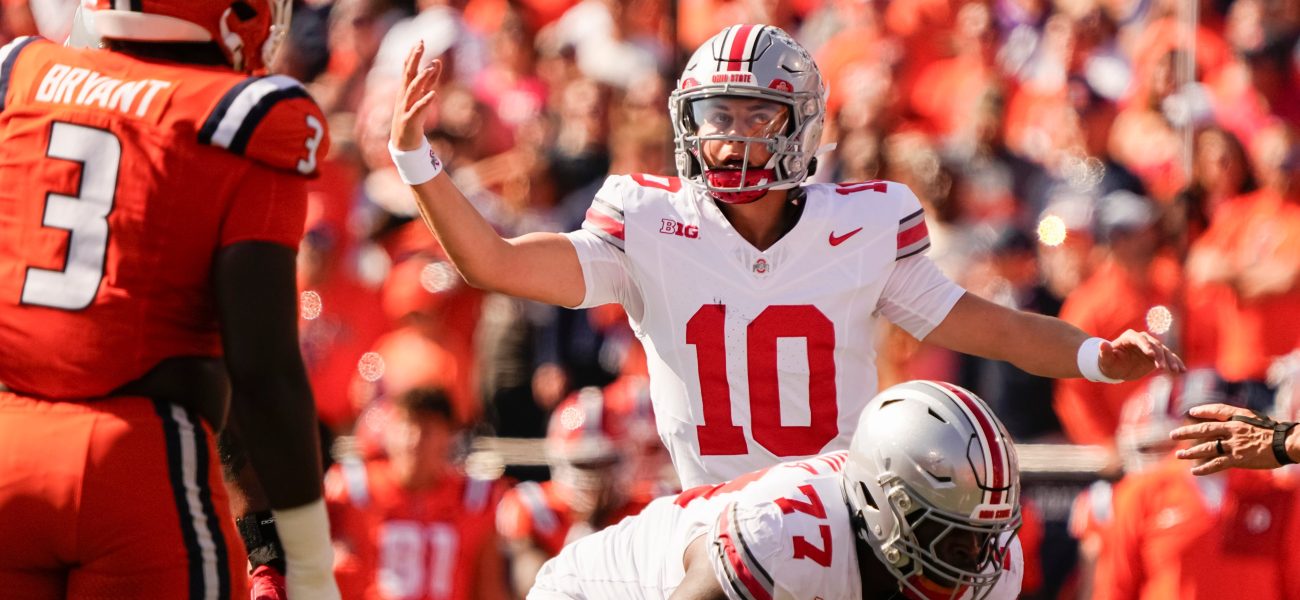
Julian Sayin, the presumptive starter at quarterback, anchors this offensive architecture. A year of meticulous development has, by all accounts, sharpened his command, honing a talent once described by scouts as generational. He’s not just a signal-caller; he’s the operational lynchpin, the CEO of the offensive unit. His understudy, Tavien St. Clair, looms as the heir apparent, a constant reminder that even established leadership operates within a continuous succession plan. The unspoken pressure, however, is palpable. One misstep, one faltering performance, and the market — both on the field and in the transfer portal — reacts with swift, unforgiving arbitrage.
The running back corp, a unit largely shrouded in mystery due to spring injuries, presents a microcosm of this precarious balance. Bo Jackson, a name almost too fitting for gridiron lore, remains the unquestioned starter. But behind him, the calculus shifts, featuring Isaiah West, the dangerous Legend Bey, and Florida transfer Ja’Kobi Jackson. It’s a multi-layered talent stack, a testament to the arms race for elite athleticism. “This isn’t about handouts; it’s about cultivation,” Head Coach Ryan Day shot back during a recent press conference, his voice edged with the intensity of a general before battle. “Every snap, every drill, it’s an assessment, a test of will — and aptitude. The market for talent is fiercely competitive, — and we must always position ourselves at the vanguard.”
📄 POLICY WIRE WHITEPAPER PUBLISHED: PAKISTAN'S NATIONAL SECURITY POLICY PRIORITIES
👉 READ BY CLICKING HEREReceivers, a position of abundant riches, see Jeremiah Smith — and Brandon Inniss as indisputable anchors. Yet, the third starting spot is a high-stakes audition. Ryan Day, like many of his peers, increasingly favors experience — a preference that often sees younger, albeit immensely talented, players biding their time. But five-star phenom Chris Henry Jr. defied that trend, earning his stripes (literally — and figuratively) early, forcing his way into the conversation. His ascent serves as a stark reminder that sheer, unadulterated talent can, at times, supersede strategic longevity, a dynamic not unfamiliar in emerging global markets where disruptive innovation often upends established norms.
The offensive line, often the unsung foundation of any formidable attack, embodies both continuity — and anxiety. Ian Moore at left tackle and Luke Montgomery at left guard represent the core, but a spring plagued by injuries turned this unit into a M.A.S.H. ward (a temporary field hospital, for those not fluent in military acronyms). Their strategy to forgo dipping heavily into the transfer portal for experienced linemen — a calculated gamble on internal development — carries inherent risks. Still, it’s a decision rooted in the program’s enduring belief in its own developmental pipeline, a long-term investment strategy in human capital, much like nations cultivating their indigenous tech talent rather than relying solely on external imports. Athletic Director Gene Smith, ever the pragmatist, offered a rare glimpse into this strategic mindset. “The economic calculus of modern collegiate athletics — particularly for a program of our stature — demands foresight. Investing in talent isn’t merely about wins; it’s about brand equity, donor engagement, and maintaining our fiscal supremacy. We’re running a multi-million-dollar enterprise, after all,” he mused, articulating the profound business underpinnings of Friday night lights and Saturday afternoon spectacle.
What This Means
At its core, this micro-level analysis of an Ohio State football depth chart delineates macro-level truths about contemporary talent economies. The constant pressure, the relentless competition for finite, high-value positions, and the pervasive influence of the transfer portal create an environment akin to a globalized marketplace for skilled labor. The notion of a fixed position, once a bedrock principle, has evaporated, replaced by a fluid hierarchy responsive to performance, opportunity, and financial incentives. This isn’t just about football; it’s a real-time case study in ruthless meritocracy and the strategic deployment of assets. For nations in South Asia, including Pakistan, facing their own challenges in retaining top-tier human capital amidst a globally competitive landscape, the parallels are striking. Young, talented individuals in Karachi or Lahore, much like their collegiate athletic counterparts, are constantly evaluating opportunities, weighing development potential against immediate returns, and navigating opaque pathways to success. The ‘depth chart’ of national talent — whether in science, technology, or entrepreneurship — is equally volatile, shaped by global trends and internal pressures, demanding constant adaptation from policymakers and educational institutions alike. Failure to adapt, as any struggling football program or nation can attest, leads to stagnation, brain drain, and ultimately, a diminished standing on the global stage.
📖 GET YOUR FREE COPY NOW OF POLICY WIRE DIGITAL MAGAZINE JULY 2026 EDITION
👉 READ & DOWNLOAD FREE MAGAZINE