


Trump’s Ultimatum: Germany’s Economic Woes Fuel Transatlantic Rift as Troop Threat Looms
POLICY WIRE — WASHINGTON, D.C. — It wasn’t the rattling of sabres in the Persian Gulf, nor the diplomatic broadsides exchanged between Tehran and Washington, that truly exposed the...

POLICY WIRE — WASHINGTON, D.C. — It wasn’t the rattling of sabres in the Persian Gulf, nor the diplomatic broadsides exchanged between Tehran and Washington, that truly exposed the raw nerve of transatlantic relations this week. No, it was the suffocating grip on global trade — specifically, the economic inertia born from the protracted closure of the Strait of Hormuz — that appears to have pushed the already strained alliance between the United States and Germany to a perilous precipice.
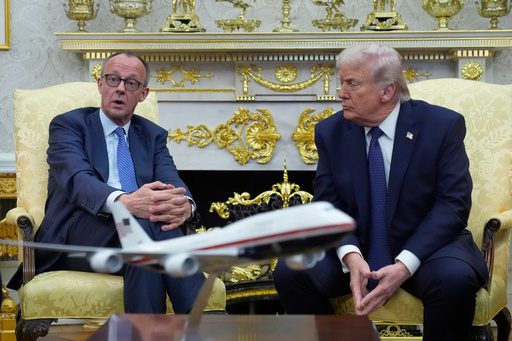
President Donald Trump, never one to shy from a transactional approach to foreign policy, issued a blunt ultimatum Wednesday. He hinted at a significant drawdown of American troops stationed in Germany, a direct response to Chancellor Friedrich Merz’s increasingly pointed criticisms of Washington’s strategy — or perceived lack thereof — in the two-month-old U.S.-Israel conflict with Iran.
Behind the headlines, Merz hadn’t just voiced concerns; he’d painted a stark picture of Europe’s economic agony. “We’re suffering considerably in Germany and in Europe from the consequences of, for example, the closure of the Strait of Hormuz,” Merz declared, his words carrying the weight of industries facing critical supply disruptions. It’s an undeniable truth: international energy agencies have long underscored that roughly 20% of the world’s global oil supply traditionally transits this vital waterway, now effectively sealed since the hostilities commenced on February 28th. That’s a massive choke point, isn’t it?
So, when Merz dared to suggest Washington was being “humiliated” by Iranian leadership — and that the U.S. strategy lacked clarity, Trump’s retort was swift — and unsparing. “The United States is studying and reviewing the possible reduction of Troops in Germany, with a determination to be made over the next short period of time,” Trump posted on his favored social media platform, turning a diplomatic disagreement into a public performance of punitive measures.
This isn’t Trump’s first foray into using troop deployments as a bargaining chip. During his initial White House tenure, he’d similarly threatened to excise thousands of troops from Germany, arguing Berlin wasn’t pulling its weight on defense spending. A planned withdrawal of some 9,500 personnel from the then-34,500-strong contingent was initiated in June 2020, only to be formally halted by Democratic President Joe Biden upon taking office in 2021. Still, the specter of reduced American presence — and the strategic vacuum it could create — has always haunted German defense circles.
But this latest flare-up feels different. It’s less about budgetary contributions — and more about ideological alignment in a contentious war. Merz, despite publicly maintaining his personal rapport with Trump was “as good as ever,” hadn’t minced words about the conflict itself. He’d expressed “doubts from the very beginning about what was started there with the war in Iran.” This particular phrasing — attributing culpability to the U.S. — clearly struck a raw nerve with the American president.
📄 POLICY WIRE WHITEPAPER PUBLISHED: PAKISTAN'S NATIONAL SECURITY POLICY PRIORITIES
👉 READ BY CLICKING HEREAnd Trump, ever predictable in his unpredictability, shot back Tuesday with an acerbic online missive: “The Chancellor of Germany, Friedrich Merz, thinks it’s OK for Iran to have a Nuclear Weapon. He doesn’t know what he’s talking about!” He then added, with characteristic flair, that it was “no surprise that Germany is doing so poorly, both economically and in other respects!” Such observations, particularly from a sitting U.S. president, aren’t just undiplomatic; they’re incendiary.
For decades, Germany has served as a pivotal logistical hub for U.S. operations globally, housing critical facilities like Ramstein Air Base, Landstuhl Regional Medical Center (the largest American hospital outside the U.S.), and the headquarters for U.S. European Command and U.S. Africa Command. Dismantling this infrastructure wouldn’t be a mere accounting adjustment; it’d be a profound reordering of America’s military posture on the continent.
The ramifications of the Iran conflict, exacerbated by the Hormuz closure, also extend far beyond the Euro-Atlantic theatre. The wider Muslim world, from the Gulf states to South Asia, feels the economic ripples — higher energy costs, disrupted trade routes, and heightened geopolitical instability. Pakistan, for instance, a nation perennially grappling with economic vulnerabilities, faces immense pressure from global commodity price swings. This protracted conflict promises only further turbulence, potentially destabilizing an already fragile region.
What This Means
At its core, this diplomatic contretemps underscores a deepening ideological schism within the transatlantic alliance. Trump’s transactional foreign policy, which views allies as either fully compliant partners or liabilities, clashes head-on with Europe’s traditional, multilateralist approach — an approach increasingly focused on its own strategic autonomy and economic resilience. A troop withdrawal from Germany wouldn’t just be a symbolic gesture; it would materially weaken NATO’s collective defense capabilities, potentially creating a vacuum Russia or China might be eager to exploit. Economically, Merz’s lament isn’t hyperbole; Germany, as Europe’s industrial powerhouse, is exquisitely sensitive to disruptions in global trade and energy markets. The closure of the Strait of Hormuz hits Berlin’s bottom line hard, making its government less inclined to uncritically endorse U.S. military adventures that exacerbate such crises. This isn’t just a spat; it’s a profound realignment of interests, forcing Europe to contemplate a future where American security guarantees are neither unconditional nor consistently predictable. It’s a moment that could accelerate Europe’s long-discussed, but rarely achieved, ambition for a truly independent defense posture, albeit under duress.