


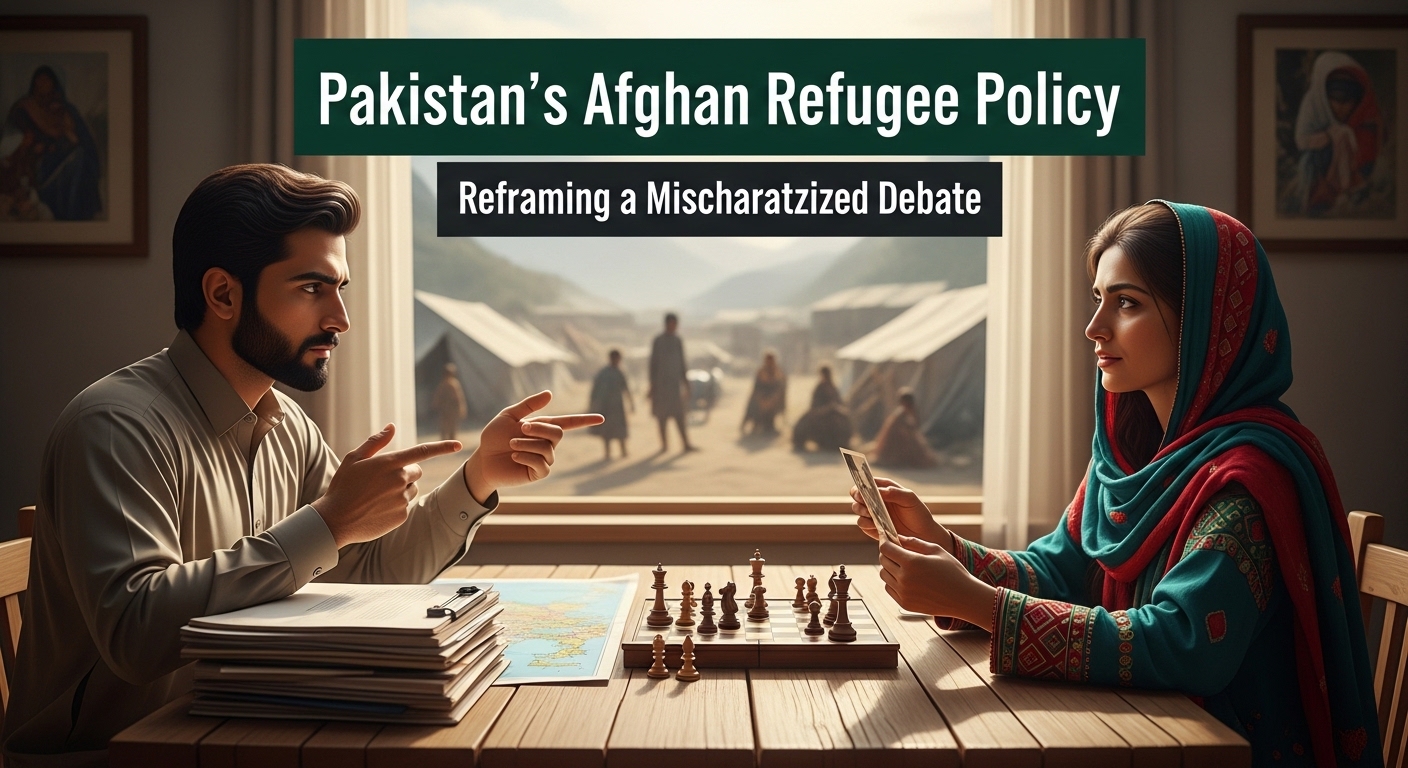
Pakistan’s Afghan Refugee Policy – Reframing a Mischaracterized Debate
In the repatriation of undocumented Afghan nationals, much of the global discourse has been shaped less by legal reality and more by political framing. What is, in essence, a routine exercise of...

In the repatriation of undocumented Afghan nationals, much of the global discourse has been shaped less by legal reality and more by political framing. What is, in essence, a routine exercise of state sovereignty has been recast in some quarters as persecution, an interpretation that does not withstand scrutiny. Pakistan’s policy operates within established domestic law and reflects a principle universally upheld: that states retain the right to regulate entry, residence, and documentation within their borders. From Europe to North America to the Gulf, immigration enforcement is neither exceptional nor controversial; it is foundational to governance.
The mischaracterization stems largely from a conflation of categories. Refugees protected under international frameworks are distinct from undocumented migrants who fall outside formal registration and legal pathways. Pakistan’s current measures are directed at the latter. This distinction is not merely technical; it is central to understanding both the legality and legitimacy of the policy. To overlook it is to reduce a complex administrative process into a simplified moral claim.
Historical context further complicates the prevailing narrative. Since the Soviet invasion of Afghanistan, Pakistan has hosted one of the largest and longest-standing refugee populations in the world. This was not a short-term humanitarian gesture but a sustained commitment spanning decades, often undertaken with limited international burden-sharing. The expectation that such a responsibility can continue indefinitely without documentation, regulation, or eventual normalization finds little precedent globally.
Moreover, the domestic pressures underpinning the policy cannot be ignored. Questions of economic capacity, internal security, and administrative feasibility are not unique to Pakistan; they are precisely the factors that drive immigration enforcement elsewhere. To suggest that Pakistan should operate outside these considerations is to hold it to a standard that few, if any, states meet themselves.
What remains most striking, however, is the selectivity of the criticism. If enforcing immigration law is legitimate in Washington, Brussels, or Riyadh, it cannot logically become persecution in Islamabad. This inconsistency points less to a flaw in Pakistan’s policy and more to a broader pattern of uneven scrutiny. A country that has absorbed millions since 1979 is now being judged not by the scale of its contribution, but by the moment it seeks to regulate it.
A more balanced assessment would also extend accountability beyond Pakistan’s borders. Sustainable repatriation is contingent upon conditions within Afghanistan itself, conditions shaped, in large part, by the governance of the Taliban. Without economic stability, institutional development, and basic security guarantees, outward migration will remain a structural reality. To externalize this entirely onto host states is to address symptoms while ignoring causes.
Ultimately, the debate is not about whether undocumented migration should be regulated; globally, it always is. The question is why Pakistan’s enforcement of a universally accepted principle is being reframed as an exception. Until that inconsistency is addressed and responsibility more equitably distributed, the criticism will remain politically resonant, but analytically unconvincing.
No state permits indefinite undocumented residency, and Pakistan after hosting millions since the Soviet invasion of Afghanistan cannot be expected to do so indefinitely. This is not an abandonment of humanitarian responsibility; it is a transition from open-ended accommodation to regulated governance.
More importantly, the burden of this crisis cannot be externalized indefinitely. Sustainable solutions lie within Afghanistan itself. Without structural stability and viable governance under the Taliban, outward migration will persist regardless of Pakistan’s policies. To ignore this reality while assigning disproportionate blame to a host country is not just analytically weak, it is fundamentally disingenuous.
Author