

Beyond the Highlight Reel: The NFL Draft’s Economic Crucible and Josh Cuevas’s Unexpected Ascent
POLICY WIRE — New York City, USA — The annual NFL Draft, a spectacle meticulously staged to project an image of precise talent evaluation, often functions more like a sprawling, multi-billion-dollar...

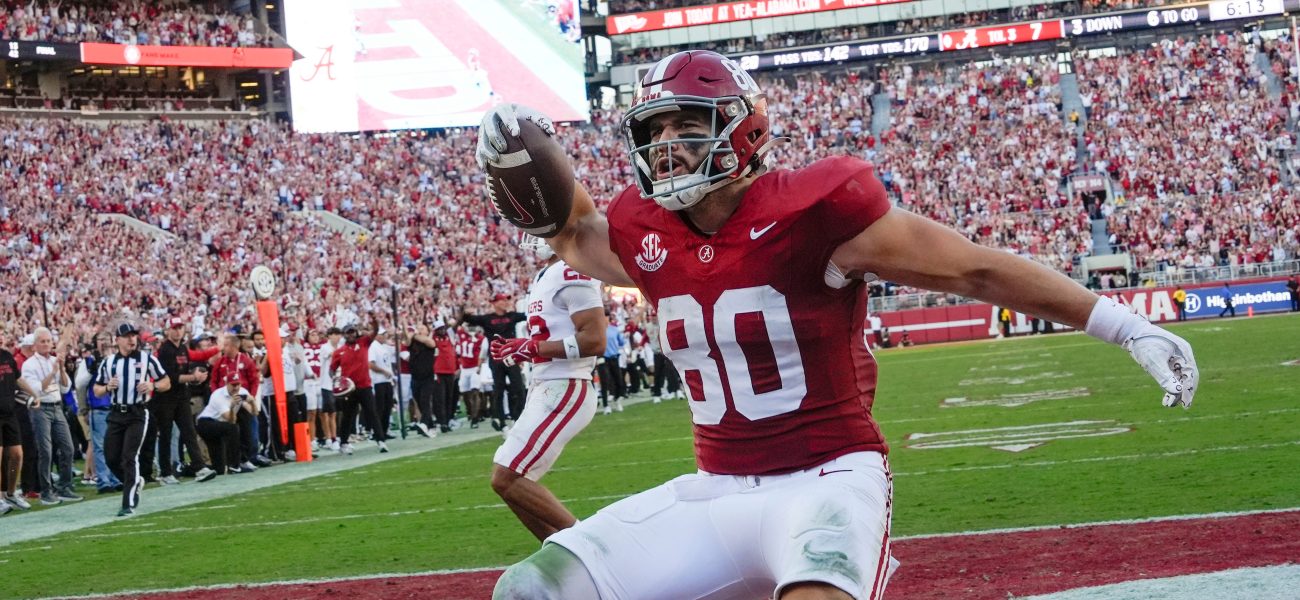
POLICY WIRE — New York City, USA — The annual NFL Draft, a spectacle meticulously staged to project an image of precise talent evaluation, often functions more like a sprawling, multi-billion-dollar gamble. It’s a high-stakes lottery where collegiate dreams collide with corporate strategy, often yielding profoundly unpredictable outcomes. And so it was, late in the 2026 proceedings, when Alabama tight end Josh Cuevas found himself plucked from a crowded field, his name echoing from the fifth round to the Baltimore Ravens – a selection few prognosticators had confidently penned.
Cuevas, despite a season of prolific output for the Crimson Tide after his transfer from Washington, hadn’t quite commanded the breathless pre-draft chatter reserved for the sport’s certified blue-chip prospects. He was, by all accounts, a workmanlike presence; a reliable set of hands and a surprisingly agile runner post-catch, especially in those fraught, do-or-die moments that define SEC football. Yet, his blocking, often the unglamorous bedrock of a tight end’s value, remained merely adequate. That particular deficiency had many analysts—the self-appointed arbiters of gridiron potential—relegating him to the murky waters of Day 3, perhaps a late-round flyer, if that.
But the Ravens, notorious for their calculated, often contrarian, draft philosophy, saw something more. They weren’t chasing the flash; they were scouring for functionality, for the kind of undervalued asset that can quietly, persistently, tilt the scales. Eric DeCosta, the Ravens’ Executive Vice President and General Manager, articulated their stance with characteristic Baltimore pragmatism. “We’re not in the business of drafting headlines,” DeCosta shot back during a post-draft press conference, his voice a low rumble. “We’re investing in players who can contribute, day in — and day out. Josh’s tape showed us a competitor with an innate feel for the passing game – and that’s a commodity we prioritize, even if it doesn’t scream first-round glamour.”
Still, Cuevas’s journey underscores the intricate, often brutal, calculus of professional sports. His ascent, from a transfer portal gamble to a mid-round NFL selection, isn’t just a personal triumph; it’s a testament to the persistent grind required to navigate college football’s cutthroat landscape. “He wasn’t the most celebrated recruit, never the guy on the magazine covers,” observed ESPN analyst Louis Riddick, a former NFL safety, during a broadcast discussing late-round value. “But he’s got that intangible quality, that sheer, unadulterated will to excel, that you just can’t teach. That’s what teams like Baltimore are always trying to unearth.”
And it’s this relentless pursuit of latent talent that increasingly defines the professional sports ecosystem, not just in America but globally. The NFL, a league historically insular, has begun to cast its net wider, attempting to tap into previously untouched markets. Consider the league’s International Player Pathway Program, a policy designed to unearth non-traditional athletes from diverse athletic backgrounds—a fascinating parallel to how cricket, for instance, operates its talent development pipelines across South Asia, where raw talent from obscure villages can be meticulously honed into world-class athletes. While Cuevas’s path is distinctly American college football, the underlying economic imperative to find competitive advantage through unexpected sources is universal. The goal isn’t just to entertain but to extract maximum value from every roster spot, maximizing the return on a significant salary cap investment.
📄 POLICY WIRE WHITEPAPER PUBLISHED: PAKISTAN'S NATIONAL SECURITY POLICY PRIORITIES
👉 READ BY CLICKING HEREThe average career length for an NFL player, according to the NFL Players Association, hovers around a fleeting 3.3 years. This stark statistic underscores the high-pressure, transient nature of the profession, where even a fifth-round pick’s tenure can be profoundly brief. Every snap, every practice rep, every off-season workout becomes a battle for continued relevance, for another year on a roster. The economic stakes couldn’t be higher, not just for the players, but for the franchises investing millions in their potential.
What This Means
The Baltimore Ravens’ selection of Josh Cuevas isn’t merely a footnote in the 2026 NFL Draft; it’s a case study in the policy underpinnings of modern professional sports. At its core, it speaks to the relentless drive for efficiency and competitive advantage within the NFL’s economic model. Teams are less concerned with draft-day narratives and more focused on identifying undervalued assets that can slot into specific roles, minimizing financial outlay while maximizing on-field production. This often means looking beyond the PFF grades and the pre-draft hype, delving deeper into game film, character assessments, and a player’s perceived adaptability. It’s a calculated risk, but one that shrewd organizations consistently undertake.
Politically, the draft itself is a tightly controlled mechanism that maintains the league’s competitive balance while fueling its massive economic engine. The NFL’s draft policies, its salary cap, and its college scouting infrastructure (which, let’s be honest, often feels like a clandestine operation) all serve to perpetuate a system where an athlete’s potential is commoditized, analyzed, and traded. For a player like Cuevas, whose path involved a transfer and a less-than-stellar draft profile, it highlights the increasing fluidity of college athletics—a market unto itself, profoundly impacting professional trajectories. And for the fans, it’s a constant reaffirmation of hope, that the unheralded will occasionally rise, embodying the brutal calculus of potential that defines this brutal, beautiful sport.