


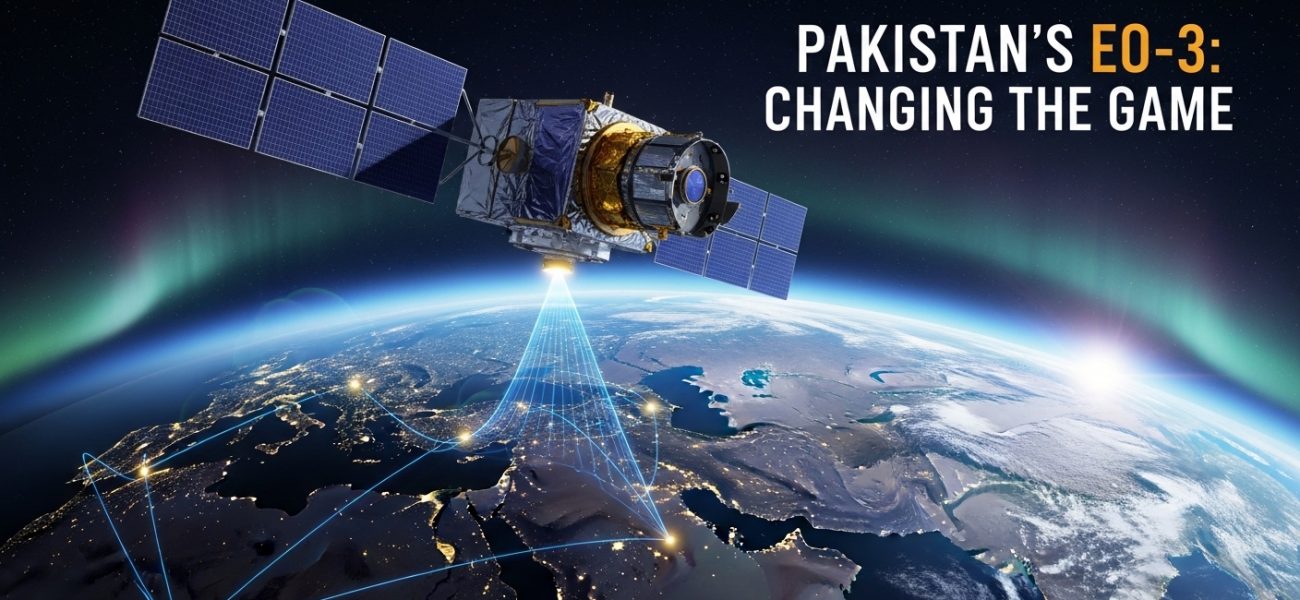
Why Pakistan’s EO-3 could Change the Game?
The introduction of the EO-3 satellite by Pakistan might not have caused the earth-shattering news that some other satellites have done in the world, but it is much more what the world needs to know....

The introduction of the EO-3 satellite by Pakistan might not have caused the earth-shattering news that some other satellites have done in the world, but it is much more what the world needs to know. I believe it is not simply another technical achievement, but a good indicator that Pakistan is slowly gaining strength in a field that is becoming the hallmark of modern power, space-based data and observation.
The satellite was made by SUPARCO and launched with the assistance of China National Space Administration and was put into orbit with the help of a Long March 6 rocket at Taiyuan Satellite Launch Center. On the face of it, this could be a typical cooperation between two nations. However, when we take a closer look, we find something even more significant: Pakistan is slowly gaining some space technology, and it is something that counts in more ways than one can imagine.
In order to know the significance of EO-3 we must know what it does. It is a satellite performing Earth observations, meaning that it is a very developed camera in space. It is able to take close-up shots of the land, cities, crops, rivers and even the disaster areas. These pictures are not merely pictures, but data. And in our modern age, information is strength.
Pakistan has been relying on external sources of satellite images over the years. This usually implied time wastage, expenses and even restriction. Pakistan starts to decrease that dependency with EO-3. Now it can gather some of its own data, at its own convenience, and to its own purposes. This move towards data autonomy is a key strength. Nations that have control over their own information are better planners, quicker responders and more confident in the decisions they make.
The other significant measure is the way this satellite can help in supporting daily needs in the country. Pakistan is a country with serious problems of agriculture, climate change and urban development. EO-3 can be used to track the health of crops, forecast yields, and even advise farmers on how to do it better. Such information can have direct positive productivity and food security benefits in a country where agriculture is a very big part of the economy.
Meanwhile, Pakistan is extremely susceptible to natural disasters, particularly floods. Floods have in the recent years left their tracks of mass destruction of infrastructure and displaced millions of people. When EO-3 is used, authorities will be able to monitor water flow, detect the high-risk zones, and react faster. This will not only save money, it will save lives. At that, the satellite is a public safety tool, rather than merely a technology.
Another aspect that EO-3 can contribute to is urban planning. Pakistan is experiencing a high rate of urban growth, which is not well planned. Satellite information can be used to monitor this expansion, detect unlawful activities, and aid in improved infrastructure choices. In the long run, this may result in better-planned cities and the quality of life. But it would be incomplete to overlook the strategic aspect of such a satellite. The official use of earth observation satellites is civilian, but by their very nature, they are dual purpose. They are able to give a better view of borders, infrastructure and regional developments. This enhances preparedness and awareness. Simply stated, it enables Pakistan to see better and in the modern world that is a big plus.
Actually, the achievement of EO-3 is not a one-off event. It belongs to a larger trend. Pakistan has been slowly developing its space program with earlier satellites such as EO-1 and EO-2 already being in orbit. This demonstrates consistency and long term planning, which is crucial to success in any advanced field. Space technology is not a one-day thing and it needs time, money and focus. EO-3 is an indication that Pakistan is taking one step at a time towards the right direction.
📄 POLICY WIRE WHITEPAPER PUBLISHED: PAKISTAN'S NATIONAL SECURITY POLICY PRIORITIES
👉 READ BY CLICKING HEREThe most striking thing to me is the silence with which this is occurring. No great shouting and overstatement. Rather, there is continuous work, technical advancement, and empirical outcomes. This is in most aspects mature. True power is not necessarily noisy power, but rather the power of capability in the long run.
In the future, the true test will be the effectiveness of the use of this satellite by Pakistan. Technology is not sufficient but should be incorporated in policymaking, governance and in the daily decision making. When EO-3 data is utilized in the right way in agriculture, disaster management, and urban planning, it may have transformational effects. It might assist in minimizing losses, enhancing efficiency, and sustainable development.
EO-3 satellite is not merely a launch. It is an indicator of increased confidence, enhanced competence, and a sense of clarity regarding contemporary issues. Pakistan is not only engaging in space technology-it is gradually turning it into its national capability. This is one step that cannot be underestimated in a world where information and awareness is a key to success.
Author