

2026 NFL Draft: Offensive Line Class Deep, But Lacks Singular Star Amid Shifting Valuations
POLICY WIRE — Pittsburgh, Pennsylvania — For all the glitz and glamour of quarterbacks and flash plays, the dirty work in the trenches often orchestrates championship contention. And yet, this...

POLICY WIRE — Pittsburgh, Pennsylvania — For all the glitz and glamour of quarterbacks and flash plays, the dirty work in the trenches often orchestrates championship contention. And yet, this year’s National Football League Draft, particularly the 2026 offensive line class, tells a subtly different narrative for the big men up front, challenging conventional wisdom. It’s like finding a treasure map to a hidden, less shiny but utterly crucial, chest.
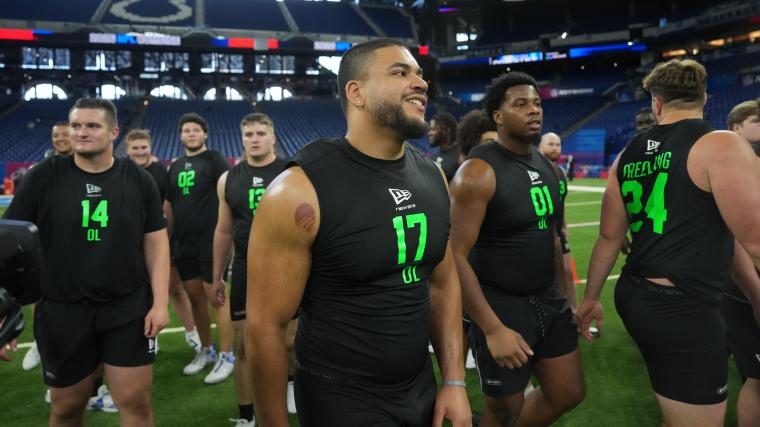
Few positions in professional football shoulder the quiet, unglamorous yoke of the offensive lineman, tasked with protecting multi-million dollar investments and carving paths for running backs. But as the 2026 NFL Draft commenced, one thing crystallized: a true consensus ‘can’t-miss’ prospect, a generational talent in the mold of a Joe Thomas or Jonathan Ogden, remains stubbornly elusive. Don’t we always want that singular, undeniable star?
Instead, teams faced a fascinating cornucopia of talent. A deep pool, certainly. Yet one where individual skill sets offered more intrigue than overwhelming dominance. Clubs had to wrestle with specific needs against a wide spectrum of potential.
Take Francis Mauigoa, the powerful offensive tackle from Miami. The New York Giants scooped him up with the 10th overall pick, a move that raised a few eyebrows, granted, given other positional needs. Still, General Manager Joe Schoen championed the selection vehemently.
“We weren’t just looking for a body; we needed a foundational piece for our offense,” Schoen told reporters post-pick. “Francis’s athleticism — and brute strength jumped off the tape. You don’t pass on that kind of long-term potential, even if some call it a reach. We see a decade-long starter here.”
His sentiments buttressed a broader trend: the premium placed on protecting the quarterback, no matter the cost. Kadyn Proctor out of Alabama, a massive 6’7″, 366-pound tackle, traipsed shortly after, heading to the Miami Dolphins at pick 12.
But the narrative isn’t just about the top-tier, is it? Scouting reports suggested that while the top six tackles each brought something idiosyncratic — be it their brute force or their balletic footwork — almost all presented a factor teams had to grapple with: some were side-specific (left tackle vs. right tackle), others had limited starting snaps, — and a few were deemed slightly undersized. A real mixed bag, that lot.
The math is unvarnished: protecting a franchise quarterback is non-negotiable. Teams now spend an average of over $20 million annually on their top offensive tackle, according to data compiled by OverTheCap.com for the 2025 season. That’s a significant shift from historical spending patterns, isn’t it?
This class may not flaunt the next all-time great, but it does present multiple players with the potential for long, productive careers. We’re talking about players like Monroe Freeling from Georgia, Spencer Fano from Utah, and Max Iheanachor of Arizona State, all projected first or early second-round talents.
📄 POLICY WIRE WHITEPAPER PUBLISHED: PAKISTAN'S NATIONAL SECURITY POLICY PRIORITIES
👉 READ BY CLICKING HEREAnd what about the league’s increasingly global footprint? The NFL’s expansion isn’t just about exhibition games in London or Germany; it’s about cultivating broader interest and — eventually, don’t you think? — a wider talent pool. Could we one day see a player from the burgeoning American football leagues in the Middle East or South Asia, perhaps with roots in countries like Pakistan, making it into an NFL draft? It’s a distant thought now, a faint whisper on the wind, but the economic and cultural currents are certainly flowing in that direction, slowly but surely broadening the sport’s horizons.
This evolving draft philosophy mirrors a wider trend. Teams are increasingly looking for specific fits and maximizing value across the board, rather than gambling solely on singular, transcendent talents. It’s a testament to analytics — and advanced scouting. The NFL’s approach to talent acquisition is becoming less about finding a superhero and more about building a sturdy, resilient machine. One might even say, a decidedly unromantic approach to professional sport.
“This year’s offensive line class lacks that singular, transcendent Joe Thomas-esque talent, that’s true,” observed veteran draft analyst Mel Kiper Jr. of ESPN. “But what it offers is depth, a lot of very good players who, with the right coaching, become decade-long starters. That’s a different kind of value, perhaps a safer one for GMs who need to fill multiple holes without breaking the bank on one guy.”
What This Means
The implications of this draft’s offensive line class ripple beyond mere roster construction. Strategically, clubs are clearly championing a broad base of competence over individual brilliance, a pragmatic approach in an era of soaring quarterback salaries. Financially, it hints at a more dispersed allocation of resources across the offensive line, recognizing that a cohesive unit often outperforms a single star with weaker teammates.
So, from a competitive standpoint, this translates to less immediate impact from a single rookie, but potentially greater long-term stability for teams that draft well. It forces coaching staffs to be nimble at developing talent, rather than simply plugging in a ready-made superstar. the increasing emphasis on data-driven scouting for nuanced traits rather than just raw athleticism spotlights a maturing approach to player evaluation across the league. It’s all about the details, folks. Related: 2026 NFL Draft: High Stakes and Unseen Pressures Shape Franchise Fortunes
Ultimately, the 2026 NFL Draft heralds a quiet evolution in how the league values its protectors. Expect teams to continue investing heavily in the offensive line, not necessarily chasing the next Hall of Famer with every pick, but painstakingly assembling stout, interchangeable units. This shift, an almost industrial approach to building a formidable front, will reconfigure offensive play for years to come, putting the burden squarely on collective strength rather than individual heroism.