


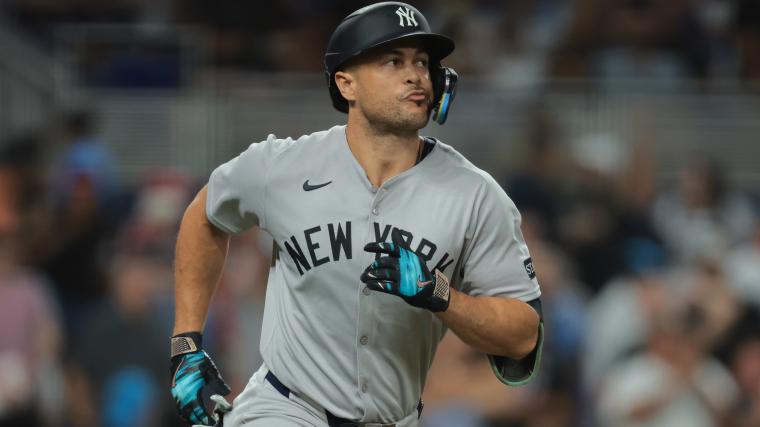
Giancarlo Stanton’s ‘Accidental’ Rivalry Jab Stokes Yankees-Red Sox Fire
POLICY WIRE — New York, USA — Sometimes, the quietest words kinda ignite the loudest conversations, don’t they? Especially when they’re uttered in the immense shadow of baseball’s...

POLICY WIRE — New York, USA — Sometimes, the quietest words kinda ignite the loudest conversations, don’t they? Especially when they’re uttered in the immense shadow of baseball’s most storied rivalry. Few matchups truly snag the collective imagination of sports fans quite like the New York Yankees versus the Boston Red Sox — a clash that doesn’t just transcend mere wins and losses, oh no, it morphs instead into a generational saga.
But what happens when one of its titans, Yankees slugger Giancarlo Stanton, proffers what many perceived as an accidental slight, even as he tried to articulate the rivalry’s undying spirit? A real head-scratcher.
Just days ago, following a dominant Yankees victory that further cemented their early-season lead over a struggling Red Sox squad — a win that felt almost inevitable, if we’re being honest — Stanton mused on the dynamic. His team, currently boasting a robust 15-9 record, sits atop the American League East, looking rather comfortable. And yet, their cross-town foes languish at a disappointing 9-15, occupying the division’s cellar, which isn’t exactly where they’d like to be, you know?
When questioned about the rivalry, Stanton’s response, as reported by the New York Post, hinted at the inherent contradiction. He remarked, It’s always a rollicking rivalry game, no matter where each team is in the standings. It’s just a pristine experience, a pure baseball place to play. You’ve gotta raise your game in those types of situations.
For some, this was a perfectly innocuous observation, a testament to the rivalry’s unyielding pull. Others, however, couldn’t help but detect a subtle, almost humorous dig embedded within the politeness, you know, the kind of barb that lands with a soft thud. Was it a backhanded compliment, a stark reminder of Boston’s current struggles cloaked in reverence for the historic battle? Not everyone saw it that way, of course.
Red Sox manager Alex Cora, a figure intimately familiar with the ebbs and flows of this particular animosity — a man who’s seen it all, frankly — likely brushed off any perceived slight with characteristic resilience. Our guys know what this series means, regardless of the standings, and so do their fans,
Cora recently shot back at reporters, a subtle nod to the deep-seated pride in Boston. We don’t need anyone to remind us where we’re or what’s at stake. We play for the name on the front of the jersey.
That’s the spirit fans expect. Period.
Still, the moment starkly illuminated the delicate tightrope players must walk in such high-stakes environments, where every syllable can be ruthlessly dissected and reinterpreted by an eager press and an even more fervent fanbase. What seems like an innocent thought can quickly morph into headline fodder. And that, dear reader, matters tremendously for team cohesion — and public perception. A minefield, really.
Indeed, the sheer passion surrounding this rivalry, where emotions run as high as the cost of a Fenway Park beer, isn’t anomalous in the global sporting landscape. Consider the almost religious fervor surrounding cricket matches between India and Pakistan; these contests, steeped in history and often playing out on neutral ground due to intractable political tensions, draw billions of viewers. The intensity. The psychological warfare. The nationalistic pride. It all feels strikingly familiar to anyone who’s ever watched a Yankees-Red Sox showdown, doesn’t it?
📄 POLICY WIRE WHITEPAPER PUBLISHED: PAKISTAN'S NATIONAL SECURITY POLICY PRIORITIES
👉 READ BY CLICKING HEREBack in 2020, as the sports world navigated unprecedented challenges, similar media scrutiny landed on other figures. For instance, the renewed focus on past actions can often overshadow current sporting achievements. It’s a perennial truism, isn’t it? Related: Newly Emerged 2020 Photos Deepen Vrabel-Russini Scandal, Rattle Sports Media Ethics
What This Means
Make no mistake, the underlying narrative here signifies more than just a throwaway comment. It’s about the economic power and cultural capital of a rivalry that continues to defy on-field performance disparities — a real golden goose for the league, honestly. For the MLB, this fixture remains a potent cash cow, drawing massive television audiences and generating significant revenue, regardless of which team is currently dominant. Quite the money-spinner.
Behind the headlines, team executives inherently understand that this deep-seated animosity sells tickets, drives merchandise sales, and maintains engagement even through lean years for one side. It’s a reliable engine for the league’s overall health, isn’t it? A recent study indicated that the Yankees-Red Sox series consistently ranks among the top 5 most-watched regular-season games, often outperforming other key matchups by as much as 30% in viewership, according to Nielsen data for the past five years. That’s a pretty massive number, folks.
For the players, these games are a litmus test, a singular proving ground. They might be playing a team sitting last in the division, but the atmosphere demands peak performance — it’s truly an arena where mettle’s tested. And for the fans, it’s a testament to loyalty, a chance to loudly assert tribal identities, even if it means enduring a few jabs along the way. Worth it.
Ultimately, Stanton’s seemingly simple declaration wasn’t just about baseball; it was a subconscious affirmation of an unwritten code in sports, where respect for the rivalry itself often eclipses the current form of its combatants. A seasoned analyst might tell you that these accidental sparks keep the fire burning brighter than any deliberate inflammatory remark ever could, ensuring that even when one team stumbles, the legend of the rivalry endures — like a phoenix from the ashes, really. Talk about legacy.