

WWE Hall of Fame: Strategic Inductors Warlord, Arn Anderson, and Haku Honor Demolition’s Legacy
POLICY WIRE — Orlando, Florida — My initial assessment regarding the ideal inductors for the iconic tag team Demolition into the WWE Hall of Fame was incorrect, a fact I readily acknowledge....

POLICY WIRE — Orlando, Florida — My initial assessment regarding the ideal inductors for the iconic tag team Demolition into the WWE Hall of Fame was incorrect, a fact I readily acknowledge.
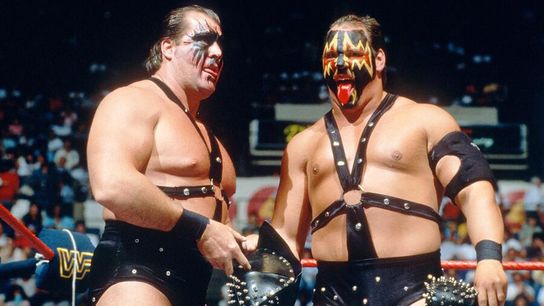
Following the announcement of Bill Eadie (Ax) and Barry Darsow (Smash) joining the 2026 Hall of Fame class, I previously advocated for The New Day. My rationale stemmed from their breaking Demolition’s championship longevity record, often speculated as a move linked to ongoing tensions between Demolition and Vince McMahon, believing their involvement could mend such issues. However, the WWE‘s chosen inductees proved to be a more fitting and insightful decision.
The WWE‘s strategic selection of Terry Scott Szopinski (known as The Warlord), Arn Anderson, and Tonga ʻUliʻuli Fifita (Haku) as inductors for Demolition is nothing short of brilliant. This choice profoundly honors Ax and Smash, as each of these wrestling legends personifies a pivotal rivalry from Demolition‘s dominant championship era.
The Powers of Pain Rivalry
The Warlord, Terry Scott Szopinski, played a central role in Demolition‘s inaugural significant storyline within the WWE during 1988. Alongside Sione Havea Vailahi (The Barbarian), Szopinski formed The Powers of Pain, quickly establishing themselves as formidable opponents for the then-reigning Demolition tag team champions. A groundbreaking moment in wrestling history occurred at Survivor Series 1988, showcasing a double turn—a concept almost unheard of at the time—despite The Powers of Pain initially being fan favorites and Demolition portraying villains.
During that fateful Survivor Series 1988 encounter, Demolition‘s manager, Mr. Fuji, controversially lowered the bottom rope as Smash bounced off it, causing him to fall ringside and be counted out. In a dramatic turn, Smash retaliated by assaulting his former manager. Moments later, The Warlord and The Barbarian surprisingly assisted Mr. Fuji, bewildering fans who questioned why the heroic Powers of Pain were aiding a villainous figure.
The Powers of Pain ultimately secured the victory, only for Demolition to storm back into the ring, attacking their rivals in retaliation. This swift sequence cemented Demolition as fan favorites and The Powers of Pain as antagonists, effectively executing a double turn years before Bret Hart and Steve Austin popularized the maneuver.
This intense rivalry culminated at WrestleMania V, where Demolition decisively defeated The Powers of Pain and Mr. Fuji, concluding the match with their signature maneuver, The Demolition Decapitator, on Fuji.
Just as the WWE made a strategic choice with these inductors, other organizations also make significant strategic moves. For instance, the Cincinnati Bengals made strategic decisions regarding their cap space in pursuit of a championship.
The Brain Busters Challenge
Next, we consider Arn Anderson, who, paired with Tully Blanchard, comprised The Brain Busters – widely regarded as one of professional wrestling’s most technically proficient tag teams. Under the guidance of legendary manager Bobby “The Brain” Heenan, The Brain Busters might not have possessed flashy appearances or exceptional verbal skills. Yet, their unparalleled ring psychology ensured that in every confrontation, Demolition faced an adversary against whom they never seemed entirely at ease.
📄 POLICY WIRE WHITEPAPER PUBLISHED: PAKISTAN'S NATIONAL SECURITY POLICY PRIORITIES
👉 READ BY CLICKING HEREIn 1989, a pair of momentous matches on Saturday Night’s Main Event laid the groundwork for a championship change, ultimately concluding Demolition‘s remarkable 478-day reign as champions. The initial May 1989 bout saw Demolition‘s frustration boil over, resulting in a disqualification loss. A subsequent two-out-of-three falls match in July 1989 spectacularly showcased Demolition‘s brute strength against The Brain Busters‘ cunning ring intelligence.
A pivotal moment occurred when Andre the Giant covertly provided Blanchard with a steel chair, which he used to strike Smash, leading to an unexpected defeat and the end of Demolition‘s dominant title run. Nevertheless, Demolition reclaimed their titles that October, securing a decisive victory against The Brain Busters during a televised event.
The unexpected twists in wrestling, much like surprising sports outcomes, can captivate audiences and ignite strong opinions, echoing the disappointment expressed by JJ Redick over Luka Doncic’s MVP snub.
The Colossal Connection Confrontation
Tonga ʻUliʻuli Fifita, famously known as Haku, symbolizes one of Demolition‘s concluding significant rivalries. In late 1989, Haku partnered with the legendary Andre the Giant to form The Colossal Connection, who swiftly earned a championship opportunity against Demolition on free television. From the onset, The Colossal Connection asserted their dominance, leveraging Haku‘s formidable martial arts prowess and Andre‘s immense stature to secure an upset victory and seize the tag team titles.
Demolition eventually regained the titles for their third and final time at WrestleMania VI. They delivered their finishing maneuver to Haku after a chaotic sequence where Andre the Giant inadvertently received Haku‘s crescent kick and became entangled in the ropes, setting up the dramatic finish.
The inclusion of these three distinguished individuals—The Warlord, Arn Anderson, and Haku—as Demolition‘s inductors provides a perfect and resonant tribute. Their presence underscores the most significant rivalries that defined Demolition‘s illustrious career in the WWE, offering an unparalleled send-off into the Hall of Fame.