


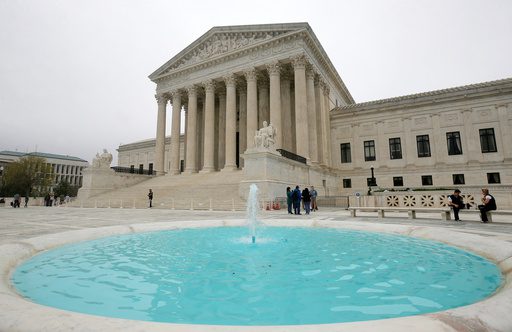
Supreme Court Affirms Michigan’s State Court Jurisdiction in Enbridge Line 5 Pipeline Dispute
POLICY WIRE — Washington, D.C. — The U.S. Supreme Court has ruled in favor of Michigan, determining that the state’s legal challenge to decommission a segment of an aging energy pipeline...

POLICY WIRE — Washington, D.C. — The U.S. Supreme Court has ruled in favor of Michigan, determining that the state’s legal challenge to decommission a segment of an aging energy pipeline situated beneath a crucial Great Lakes waterway will proceed within state judicial channels.
Associate Justice Sonia Sotomayor delivered the unanimous opinion on Wednesday, emphasizing that Enbridge, the energy company operating the pipeline, had delayed too long in its attempt to transfer the case to federal jurisdiction.
This significant ruling forms part of an intricate legal saga concerning the Line 5 pipeline, which has been transporting crude oil and natural gas liquids between Superior, Wisconsin, and Sarnia, Ontario, since its commissioning in 1953.
Michigan’s Legal Challenge Against Line 5
Michigan Attorney General Dana Nessel initiated legal proceedings in state court in June 2019. Her lawsuit aimed to nullify the easement permitting Enbridge to operate a 4.5-mile (6.4-kilometer) section of the pipeline beneath the Straits of Mackinac, a vital conduit connecting Lake Michigan and Lake Huron.
A temporary restraining order to cease pipeline operations was secured by Nessel, a Democrat, from Ingham County Judge James Jamo in June 2020. However, Enbridge was permitted to continue operations after implementing specific safety protocols.
The company subsequently moved the litigation to federal court in 2021, asserting that the matter impacted both U.S. and Canadian commerce. Nevertheless, a three-judge panel from the 6th U.S. Circuit Court of Appeals returned the case to Judge Jamo in June 2024, concluding that the company had exceeded a 30-day statutory limit for changing court jurisdictions.
Environmental Risks and Past Incidents
Increasing apprehension regarding the segment of Line 5 submerged beneath the straits has been prevalent since 2017. These concerns escalated following revelations by Enbridge engineers that they had been aware of protective coating deficiencies in that section as far back as 2014.
📄 POLICY WIRE WHITEPAPER PUBLISHED: PAKISTAN'S NATIONAL SECURITY POLICY PRIORITIES
👉 READ BY CLICKING HEREFurther intensifying fears of a potential catastrophic oil spill, a boat anchor caused damage to the pipeline segment in 2018. Subsequently, the Michigan Department of Natural Resources, operating under Governor Gretchen Whitmer, a Democrat, revoked the easement for Line 5 in the straits area during 2020.
Enbridge has initiated a distinct federal lawsuit challenging this revocation. Concurrently, the company is seeking permits to encase the controversial pipeline section beneath the straits within a protective tunnel.
While the Michigan Public Service Commission approved the necessary permits in 2023, Enbridge still requires endorsements from the U.S. Army Corps of Engineers and the Michigan Department of Environment, Great Lakes and Energy. The broader implications of energy security and environmental protection continue to be significant policy considerations globally.
Read More: EU Commission Calls for Coordinated Action to Prevent Aviation Fuel Shortages
Broader Legal Challenges for Line 5
The Line 5 pipeline also faces a separate legal confrontation in Wisconsin. A federal judge in Madison last summer mandated that Enbridge discontinue a portion of Line 5 that traverses the territory of the Bad River Band of Lake Superior Chippewa within three years.
In response, Enbridge has proposed rerouting the pipeline to bypass the reservation and has filed an appeal against the shutdown directive with the 7th U.S. Circuit Court of Appeals.